
Incentives & Control Week 1
Two basic assumptions of economic models:
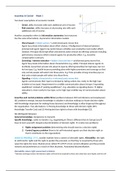
- Greed, utility increases with each additional unit of income
- Risk-aversion, utility increases at decreasing rate with each
additional unit of income.
Another assumption refers to information asymmetry (not everyone
has the same information). Asymmetric information models:
- Moral hazard = hidden actions + uninformed party moves first
Agent has private information about effort choices. Misalignment of interest between
principal and agent (agent may prefer leisure activities over productive (and costly) effort).
Solution: Principal elicits high effort and desired action choices by offering contracts including
performance measures which rewards agents for productive effort. E.g. incentive
compensation contracts.
- Screening / Adverse selection = hidden characteristics + uninformed party moves first.
Agent has private information about characteristics (e.g. skills). Principal induces agents to
truthfully reveal their private info about its type by offering beneficial for high type, but not
for low type. E.g. health insurers providing plans with higher premiums and coverage so that
only certain people self-select into those plans. E.g. firms provides strong incentive pays so
that only certain people self-select into those firms.
- Signaling = hidden characteristics + informed party moves first
Agents communicate their type to principal by taking actions less costly to the high type
(relative to low type). Requirement for credible communication about its type (‘separating
equilibrium’ instead of ‘pooling equilibrium’). E.g. education as signaling device Higher
education is more costly for low type, so for high type credible way of communication about
ability.
Incentive and control problems within firms (problems between CEO and divisions and employees):
I&C problems emerge, because knowledge is valuable in decision making (co-locate decision rights
with knowledge important for making those decisions) and knowledge is often dispersed throughout
the organization. Two alternatives: 1) Moving knowledge to those with decision rights (KTC,
Knowledge Transfer Cost) and 2) Moving decision rights to those with knowledge (CC).
We distinguish between:
General knowledge, inexpensive to transmit.
Specific knowledge, costly to transfer. E.g. negotiating in China is different than in Europe (you’ll
have to learn yourself). Requires decentralization of decision rights creates two problems:
1) Rights assignment problem (determining who should exercise a decision right)
2) Control/agency problem (How to let self-interested agents use their decision right so
that it contributes to the organization).
Jensen & Meckling (1992), outside markets have a system of alienable rights. Alienability, the right
to sell/transfer rights and the right to pocket the proceeds, so that they’re acquired by those who
value the rights the most. Market prices reflect PV of FCF’s from current utilization and thus provide
rewards and punishment as a result of their decisions. Automated decentralization.
Alienability solves right assessment problem:
“Voluntary exchange ensures that decision rights will tend to be acquired by those who value them most highly, and this will
Two basic assumptions of economic models:
- Greed, utility increases with each additional unit of income
- Risk-aversion, utility increases at decreasing rate with each
additional unit of income.
Another assumption refers to information asymmetry (not everyone
has the same information). Asymmetric information models:
- Moral hazard = hidden actions + uninformed party moves first
Agent has private information about effort choices. Misalignment of interest between
principal and agent (agent may prefer leisure activities over productive (and costly) effort).
Solution: Principal elicits high effort and desired action choices by offering contracts including
performance measures which rewards agents for productive effort. E.g. incentive
compensation contracts.
- Screening / Adverse selection = hidden characteristics + uninformed party moves first.
Agent has private information about characteristics (e.g. skills). Principal induces agents to
truthfully reveal their private info about its type by offering beneficial for high type, but not
for low type. E.g. health insurers providing plans with higher premiums and coverage so that
only certain people self-select into those plans. E.g. firms provides strong incentive pays so
that only certain people self-select into those firms.
- Signaling = hidden characteristics + informed party moves first
Agents communicate their type to principal by taking actions less costly to the high type
(relative to low type). Requirement for credible communication about its type (‘separating
equilibrium’ instead of ‘pooling equilibrium’). E.g. education as signaling device Higher
education is more costly for low type, so for high type credible way of communication about
ability.
Incentive and control problems within firms (problems between CEO and divisions and employees):
I&C problems emerge, because knowledge is valuable in decision making (co-locate decision rights
with knowledge important for making those decisions) and knowledge is often dispersed throughout
the organization. Two alternatives: 1) Moving knowledge to those with decision rights (KTC,
Knowledge Transfer Cost) and 2) Moving decision rights to those with knowledge (CC).
We distinguish between:
General knowledge, inexpensive to transmit.
Specific knowledge, costly to transfer. E.g. negotiating in China is different than in Europe (you’ll
have to learn yourself). Requires decentralization of decision rights creates two problems:
1) Rights assignment problem (determining who should exercise a decision right)
2) Control/agency problem (How to let self-interested agents use their decision right so
that it contributes to the organization).
Jensen & Meckling (1992), outside markets have a system of alienable rights. Alienability, the right
to sell/transfer rights and the right to pocket the proceeds, so that they’re acquired by those who
value the rights the most. Market prices reflect PV of FCF’s from current utilization and thus provide
rewards and punishment as a result of their decisions. Automated decentralization.
Alienability solves right assessment problem:
“Voluntary exchange ensures that decision rights will tend to be acquired by those who value them most highly, and this will



