Children’s Writing Notes
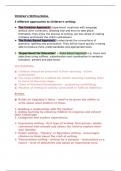
3 different approaches to Children’s writing:
★ The Creative Approach - experiment creatively with language
without strict correction, allowing trial and error to take place.
Ultimately, they enjoy the process of writing, are less afraid of making
mistakes and boosts the child’s self-esteem.
★ The Rules Based Approach - understands the conventions of
grammar, spelling and punctuation. They will be move quickly in being
able to produce more understandable and appropriate texts.
1. ‘Department for Education’ = Rules Based Approach e.g. nouns and
adjectives using suffixes, subordination and coordination in sentence
formation, present and past tense.
Lev Vygotsky:
● Children should be proactive in their learning - active
participants
● You need a MKO to scaffold the child’s learning enabling them
to move to the next stage.
● ‘Zone of Proximal Development’ - pushed by scaffolding.
● Mastery of writing to satisfy some need or fulfil an intention.
Britton
● Builds on Vygotsky’s ideas - need to be given the ability to
write about what matters to them.
1. Building a relationship with the teacher
2. Aiding learning by allowing children to organise and extend
their knowledge
3. Categorise and explore experiences.
❖ Expressive writing - first type of writing: first person, wholly
concerned with oneself and allows the child to explore their
own identity.
❖ Poetic writing - ‘literary’ or figurative writing - encourages
children to think about the craft of writing.
❖ Transactional writing - writing for a purpose - instructions or a
report - level of objectivity and adopt an impersonal tone.
3 different approaches to Children’s writing:
★ The Creative Approach - experiment creatively with language
without strict correction, allowing trial and error to take place.
Ultimately, they enjoy the process of writing, are less afraid of making
mistakes and boosts the child’s self-esteem.
★ The Rules Based Approach - understands the conventions of
grammar, spelling and punctuation. They will be move quickly in being
able to produce more understandable and appropriate texts.
1. ‘Department for Education’ = Rules Based Approach e.g. nouns and
adjectives using suffixes, subordination and coordination in sentence
formation, present and past tense.
Lev Vygotsky:
● Children should be proactive in their learning - active
participants
● You need a MKO to scaffold the child’s learning enabling them
to move to the next stage.
● ‘Zone of Proximal Development’ - pushed by scaffolding.
● Mastery of writing to satisfy some need or fulfil an intention.
Britton
● Builds on Vygotsky’s ideas - need to be given the ability to
write about what matters to them.
1. Building a relationship with the teacher
2. Aiding learning by allowing children to organise and extend
their knowledge
3. Categorise and explore experiences.
❖ Expressive writing - first type of writing: first person, wholly
concerned with oneself and allows the child to explore their
own identity.
❖ Poetic writing - ‘literary’ or figurative writing - encourages
children to think about the craft of writing.
❖ Transactional writing - writing for a purpose - instructions or a
report - level of objectivity and adopt an impersonal tone.