1
WEEK 1: Personality disorders
Lecture 1: Personality disorders
Leerdoelen
To identify the characteristics of a personality disorder (PD
To distinguish between personality traits vs. personality disorders
To identify the various etiologies of PD
To compare and distinguish the different PDs and their characteristics, including:
o Three clusters
o Diagnostic criteria and (associated) features
o Prevalence, development and course
o Risk and prognostic factors
o Culture- and gender-related diagnostic issues
o Differential diagnosis
To apply knowledge of PDs and their characteristics to clinical examples
Test yourself
Samenvatting van PD’s volgens de DSM-V met steekwoorden
o Paranoid personality disorder: wantrouwen en achterdocht (paranoid, careful, caring)
o Schizoid personality disorder: onthechting sociale relaties, beperkte emotionele expressie (loners,
independent, autonomous)
o Schizotyal personality disorder: ongemak bij relaties, cognitieve/perceptuele verstoringen,
excentriek gedrag (eccentric, unique)
o Antisocial personality disorder: schending rechten van anderen (antisocial, ‘own agenda’)
o Borderline personalityd disorder: instabiliteit in interpersoonlijke relaties, zelfbeeld en affect.
Impulsiviteit (drama queens, sensitive)
o Histrionic personality disorder: excessieve emotionaliteit en aandacht zoekend gedrag (attention
seeker, dramatic, flairs)
o Narcissistic personality disorder: patroon van grandiositeit, behoefte voor bewondering en gebrek
aan empathie (me-myself and I, special, unique)
o Avoidant personality disorder: patroon van sociale inhibitie, gevoelens van inadequaatheid en
hypersensitiviteit voor negatieve evaluatie (shy)
o Dependent personality disorder: onderdanig en claimend gedrag (clingy, loyal, people-person)
, 2
o Obsessive-compulsive personality disorder: patroon van bezigzijn met ordelijkheid, perfectionism
en controle (controlling, perfectionistic, consientious)
Puzzel auto’s: indicate which personality disorder matches which car
best
1. Paranoid personality disorder: cornered again!
2. Narcissistic personality disorder: largest car, prominent hood
ornament
3. Dependent personality disorder: needs other cars to feel
sheltered
4. passive-aggressive personality disorder (bestaat niet meer in
DSM-V)
5. Borderline personality disorder: rams into car of ex-lover
6. Antisocial personality disorder: blocks other car
7. Histrionic personality disorder: parks in center a lot for
dramatic effect
8. Obsessive-compulsive personality disorder: perfect
alignment in parking space
9. Avoidant personality disorder: hides in corner
10. Schizoid personality disorder: can’t tolerate closeness to
other carts
11. Schizotypal personality disorder: intergalactic parking
Course overview
First (personality disorders), second (personality organization) and sixth lecture (individual therapy) are very
important for the exam
Literature: DSM-V, Emmelkamp & Kamphuis, and chapters & articles
Read and study with the learning goals in mind!
Debat: suicide and euthanasia in mental health care. We don’t have to debate, just sit back and watch (not
mandatory)
Course assignment: Young Schema Questionnaire. The assignment is to interpret your schema’s
(mandatory)
Course exam: ongeveer 50 MC vragen met 4 opties. De examenstof betreft de colleges en de literatuur.
Sample questions will be presented every week during the lectures
Read and study with the learning goals in mind!
Questions:
o Fellow-student
o Lectures
o Discussion board
o Q&A lecture
o NOT via email
For prevalence: the DSM-V is the reliable source!
For exam: knowing the differences and the commonalities between the PDs is important!
Personality disorders
What?
o A personality disorder is an enduring pattern of inner experience and behavior that deviates
markedly from the expectations of the individual’s culture, is pervasive and inflexible, has on onset
in adolescence or early adulthood, is stable over time, an leads to distress or impairment.
o Normal versus abnormal
o PD criteria:
Enduring pattern of inner experiences and behavior
Deviates from expectations of the indivial’s culture
Not better explained by another mental disorder, medical condition (e.g. brain tumor) or
drugs
Clinically significant distress
Stable and of long duration
Not better explained by another mental disorder, medical condition or drugs
o Prevalence of any PD is 9.1%
o 3 P’s: persistent over time, pervasive over context and pathological
, 3
o No important differences between DSM-IV and DSM-V
Etiology
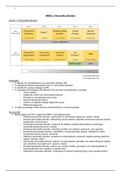
o The diathesis-stress model: there is a
precondition (sensitivity) which makes you
more vulnerable (e.g. genetics, brain
abnormality or neurotransmitters) for
psychological disorders. In addition to that we
assume that there are some types of
stressors (e.g. trauma) and this interaction
leads to psychological disorders
o We don’t know much about where personality
disorders come from
Clusters
o A (atypical unofficial name) = prevalence;
5.7%
Paranoid personality disorder:
pattern of distrust and
suspiciousness. More men than
women have this PD. People with this PD are very guarded and suspicious about other
people’s motives. Someone who may have had this disorder is Stalin.
Schizoid personality disorder: is about social relationships and detaching from
relationships. More men than women have this PD. No desire/interest for social
relationships, limited interactions, little connectedness. More observants rather than
participants in society. Very first episodes of TV series Dexter is an example.
Schizotypal personality disorder: acute discomfort in close relationships, perceptual
distortions. There is interest in social interactions, but is causes discomfort. Odd, eccentric,
misinterpreting other people’s behaviors. An example is Willie Wonk from Willia Wonka
and the chocolate factory. There is a strong link between this PD and depression, about
half has had a major depressive episode.
o B (boohoo (drama) is unofficial name) = prevalence: 1.5%. Borderline personality disorders is in
cluster B. Personality disorders in this cluster are the most well-known, but the prevalence is
actually the lowest. Probably due to the societal costs associated with these PD’s.
Antisocial personality disorder: Joran van der Sloot is an example of someone who may
have this disorder. It’s about a disregard of and a violation of other people’s rights. I’m
doing just my thing and whatever happens as a result I don’t care. We expect conduct
disorder in childhood. Often people with inflated or arrogant attitudes. It is not the same
thing as psychopathy: most psychopaths will meet the criteria for ASP but most people
with ASP are not psychopaths. More men than women
Borderline personality disorder: pattern of instability of how one views themselves (self-
image), how one feels (affect) and interpersonal relationships. Predominantly women who
suffer from this PD. Often self-harm, impulsivity, difficulty with separation and rejection.
Feelings of emptiness and instability. Angelina Jolie has this PD and Amy Winehouse had
this PD.
Histrionic personality disorder: was called hysteria and hysterical neurosis in the past.
There is overlap with BPD in terms of criteria, but is more about being the center of
attention. If they are not in the center of attention they feel uncomfortable. More in women
than in men. They are often the victim or the princess when they are the center, sexuality
is often a part of it because it is an easy way to get attention. Regina (mean girls) is an
example.
Narcissistic personality disorder: was previously described as being anal in the past.
Pattern of grandiosity, need for admiration, lack of empathy, me, myself and I. They are
special and the rest are not, unless you are associated with them. Examples are Kim
Kardashian and Donald Trump (not confirmed for both). More men than women.
o C (control is unofficial name, control of fear is central aspect) = prevalence: 6.0%
Avoidant personality disorder: an example is Michael Jackson (not confirmed). People
show social inhibit, refrain from others, feeling inadequate around others. No differences in
gender in terms of prevalence. Sensitive to how others feel and fear of begin rejected and
negative evaluation.
, 4
Dependent personality disorder: an example is Buster from Arrested Development.
People who are super submissive and clinging to others. Worried about criticism and
disapproval.
Obsessive compulsive personality disorder: an example is Steve Jobs. Preoccupation
with order, perfection and control. Adherence to rules, systems and structure. It can be
difficult to prioritize, because everything needs to be perfect. It has been linked to violence
at home. Symptoms are ego syntonic (not the case with OCD). OCD feel like victims of
their compulsions while people with OCPD like to stick to their framework.
Practice questions
Which of these symptoms does not fit the criteria of a schizotypal personality disorder?
1) Unusual perceptual experiences
2) Inappropriate or constricted affect
3) Magical thinking
4) Little, if any, interest in sexual experiences with others
Fear of abandonment is a common feature of which of the two following personality disorders?
1) (1) borderline; (2) dependent
2) (1) schizoid; (2) avoidant
3) (1) borderline; (2) avoidant
4) (1) schizoid; (2) dependent
Which of the following is NOT a shared feature of avoidant and dependent personality disorder?
1) Feelings of inadequacy
2) Hypersensitivity to criticism
3) Need for reassurance
4) Fear of abandonment
American Psychiatric Association (2013): DSM-V
Literatuur opmerking: DSM-V criteria for the relevant pathologies, including diagnostic features, associated features
supporting diagnosis, prevalence, development and course, risk, and prognostic factors, culture-related
diagnostics, gender-related diagnostics issues and differential diagnosis.
Introduction
Algemene definitie van persoonlijkheidsstoornissen van de tien specifieke persoonlijkheidsstoornissen: een
aanhoudend patroon van innerlijke ervaringen en gedrag dat duidelijk afwijkt van de verwachtingen van
iemands individuele cultuur, doordringend en inflexibel is, een aanvang heeft in de adolescentie of jonge
volwassenheid, stabiel is over tijd en leidt tot stress of beperkingen. Onderstaand de verschillende PDs in
het kort.
Paranoid personality disorder is a pattern of distrust and suspiciousness such that others' motives are
interpreted as malevolent.
Schizoid personality disorder is a pattern of detachment from social relationships and a restricted range of
emotional expression.
Schizotypal personality disorder is a pattern of acute discomfort in close relationships, cognitive or
perceptual distortions, and eccentricities of behavior.
Antisocial personality disorder is a pattern of disregard for, and violation of, the rights of others.
Borderline personality disorder is a pattern of instability in interpersonal relationships, self-image, and
affects, and marked impulsivity.
Histrionic personality disorder is a pattern of excessive emotionality and attention seeking.
Narcissistic personality disorder is a pattern of grandiosity, need for admiration, and lack of empathy.
Avoidant personality disorder is a pattern of social inhibition, feelings of inadequacy, and hypersensitivity
to negative evaluation.
Dependent personality disorder is a pattern of submissive and clinging behavior related to an excessive
need to be taken care of.
Obsessive-compulsive personality disorder is a pattern of preoccupation with orderliness, perfectionism,
and control.
Personality change due to another medical condition is a persistent personality disturbance that is
judged to be due to the direct physiological effects of a medical condition (e.g., frontal lobe lesion).
WEEK 1: Personality disorders
Lecture 1: Personality disorders
Leerdoelen
To identify the characteristics of a personality disorder (PD
To distinguish between personality traits vs. personality disorders
To identify the various etiologies of PD
To compare and distinguish the different PDs and their characteristics, including:
o Three clusters
o Diagnostic criteria and (associated) features
o Prevalence, development and course
o Risk and prognostic factors
o Culture- and gender-related diagnostic issues
o Differential diagnosis
To apply knowledge of PDs and their characteristics to clinical examples
Test yourself
Samenvatting van PD’s volgens de DSM-V met steekwoorden
o Paranoid personality disorder: wantrouwen en achterdocht (paranoid, careful, caring)
o Schizoid personality disorder: onthechting sociale relaties, beperkte emotionele expressie (loners,
independent, autonomous)
o Schizotyal personality disorder: ongemak bij relaties, cognitieve/perceptuele verstoringen,
excentriek gedrag (eccentric, unique)
o Antisocial personality disorder: schending rechten van anderen (antisocial, ‘own agenda’)
o Borderline personalityd disorder: instabiliteit in interpersoonlijke relaties, zelfbeeld en affect.
Impulsiviteit (drama queens, sensitive)
o Histrionic personality disorder: excessieve emotionaliteit en aandacht zoekend gedrag (attention
seeker, dramatic, flairs)
o Narcissistic personality disorder: patroon van grandiositeit, behoefte voor bewondering en gebrek
aan empathie (me-myself and I, special, unique)
o Avoidant personality disorder: patroon van sociale inhibitie, gevoelens van inadequaatheid en
hypersensitiviteit voor negatieve evaluatie (shy)
o Dependent personality disorder: onderdanig en claimend gedrag (clingy, loyal, people-person)
, 2
o Obsessive-compulsive personality disorder: patroon van bezigzijn met ordelijkheid, perfectionism
en controle (controlling, perfectionistic, consientious)
Puzzel auto’s: indicate which personality disorder matches which car
best
1. Paranoid personality disorder: cornered again!
2. Narcissistic personality disorder: largest car, prominent hood
ornament
3. Dependent personality disorder: needs other cars to feel
sheltered
4. passive-aggressive personality disorder (bestaat niet meer in
DSM-V)
5. Borderline personality disorder: rams into car of ex-lover
6. Antisocial personality disorder: blocks other car
7. Histrionic personality disorder: parks in center a lot for
dramatic effect
8. Obsessive-compulsive personality disorder: perfect
alignment in parking space
9. Avoidant personality disorder: hides in corner
10. Schizoid personality disorder: can’t tolerate closeness to
other carts
11. Schizotypal personality disorder: intergalactic parking
Course overview
First (personality disorders), second (personality organization) and sixth lecture (individual therapy) are very
important for the exam
Literature: DSM-V, Emmelkamp & Kamphuis, and chapters & articles
Read and study with the learning goals in mind!
Debat: suicide and euthanasia in mental health care. We don’t have to debate, just sit back and watch (not
mandatory)
Course assignment: Young Schema Questionnaire. The assignment is to interpret your schema’s
(mandatory)
Course exam: ongeveer 50 MC vragen met 4 opties. De examenstof betreft de colleges en de literatuur.
Sample questions will be presented every week during the lectures
Read and study with the learning goals in mind!
Questions:
o Fellow-student
o Lectures
o Discussion board
o Q&A lecture
o NOT via email
For prevalence: the DSM-V is the reliable source!
For exam: knowing the differences and the commonalities between the PDs is important!
Personality disorders
What?
o A personality disorder is an enduring pattern of inner experience and behavior that deviates
markedly from the expectations of the individual’s culture, is pervasive and inflexible, has on onset
in adolescence or early adulthood, is stable over time, an leads to distress or impairment.
o Normal versus abnormal
o PD criteria:
Enduring pattern of inner experiences and behavior
Deviates from expectations of the indivial’s culture
Not better explained by another mental disorder, medical condition (e.g. brain tumor) or
drugs
Clinically significant distress
Stable and of long duration
Not better explained by another mental disorder, medical condition or drugs
o Prevalence of any PD is 9.1%
o 3 P’s: persistent over time, pervasive over context and pathological
, 3
o No important differences between DSM-IV and DSM-V
Etiology
o The diathesis-stress model: there is a
precondition (sensitivity) which makes you
more vulnerable (e.g. genetics, brain
abnormality or neurotransmitters) for
psychological disorders. In addition to that we
assume that there are some types of
stressors (e.g. trauma) and this interaction
leads to psychological disorders
o We don’t know much about where personality
disorders come from
Clusters
o A (atypical unofficial name) = prevalence;
5.7%
Paranoid personality disorder:
pattern of distrust and
suspiciousness. More men than
women have this PD. People with this PD are very guarded and suspicious about other
people’s motives. Someone who may have had this disorder is Stalin.
Schizoid personality disorder: is about social relationships and detaching from
relationships. More men than women have this PD. No desire/interest for social
relationships, limited interactions, little connectedness. More observants rather than
participants in society. Very first episodes of TV series Dexter is an example.
Schizotypal personality disorder: acute discomfort in close relationships, perceptual
distortions. There is interest in social interactions, but is causes discomfort. Odd, eccentric,
misinterpreting other people’s behaviors. An example is Willie Wonk from Willia Wonka
and the chocolate factory. There is a strong link between this PD and depression, about
half has had a major depressive episode.
o B (boohoo (drama) is unofficial name) = prevalence: 1.5%. Borderline personality disorders is in
cluster B. Personality disorders in this cluster are the most well-known, but the prevalence is
actually the lowest. Probably due to the societal costs associated with these PD’s.
Antisocial personality disorder: Joran van der Sloot is an example of someone who may
have this disorder. It’s about a disregard of and a violation of other people’s rights. I’m
doing just my thing and whatever happens as a result I don’t care. We expect conduct
disorder in childhood. Often people with inflated or arrogant attitudes. It is not the same
thing as psychopathy: most psychopaths will meet the criteria for ASP but most people
with ASP are not psychopaths. More men than women
Borderline personality disorder: pattern of instability of how one views themselves (self-
image), how one feels (affect) and interpersonal relationships. Predominantly women who
suffer from this PD. Often self-harm, impulsivity, difficulty with separation and rejection.
Feelings of emptiness and instability. Angelina Jolie has this PD and Amy Winehouse had
this PD.
Histrionic personality disorder: was called hysteria and hysterical neurosis in the past.
There is overlap with BPD in terms of criteria, but is more about being the center of
attention. If they are not in the center of attention they feel uncomfortable. More in women
than in men. They are often the victim or the princess when they are the center, sexuality
is often a part of it because it is an easy way to get attention. Regina (mean girls) is an
example.
Narcissistic personality disorder: was previously described as being anal in the past.
Pattern of grandiosity, need for admiration, lack of empathy, me, myself and I. They are
special and the rest are not, unless you are associated with them. Examples are Kim
Kardashian and Donald Trump (not confirmed for both). More men than women.
o C (control is unofficial name, control of fear is central aspect) = prevalence: 6.0%
Avoidant personality disorder: an example is Michael Jackson (not confirmed). People
show social inhibit, refrain from others, feeling inadequate around others. No differences in
gender in terms of prevalence. Sensitive to how others feel and fear of begin rejected and
negative evaluation.
, 4
Dependent personality disorder: an example is Buster from Arrested Development.
People who are super submissive and clinging to others. Worried about criticism and
disapproval.
Obsessive compulsive personality disorder: an example is Steve Jobs. Preoccupation
with order, perfection and control. Adherence to rules, systems and structure. It can be
difficult to prioritize, because everything needs to be perfect. It has been linked to violence
at home. Symptoms are ego syntonic (not the case with OCD). OCD feel like victims of
their compulsions while people with OCPD like to stick to their framework.
Practice questions
Which of these symptoms does not fit the criteria of a schizotypal personality disorder?
1) Unusual perceptual experiences
2) Inappropriate or constricted affect
3) Magical thinking
4) Little, if any, interest in sexual experiences with others
Fear of abandonment is a common feature of which of the two following personality disorders?
1) (1) borderline; (2) dependent
2) (1) schizoid; (2) avoidant
3) (1) borderline; (2) avoidant
4) (1) schizoid; (2) dependent
Which of the following is NOT a shared feature of avoidant and dependent personality disorder?
1) Feelings of inadequacy
2) Hypersensitivity to criticism
3) Need for reassurance
4) Fear of abandonment
American Psychiatric Association (2013): DSM-V
Literatuur opmerking: DSM-V criteria for the relevant pathologies, including diagnostic features, associated features
supporting diagnosis, prevalence, development and course, risk, and prognostic factors, culture-related
diagnostics, gender-related diagnostics issues and differential diagnosis.
Introduction
Algemene definitie van persoonlijkheidsstoornissen van de tien specifieke persoonlijkheidsstoornissen: een
aanhoudend patroon van innerlijke ervaringen en gedrag dat duidelijk afwijkt van de verwachtingen van
iemands individuele cultuur, doordringend en inflexibel is, een aanvang heeft in de adolescentie of jonge
volwassenheid, stabiel is over tijd en leidt tot stress of beperkingen. Onderstaand de verschillende PDs in
het kort.
Paranoid personality disorder is a pattern of distrust and suspiciousness such that others' motives are
interpreted as malevolent.
Schizoid personality disorder is a pattern of detachment from social relationships and a restricted range of
emotional expression.
Schizotypal personality disorder is a pattern of acute discomfort in close relationships, cognitive or
perceptual distortions, and eccentricities of behavior.
Antisocial personality disorder is a pattern of disregard for, and violation of, the rights of others.
Borderline personality disorder is a pattern of instability in interpersonal relationships, self-image, and
affects, and marked impulsivity.
Histrionic personality disorder is a pattern of excessive emotionality and attention seeking.
Narcissistic personality disorder is a pattern of grandiosity, need for admiration, and lack of empathy.
Avoidant personality disorder is a pattern of social inhibition, feelings of inadequacy, and hypersensitivity
to negative evaluation.
Dependent personality disorder is a pattern of submissive and clinging behavior related to an excessive
need to be taken care of.
Obsessive-compulsive personality disorder is a pattern of preoccupation with orderliness, perfectionism,
and control.
Personality change due to another medical condition is a persistent personality disturbance that is
judged to be due to the direct physiological effects of a medical condition (e.g., frontal lobe lesion).