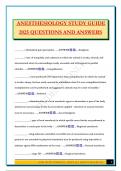
ANESTHESIOLOGY STUDY GUIDE
2025 QUESTIONS AND ANSWERS
________: diminished pain perception - ....ANSWER ...-Analgesia
________: state of tranquility and calmness in which the animal is awake, relaxed, and
unconcerned about its surroundings (easily arousable and will respond to painful
stimuli) - ....ANSWER ...-tranquilization
____________: more profound CNS depression than tranquilization in which the animal
is awake, sleepy, but less easily aroused by stimulation than if it were tranquilized (minor
manipulations can be performed and aggressive animals may be easier to handle) -
....ANSWER ...-Sedation
___________: administration of a local anesthetic agent to desensitize a part of the body
(animal not unconscious if only local anesthetic applied - chemical or manual restraint
may be necessary). - ....ANSWER ...-Local Analgesia
_____________: type of local anesthesia in which specific nerve blocks are performed to
desensitize a certain part of the body - ....ANSWER ...-Regional anesthesia
___________: drug-induced, controlled, reversible loss of consciousness and sensation;
patient is not arousable by physical stimulation (can be produced using injectable or
inhalant agents OR combination of the two). - ....ANSWER ...-General anesthesia
_____________: stage III - ....ANSWER ...-Surgical Anesthesia
....FOR STUDY PURPOSES...©️2025 ALL RIGHTS RESERVED... 1
, ______________: anesthesia that uses a combination of drugs, each in an amount
sufficient to produce its major or desired effect to the optimum degree and keep
undesirable effects to a minimum - ....ANSWER ...-Balanced anesthesia
________________: type of general anesthesia in which the animal is dissociated from its
surroundings and unaware of external stimuli (interrupted neurotransmission b/t
thalamocortical and limbic areas of CNS) - ....ANSWER ...-Dissociative Anesthesia
(animal retains muscle rigidity, open eyes with palpebral reflexes, and somewhat intact
swallowing reflexes)
What are 5 necessary components of general anesthesia? - ....ANSWER ...-1.
Amnesia
2. Unconsciousness
3. Analgesia
4. Immobility
5. Attenuation of response to noxious stimuli (BAR)
Up to this point, your sophomore surgery dog has been quite stable at 1.25% isoflurane.
However, when the ovarian pedicle is stretched, your dog's heart rate and respiratory
rate increase. Is this dog:
a) awake and feeling pain
b) purposefully responding to inadequate anesthesia
c) showing signs of autonomic stimulants
....FOR STUDY PURPOSES...©️2025 ALL RIGHTS RESERVED... 2
2025 QUESTIONS AND ANSWERS
________: diminished pain perception - ....ANSWER ...-Analgesia
________: state of tranquility and calmness in which the animal is awake, relaxed, and
unconcerned about its surroundings (easily arousable and will respond to painful
stimuli) - ....ANSWER ...-tranquilization
____________: more profound CNS depression than tranquilization in which the animal
is awake, sleepy, but less easily aroused by stimulation than if it were tranquilized (minor
manipulations can be performed and aggressive animals may be easier to handle) -
....ANSWER ...-Sedation
___________: administration of a local anesthetic agent to desensitize a part of the body
(animal not unconscious if only local anesthetic applied - chemical or manual restraint
may be necessary). - ....ANSWER ...-Local Analgesia
_____________: type of local anesthesia in which specific nerve blocks are performed to
desensitize a certain part of the body - ....ANSWER ...-Regional anesthesia
___________: drug-induced, controlled, reversible loss of consciousness and sensation;
patient is not arousable by physical stimulation (can be produced using injectable or
inhalant agents OR combination of the two). - ....ANSWER ...-General anesthesia
_____________: stage III - ....ANSWER ...-Surgical Anesthesia
....FOR STUDY PURPOSES...©️2025 ALL RIGHTS RESERVED... 1
, ______________: anesthesia that uses a combination of drugs, each in an amount
sufficient to produce its major or desired effect to the optimum degree and keep
undesirable effects to a minimum - ....ANSWER ...-Balanced anesthesia
________________: type of general anesthesia in which the animal is dissociated from its
surroundings and unaware of external stimuli (interrupted neurotransmission b/t
thalamocortical and limbic areas of CNS) - ....ANSWER ...-Dissociative Anesthesia
(animal retains muscle rigidity, open eyes with palpebral reflexes, and somewhat intact
swallowing reflexes)
What are 5 necessary components of general anesthesia? - ....ANSWER ...-1.
Amnesia
2. Unconsciousness
3. Analgesia
4. Immobility
5. Attenuation of response to noxious stimuli (BAR)
Up to this point, your sophomore surgery dog has been quite stable at 1.25% isoflurane.
However, when the ovarian pedicle is stretched, your dog's heart rate and respiratory
rate increase. Is this dog:
a) awake and feeling pain
b) purposefully responding to inadequate anesthesia
c) showing signs of autonomic stimulants
....FOR STUDY PURPOSES...©️2025 ALL RIGHTS RESERVED... 2