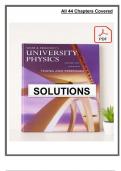
All 44 Chapters Covered
SOLUTIONS
,CONTENTS
Preface ........................................................................................................v
Part I Mechanics
Chapter 1 Units, Physical Quantities, and Vectors ..................................... 1-1
Chapter 2 Motion Along a Straight Line..................................................... 2-1
Chapter 3 Motion in Two or Three Dimensions ......................................... 3-1
Chapter 4 Newton’s Laws of Motion.......................................................... 4-1
Chapter 5 Applying Newton’s Laws........................................................... 5-1
Chapter 6 Work and Kinetic Energy........................................................... 6-1
Chapter 7 Potential Energy and Energy Conservation................................ 7-1
Chapter 8 Momentum, Impulse, and Collisions.......................................... 8-1
Chapter 9 Rotation of Rigid Bodies ............................................................ 9-1
Chapter 10 Dynamics of Rotational Motion ............................................... 10-1
Chapter 11 Equilibrium and Elasticity........................................................ 11-1
Chapter 12 Fluid Mechanics ....................................................................... 12-1
Chapter 13 Gravitation................................................................................ 13-1
Chapter 14 Periodic Motion ........................................................................ 14-1
Part II Waves/Acoustics
Chapter 15 Mechanical Waves.................................................................... 15-1
Chapter 16 Sound and Hearing ................................................................... 16-1
Part III Thermodynamics
Chapter 17 Temperature and Heat .............................................................. 17-1
Chapter 18 Thermal Properties of Matter ................................................... 18-1
Chapter 19 The First Law of Thermodynamics .......................................... 19-1
Chapter 20 The Second Law of Thermodynamics...................................... 20-1
© Copyright 2016 Pearson Education, Inc. All rights reserved. This material is protected under all copyright laws as they currently exist.
No portion of this material may be reproduced, in any form or by any means, without permission in writing from the publisher.
iii
,iv Contents
Part IV Electromagnetism
Chapter 21 Electric Charge and Electric Field............................................ 21-1
Chapter 22 Gauss’s Law ............................................................................. 22-1
Chapter 23 Electric Potential ...................................................................... 23-1
Chapter 24 Capacitance and Dielectrics ..................................................... 24-1
Chapter 25 Current, Resistance, and Electromotive Force ......................... 25-1
Chapter 26 Direct-Current Circuits............................................................. 26-1
Chapter 27 Magnetic Field and Magnetic Forces ....................................... 27-1
Chapter 28 Sources of Magnetic Field........................................................ 28-1
Chapter 29 Electromagnetic Induction ....................................................... 29-1
Chapter 30 Inductance ................................................................................ 30-1
Chapter 31 Alternating Current................................................................... 31-1
Chapter 32 Electromagnetic Waves............................................................ 32-1
Part V Optics
Chapter 33 The Nature and Propagation of Light....................................... 33-1
Chapter 34 Geometric Optics...................................................................... 34-1
Chapter 35 Interference............................................................................... 35-1
Chapter 36 Diffraction ................................................................................ 36-1
Part VI Modern Physics
Chapter 37 Relativity .................................................................................. 37-1
Chapter 38 Photons: Light Waves Behaving as Particles ........................... 38-1
Chapter 39 Particles Behaving as Waves.................................................... 39-1
Chapter 40 Quantum Mechanics I: Wave Functions .................................. 40-1
Chapter 41 Quantum Mechanics II: Atomic Structure ............................... 41-1
Chapter 42 Molecules and Condensed Matter ............................................ 42-1
Chapter 43 Nuclear Physics ........................................................................ 43-1
Chapter 44 Particle Physics and Cosmology .............................................. 44-1
© Copyright 2016 Pearson Education, Inc. All rights reserved. This material is protected under all copyright laws as they currently exist.
No portion of this material may be reproduced, in any form or by any means, without permission in writing from the publisher.
, UNITS, PHYSICAL QUANTITIES, AND VECTORS
1
1.1. IDENTIFY: Convert units from mi to km and from km to ft.
SET UP: 1 in. = 2.54 cm, 1 km = 1000 m, 12 in. = 1 ft, 1 mi = 5280 ft.
⎛ 5280 ft ⎞⎛ 12 in. ⎞⎛ 2.54 cm ⎞⎛ 1 m ⎞⎛ 1 km ⎞
EXECUTE: (a) 1.00 mi = (1.00 mi) ⎜ ⎟⎜ ⎟⎜ ⎟⎜ ⎟⎜ ⎟ = 1.61 km
⎝ 1 mi ⎠⎝ 1 ft ⎠⎝ 1 in. ⎠⎝ 102 cm ⎠⎝ 103 m ⎠
⎛ 103 m ⎞⎛ 102 cm ⎞ ⎛ 1 in. ⎞⎛ 1 ft ⎞ 3
(b) 1.00 km = (1.00 km) ⎜
⎜ 1 km ⎟⎜
⎟⎜ 1 m ⎟⎟ ⎜⎝ 2.54 cm ⎟⎜
⎠⎝ 12 in .
⎟ = 3.28 × 10 ft
⎠
⎝ ⎠⎝ ⎠
EVALUATE: A mile is a greater distance than a kilometer. There are 5280 ft in a mile but only 3280 ft in
a km.
1.2. IDENTIFY: Convert volume units from L to in.3.
SET UP: 1 L = 1000 cm3. 1 in. = 2.54 cm
⎛ 1000 cm3 ⎞ ⎛ 1 in. ⎞3 3
EXECUTE: 0.473 L × ⎜ ⎟⎟ × ⎜ ⎟ = 28.9 in. .
⎜ 1L
⎝ ⎠ ⎝ 2.54 cm ⎠
EVALUATE: 1 in.3 is greater than 1 cm3 , so the volume in in.3 is a smaller number than the volume in
cm3 , which is 473 cm3.
1.3. IDENTIFY: We know the speed of light in m/s. t = d/v. Convert 1.00 ft to m and t from s to ns.
SET UP: The speed of light is v = 3.00 × 10⁸ m/s. 1 ft = 0.3048 m. 1 s = 109 ns.
0.3048 m
EXECUTE: t = = 1.02 × 10⁻⁹ s = 1.02 ns
3.00 × 10⁸ m/s
EVALUATE: In 1.00 s light travels 3.00 × 10⁸ m = 3.00 × 10⁵ km = 1.86 × 10⁵ mi.
1.4. IDENTIFY: Convert the units from g to kg and from cm3 to m3.
SET UP: 1 kg = 1000 g. 1 m = 100 cm.
3
g ⎛ 1 kg ⎞ ⎛ 100 cm ⎞ kg
EXECUTE: 19.3 3 ⎜ 1000 g ⎟ ⎜ 1 m ⎟
× × = 1.93 × 10⁴ 3
cm ⎝ ⎠ ⎝ ⎠ m
EVALUATE: The ratio that converts cm to m is cubed, because we need to convert cm3 to m3.
1.5. IDENTIFY: Convert volume units from in.3 to L.
SET UP: 1 L = 1000 cm3. 1 in. = 2.54 cm.
EXECUTE: (327 in.3 ) × (2.54 cm/in.)3 × (1 L/1000 cm3 ) = 5.36 L
EVALUATE: The volume is 5360 cm3. 1 cm3 is less than 1 in.3 , so the volume in cm3 is a larger number
than the volume in in.3.
© Copyright 2016 Pearson Education, Inc. All rights reserved. This material is protected under all copyright laws as they currently exist.
No portion of this material may be reproduced, in any form or by any means, without permission in writing from the publisher.
1-1
SOLUTIONS
,CONTENTS
Preface ........................................................................................................v
Part I Mechanics
Chapter 1 Units, Physical Quantities, and Vectors ..................................... 1-1
Chapter 2 Motion Along a Straight Line..................................................... 2-1
Chapter 3 Motion in Two or Three Dimensions ......................................... 3-1
Chapter 4 Newton’s Laws of Motion.......................................................... 4-1
Chapter 5 Applying Newton’s Laws........................................................... 5-1
Chapter 6 Work and Kinetic Energy........................................................... 6-1
Chapter 7 Potential Energy and Energy Conservation................................ 7-1
Chapter 8 Momentum, Impulse, and Collisions.......................................... 8-1
Chapter 9 Rotation of Rigid Bodies ............................................................ 9-1
Chapter 10 Dynamics of Rotational Motion ............................................... 10-1
Chapter 11 Equilibrium and Elasticity........................................................ 11-1
Chapter 12 Fluid Mechanics ....................................................................... 12-1
Chapter 13 Gravitation................................................................................ 13-1
Chapter 14 Periodic Motion ........................................................................ 14-1
Part II Waves/Acoustics
Chapter 15 Mechanical Waves.................................................................... 15-1
Chapter 16 Sound and Hearing ................................................................... 16-1
Part III Thermodynamics
Chapter 17 Temperature and Heat .............................................................. 17-1
Chapter 18 Thermal Properties of Matter ................................................... 18-1
Chapter 19 The First Law of Thermodynamics .......................................... 19-1
Chapter 20 The Second Law of Thermodynamics...................................... 20-1
© Copyright 2016 Pearson Education, Inc. All rights reserved. This material is protected under all copyright laws as they currently exist.
No portion of this material may be reproduced, in any form or by any means, without permission in writing from the publisher.
iii
,iv Contents
Part IV Electromagnetism
Chapter 21 Electric Charge and Electric Field............................................ 21-1
Chapter 22 Gauss’s Law ............................................................................. 22-1
Chapter 23 Electric Potential ...................................................................... 23-1
Chapter 24 Capacitance and Dielectrics ..................................................... 24-1
Chapter 25 Current, Resistance, and Electromotive Force ......................... 25-1
Chapter 26 Direct-Current Circuits............................................................. 26-1
Chapter 27 Magnetic Field and Magnetic Forces ....................................... 27-1
Chapter 28 Sources of Magnetic Field........................................................ 28-1
Chapter 29 Electromagnetic Induction ....................................................... 29-1
Chapter 30 Inductance ................................................................................ 30-1
Chapter 31 Alternating Current................................................................... 31-1
Chapter 32 Electromagnetic Waves............................................................ 32-1
Part V Optics
Chapter 33 The Nature and Propagation of Light....................................... 33-1
Chapter 34 Geometric Optics...................................................................... 34-1
Chapter 35 Interference............................................................................... 35-1
Chapter 36 Diffraction ................................................................................ 36-1
Part VI Modern Physics
Chapter 37 Relativity .................................................................................. 37-1
Chapter 38 Photons: Light Waves Behaving as Particles ........................... 38-1
Chapter 39 Particles Behaving as Waves.................................................... 39-1
Chapter 40 Quantum Mechanics I: Wave Functions .................................. 40-1
Chapter 41 Quantum Mechanics II: Atomic Structure ............................... 41-1
Chapter 42 Molecules and Condensed Matter ............................................ 42-1
Chapter 43 Nuclear Physics ........................................................................ 43-1
Chapter 44 Particle Physics and Cosmology .............................................. 44-1
© Copyright 2016 Pearson Education, Inc. All rights reserved. This material is protected under all copyright laws as they currently exist.
No portion of this material may be reproduced, in any form or by any means, without permission in writing from the publisher.
, UNITS, PHYSICAL QUANTITIES, AND VECTORS
1
1.1. IDENTIFY: Convert units from mi to km and from km to ft.
SET UP: 1 in. = 2.54 cm, 1 km = 1000 m, 12 in. = 1 ft, 1 mi = 5280 ft.
⎛ 5280 ft ⎞⎛ 12 in. ⎞⎛ 2.54 cm ⎞⎛ 1 m ⎞⎛ 1 km ⎞
EXECUTE: (a) 1.00 mi = (1.00 mi) ⎜ ⎟⎜ ⎟⎜ ⎟⎜ ⎟⎜ ⎟ = 1.61 km
⎝ 1 mi ⎠⎝ 1 ft ⎠⎝ 1 in. ⎠⎝ 102 cm ⎠⎝ 103 m ⎠
⎛ 103 m ⎞⎛ 102 cm ⎞ ⎛ 1 in. ⎞⎛ 1 ft ⎞ 3
(b) 1.00 km = (1.00 km) ⎜
⎜ 1 km ⎟⎜
⎟⎜ 1 m ⎟⎟ ⎜⎝ 2.54 cm ⎟⎜
⎠⎝ 12 in .
⎟ = 3.28 × 10 ft
⎠
⎝ ⎠⎝ ⎠
EVALUATE: A mile is a greater distance than a kilometer. There are 5280 ft in a mile but only 3280 ft in
a km.
1.2. IDENTIFY: Convert volume units from L to in.3.
SET UP: 1 L = 1000 cm3. 1 in. = 2.54 cm
⎛ 1000 cm3 ⎞ ⎛ 1 in. ⎞3 3
EXECUTE: 0.473 L × ⎜ ⎟⎟ × ⎜ ⎟ = 28.9 in. .
⎜ 1L
⎝ ⎠ ⎝ 2.54 cm ⎠
EVALUATE: 1 in.3 is greater than 1 cm3 , so the volume in in.3 is a smaller number than the volume in
cm3 , which is 473 cm3.
1.3. IDENTIFY: We know the speed of light in m/s. t = d/v. Convert 1.00 ft to m and t from s to ns.
SET UP: The speed of light is v = 3.00 × 10⁸ m/s. 1 ft = 0.3048 m. 1 s = 109 ns.
0.3048 m
EXECUTE: t = = 1.02 × 10⁻⁹ s = 1.02 ns
3.00 × 10⁸ m/s
EVALUATE: In 1.00 s light travels 3.00 × 10⁸ m = 3.00 × 10⁵ km = 1.86 × 10⁵ mi.
1.4. IDENTIFY: Convert the units from g to kg and from cm3 to m3.
SET UP: 1 kg = 1000 g. 1 m = 100 cm.
3
g ⎛ 1 kg ⎞ ⎛ 100 cm ⎞ kg
EXECUTE: 19.3 3 ⎜ 1000 g ⎟ ⎜ 1 m ⎟
× × = 1.93 × 10⁴ 3
cm ⎝ ⎠ ⎝ ⎠ m
EVALUATE: The ratio that converts cm to m is cubed, because we need to convert cm3 to m3.
1.5. IDENTIFY: Convert volume units from in.3 to L.
SET UP: 1 L = 1000 cm3. 1 in. = 2.54 cm.
EXECUTE: (327 in.3 ) × (2.54 cm/in.)3 × (1 L/1000 cm3 ) = 5.36 L
EVALUATE: The volume is 5360 cm3. 1 cm3 is less than 1 in.3 , so the volume in cm3 is a larger number
than the volume in in.3.
© Copyright 2016 Pearson Education, Inc. All rights reserved. This material is protected under all copyright laws as they currently exist.
No portion of this material may be reproduced, in any form or by any means, without permission in writing from the publisher.
1-1