
Psychology and economic behavior
Lecture 1
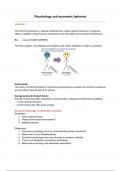
The Homo Economicus: a rational individual who makes rational decisions to maximize
utility, is capable of learning from experiences and with stable and consistent preferences
But…… we are HOMO SAPIENS
The Homo Sapien: has feelings and emotions and makes mistakes to make us irrational
Adam Smith
The theory of moral sentiments: introducing psychological concepts into economic situations
we care about what we gain from actions
George katona & Herbert Simon
Real life events are better predicted by empirical data, compared to theoretical modelling
→ not for optimal decisions
→ but for being okay with ‘good enough’
Economic psychology vs behavioral economics
Similarities
1. same historical roots
2. theory driven behavioral research
3. applied sciences
Differences
1. Economic psychology focus on understanding human mental life
2. Behavioral is more interdisciplinary
3. Economic psychology has more diversity in research methods
4. There is no deception is economic psychology
5. Behavioral psychology has libertarian paternalism
,Expected value
EV= quantity of outcome X probability of outcome
therefore you need:
1. information about utility
2. distribution of possible outcomes
3. simple unit of measurement
→ Or else it is not measurable
It is important to calculate your losses:
→ When you know what you lose it counts for your utility
Risk averse and risk seeking
Earlier in games people are more risk averse, later in games people are more risk seeking
The endowment effect
Becoming attached to what you own and believing it holds a higher value because it is
yours. You view something where you are randomly assigned to as less valuable
Prospect theory
Loss aversion = losses feel twice as painful as gains feel good
→ this causes people to make irrational choices to avoid feeling like a loser
Regret aversion = contestants fear making a choice they will regret
Sunk cost fallacy = a thinking error where people continue investing time, money or effort in
something just because they have already invested in it, even when it no longer makes
sense
RATIONALLY: past costs should not matter
Why is it fallacy: 1. sunk costs are irreversible
2. feeling get their moneys worth and not waste it
3. leading to irrational persistence
The prospect theory explains how people make decisions under risks and uncertainty, which
often deviates from rational roles
Phases:
1. editing phase: outcome for each option and seeing probabilities
2. evaluation phase: we choose the option with the highest evaluation
loss aversion means that people are more sensitive to losses than to gains
People evaluate outcomes relative to a reference point
Diminishing sensitivity = the impact of gains or losses decreases with size
!People are risk averse in gains but risk seeking in losses!
- when facing gains: sure smaller gain over a risky bigger
- when facing losses: risky larger loss over sure smaller one
, Fourfold pattern of risk attitudes
High probability of gain: risk averse
→ people prefer a sure small gain over a risky larger gain when the chance of winning is
high
e.g: a sure €900 over a big chance of having €1000
Low probability of gain: risk seeking
→ people prefer a risky big gain over a small certain gain when the chance of winning is low
e.g: small chance to win €1000 over sure €50
High probability of loss: risk seeking
→ people prefer to gamble to avoid a sure loss
e.g: choose big chance to lose €1000 over for sure losing €900
Low probability of loss: risk averse
→ people prefer
People overweight small probabilities
- a 5% chance winning = a 95% chance of losing
And losses feel bigger than gains so you go risk seeking to not feel the pain
of the loss
Lecture 1
The Homo Economicus: a rational individual who makes rational decisions to maximize
utility, is capable of learning from experiences and with stable and consistent preferences
But…… we are HOMO SAPIENS
The Homo Sapien: has feelings and emotions and makes mistakes to make us irrational
Adam Smith
The theory of moral sentiments: introducing psychological concepts into economic situations
we care about what we gain from actions
George katona & Herbert Simon
Real life events are better predicted by empirical data, compared to theoretical modelling
→ not for optimal decisions
→ but for being okay with ‘good enough’
Economic psychology vs behavioral economics
Similarities
1. same historical roots
2. theory driven behavioral research
3. applied sciences
Differences
1. Economic psychology focus on understanding human mental life
2. Behavioral is more interdisciplinary
3. Economic psychology has more diversity in research methods
4. There is no deception is economic psychology
5. Behavioral psychology has libertarian paternalism
,Expected value
EV= quantity of outcome X probability of outcome
therefore you need:
1. information about utility
2. distribution of possible outcomes
3. simple unit of measurement
→ Or else it is not measurable
It is important to calculate your losses:
→ When you know what you lose it counts for your utility
Risk averse and risk seeking
Earlier in games people are more risk averse, later in games people are more risk seeking
The endowment effect
Becoming attached to what you own and believing it holds a higher value because it is
yours. You view something where you are randomly assigned to as less valuable
Prospect theory
Loss aversion = losses feel twice as painful as gains feel good
→ this causes people to make irrational choices to avoid feeling like a loser
Regret aversion = contestants fear making a choice they will regret
Sunk cost fallacy = a thinking error where people continue investing time, money or effort in
something just because they have already invested in it, even when it no longer makes
sense
RATIONALLY: past costs should not matter
Why is it fallacy: 1. sunk costs are irreversible
2. feeling get their moneys worth and not waste it
3. leading to irrational persistence
The prospect theory explains how people make decisions under risks and uncertainty, which
often deviates from rational roles
Phases:
1. editing phase: outcome for each option and seeing probabilities
2. evaluation phase: we choose the option with the highest evaluation
loss aversion means that people are more sensitive to losses than to gains
People evaluate outcomes relative to a reference point
Diminishing sensitivity = the impact of gains or losses decreases with size
!People are risk averse in gains but risk seeking in losses!
- when facing gains: sure smaller gain over a risky bigger
- when facing losses: risky larger loss over sure smaller one
, Fourfold pattern of risk attitudes
High probability of gain: risk averse
→ people prefer a sure small gain over a risky larger gain when the chance of winning is
high
e.g: a sure €900 over a big chance of having €1000
Low probability of gain: risk seeking
→ people prefer a risky big gain over a small certain gain when the chance of winning is low
e.g: small chance to win €1000 over sure €50
High probability of loss: risk seeking
→ people prefer to gamble to avoid a sure loss
e.g: choose big chance to lose €1000 over for sure losing €900
Low probability of loss: risk averse
→ people prefer
People overweight small probabilities
- a 5% chance winning = a 95% chance of losing
And losses feel bigger than gains so you go risk seeking to not feel the pain
of the loss



