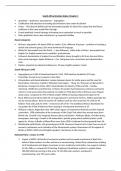
South Africa Revision Notes: Chapter 1
Apartheid – apartness/ separateness – segregation
Codification and extension of existing discriminatory laws under the British
Union – 1910 but the British had not demanded equality for black SAs, hoped that the liberal
traditions of the Cape would filter through.
Grand apartheid: overall strategy of keeping races separated as much as possible.
Petty apartheid: day-to-day restrictions e.g. separate facilities.
Racial categories
Africans: migrated to SA about 2000 yrs earlier. 8.5m. different Af groups – problem of creating a
united and cohesive group. Zulu most dominant Af language.
White SA: Descended from the Dutch – 1.6m Afrikaners, ‘white tribe of Africa’, descended from
English 1m. English tended to be wealthier, professionals.
Coloured: descendants of original San and Khoikhoi, slaves brought to SA from Asia and Africa,
inter-racial marriages. Spoke Afrikaans. 1.1m. Had grown into a merchant and administrative
class.
Indians: imported as indentured labourers. 3% pop. English speakers. Natal.
South Africa pre-1948
Segregation pre 1948: Af disenfranchised in 1936. 1948 election decided by 21% pop.
Townships. Forced to carry passes in the cities.
Urbanisation and industrialisation: tension between desire for white space and the need for
black labour. Discovery of gold in Witwatersrand region – J’burg 1m. Discovery of diamonds in
Kimberley, Orange Free State, 1867. Diversification of industry 1920s and 30s – textiles,
chemicals. ISCOR (Iron and Steel Co). In theory Af workers had temporary contracts and had to
return to rural areas when they expired. In reality by 1946 about 23% of Africans were living in
urban areas, compared to 75% of white people. WW2 increasing employment opps for Af.
Rural: 80% land owned by white SA. Af wage labourers and tenant farmers. Whites generally did
not do manual labour. Reserve land for Af: Natives Land Act 1913 reserved 7% of SA for Af.
Natives Trust and Land Act 1936 – reserved 13.6% of SA - the traditional African heartlands for
occupation by Af but Af debarred from buying or owning land elsewhere in SA.
Afrikaner culture: Anglo-Boer War 1899-1902, legacy of resentment of Britain and the imperial
connection. 1938 celebration of the centenary of the Great Trek when they moved away from
British rule. Growth of an imagined shared culture and history : Afrikaans bibles, Christian tracts,
newspapers and mags. Growth in Ak nationalism. Specific group which political parties could
appeal to. Victory in Battle of Blood River over Zulus 1838 = believed God had granted them SA.
Relationship with Britain: self-governing part of BE. Governor-General sat in Cape Town as rep of
monarch, parliament sat in imitation of the Westminster system. Resentment of SA support of
Britain in WW1/ WW2 and of English speakers’ dominance in the economy.
National Party’s victory in 1948
1. Impact of WW2: AK fearful of economic position and increased resentment of black SAs. :
influx of black workers to cities and fears of oorstrooming. United Party relaxed laws relating
to Af employment and began to prepare a more moderate racial policy. Ave wage in industry
for Af £128 p.a. compared £32 farming. Employers hired black workers to replace those
186,000 white ppl serving in the army. Of 125,000 extra workers employed in
manufacturing, only 25% were white.
, 2. Afrikaner nationalism: sense that they were special and deserved to be protected and this
made a nationalist agenda attractive: Broederbond set up 1918, Calvinist Dutch Reformed
Church established schools and cultural activities to increase pride, and the
Ossewabrandwag claimed 250,000 members by 1939, Stormjaers.
3. National Party’s campaign: offered a package which successfully appealed to a broad alliance
of Afrikaner interests by promising them what they wanted: played on fears of sexual
relations across the colour line, promised to deal with the ‘poor white problem’ by giving
them state employment, white SA and played down the republican issue.
4. International Context: More determined to defend their views, because they saw
themselves as representing western, Christian, anti-communist values. End of WW2, desire
to stamp out fascism, UN created and Smuts role in that, empires dismantled, India granted
independence 1947. Support in USA, continuation of Jim Crow laws.
5. Electoral system: NP could take advantage of its significant support among rural voters
despite its failure to gain an overall majority. Westminster constituency system. NP won 79
seats to the UP’s 71. NP 38% vote, UP 49%. UP stacked up votes in urban spaces.
Implementation of Apartheid following the NP’s victory
Strengthening NP power: 1949: 6 MPS for South West Africa – support NP.1951 Separate
Representation of Voters Act – remove the remaining coloured vote in SA. Provoked a bitter
constitutional battle because it was done with a simple majority rather than the 2/3 majority
required in SA law. 1953 election NP had gained 600,000 votes – support of majority of
Afrikaners. By 1960 had over a 50 seat majority. As Eng speakers retired from civil service they
were replaced by Ak.
Homelands: Verwoerd believed Africans saw themselves as tribal, based in rural communities.
Homelands could develop separate to white SA. 1951 Bantu Authorities Act – ensured
appointment of traditional tribal leaders in the homelands and provoked considerable
resentment as chiefs were deposed and replaced with those who would collaborate. 1959 Bantu
Self-Government Act: envisaged creation of 8 (later 10) separate, independent and self-
governing homelands for the different African groups. Internal decolonisation.
Race: Concerns about inter-racial sex and marriage. 1949 Mixed Marriages Act, 1950 Immorality
Act – banned marriage and sex by whites across the colour line. Couples were expected to
separate and could be imprisoned if they didn’t. 1950 Population Registration Act – assigned all
people in SA to one of four racial categories to determine what rights they should have. Many
were assigned to the wrong categories, court cases to be re-classified. Some Africans also tried
to get themselves reclassified as coloured.
Suppression of Communism Act, 1950: defined it as ‘any scheme aimed at bringing about pol,
soc or econ change within Union by promotion of disturbance and disorder’ = euphemism for
any form of unrest. Could ban orgs or individuals for up to 5yrs.
1953 Public Safety Act: could call a state of emergency for 12 months, with powers to renew it
indefinitely.
Segregation of Space: Group Areas Acts gave the government the power to clear informal
African communities near cities and towns – shack settlements, in operation throughout the
1950s. Areas cleared: Sophiatown in J’burg from 1953 (moved to Meadowlands; replaced by
white suburb Triomf), District Six in Cape Town and Cato Manor in Durban. Caused considerable
resentment. Moved to townships further away, lengthened their commute. Loss of culture –
Sophiatown home of Drum Magazine, shebeens etc. Largest township SOWETO – South Western
townships. Led to the eviction of 3.5m Af 1951-86.
Apartheid – apartness/ separateness – segregation
Codification and extension of existing discriminatory laws under the British
Union – 1910 but the British had not demanded equality for black SAs, hoped that the liberal
traditions of the Cape would filter through.
Grand apartheid: overall strategy of keeping races separated as much as possible.
Petty apartheid: day-to-day restrictions e.g. separate facilities.
Racial categories
Africans: migrated to SA about 2000 yrs earlier. 8.5m. different Af groups – problem of creating a
united and cohesive group. Zulu most dominant Af language.
White SA: Descended from the Dutch – 1.6m Afrikaners, ‘white tribe of Africa’, descended from
English 1m. English tended to be wealthier, professionals.
Coloured: descendants of original San and Khoikhoi, slaves brought to SA from Asia and Africa,
inter-racial marriages. Spoke Afrikaans. 1.1m. Had grown into a merchant and administrative
class.
Indians: imported as indentured labourers. 3% pop. English speakers. Natal.
South Africa pre-1948
Segregation pre 1948: Af disenfranchised in 1936. 1948 election decided by 21% pop.
Townships. Forced to carry passes in the cities.
Urbanisation and industrialisation: tension between desire for white space and the need for
black labour. Discovery of gold in Witwatersrand region – J’burg 1m. Discovery of diamonds in
Kimberley, Orange Free State, 1867. Diversification of industry 1920s and 30s – textiles,
chemicals. ISCOR (Iron and Steel Co). In theory Af workers had temporary contracts and had to
return to rural areas when they expired. In reality by 1946 about 23% of Africans were living in
urban areas, compared to 75% of white people. WW2 increasing employment opps for Af.
Rural: 80% land owned by white SA. Af wage labourers and tenant farmers. Whites generally did
not do manual labour. Reserve land for Af: Natives Land Act 1913 reserved 7% of SA for Af.
Natives Trust and Land Act 1936 – reserved 13.6% of SA - the traditional African heartlands for
occupation by Af but Af debarred from buying or owning land elsewhere in SA.
Afrikaner culture: Anglo-Boer War 1899-1902, legacy of resentment of Britain and the imperial
connection. 1938 celebration of the centenary of the Great Trek when they moved away from
British rule. Growth of an imagined shared culture and history : Afrikaans bibles, Christian tracts,
newspapers and mags. Growth in Ak nationalism. Specific group which political parties could
appeal to. Victory in Battle of Blood River over Zulus 1838 = believed God had granted them SA.
Relationship with Britain: self-governing part of BE. Governor-General sat in Cape Town as rep of
monarch, parliament sat in imitation of the Westminster system. Resentment of SA support of
Britain in WW1/ WW2 and of English speakers’ dominance in the economy.
National Party’s victory in 1948
1. Impact of WW2: AK fearful of economic position and increased resentment of black SAs. :
influx of black workers to cities and fears of oorstrooming. United Party relaxed laws relating
to Af employment and began to prepare a more moderate racial policy. Ave wage in industry
for Af £128 p.a. compared £32 farming. Employers hired black workers to replace those
186,000 white ppl serving in the army. Of 125,000 extra workers employed in
manufacturing, only 25% were white.
, 2. Afrikaner nationalism: sense that they were special and deserved to be protected and this
made a nationalist agenda attractive: Broederbond set up 1918, Calvinist Dutch Reformed
Church established schools and cultural activities to increase pride, and the
Ossewabrandwag claimed 250,000 members by 1939, Stormjaers.
3. National Party’s campaign: offered a package which successfully appealed to a broad alliance
of Afrikaner interests by promising them what they wanted: played on fears of sexual
relations across the colour line, promised to deal with the ‘poor white problem’ by giving
them state employment, white SA and played down the republican issue.
4. International Context: More determined to defend their views, because they saw
themselves as representing western, Christian, anti-communist values. End of WW2, desire
to stamp out fascism, UN created and Smuts role in that, empires dismantled, India granted
independence 1947. Support in USA, continuation of Jim Crow laws.
5. Electoral system: NP could take advantage of its significant support among rural voters
despite its failure to gain an overall majority. Westminster constituency system. NP won 79
seats to the UP’s 71. NP 38% vote, UP 49%. UP stacked up votes in urban spaces.
Implementation of Apartheid following the NP’s victory
Strengthening NP power: 1949: 6 MPS for South West Africa – support NP.1951 Separate
Representation of Voters Act – remove the remaining coloured vote in SA. Provoked a bitter
constitutional battle because it was done with a simple majority rather than the 2/3 majority
required in SA law. 1953 election NP had gained 600,000 votes – support of majority of
Afrikaners. By 1960 had over a 50 seat majority. As Eng speakers retired from civil service they
were replaced by Ak.
Homelands: Verwoerd believed Africans saw themselves as tribal, based in rural communities.
Homelands could develop separate to white SA. 1951 Bantu Authorities Act – ensured
appointment of traditional tribal leaders in the homelands and provoked considerable
resentment as chiefs were deposed and replaced with those who would collaborate. 1959 Bantu
Self-Government Act: envisaged creation of 8 (later 10) separate, independent and self-
governing homelands for the different African groups. Internal decolonisation.
Race: Concerns about inter-racial sex and marriage. 1949 Mixed Marriages Act, 1950 Immorality
Act – banned marriage and sex by whites across the colour line. Couples were expected to
separate and could be imprisoned if they didn’t. 1950 Population Registration Act – assigned all
people in SA to one of four racial categories to determine what rights they should have. Many
were assigned to the wrong categories, court cases to be re-classified. Some Africans also tried
to get themselves reclassified as coloured.
Suppression of Communism Act, 1950: defined it as ‘any scheme aimed at bringing about pol,
soc or econ change within Union by promotion of disturbance and disorder’ = euphemism for
any form of unrest. Could ban orgs or individuals for up to 5yrs.
1953 Public Safety Act: could call a state of emergency for 12 months, with powers to renew it
indefinitely.
Segregation of Space: Group Areas Acts gave the government the power to clear informal
African communities near cities and towns – shack settlements, in operation throughout the
1950s. Areas cleared: Sophiatown in J’burg from 1953 (moved to Meadowlands; replaced by
white suburb Triomf), District Six in Cape Town and Cato Manor in Durban. Caused considerable
resentment. Moved to townships further away, lengthened their commute. Loss of culture –
Sophiatown home of Drum Magazine, shebeens etc. Largest township SOWETO – South Western
townships. Led to the eviction of 3.5m Af 1951-86.