1
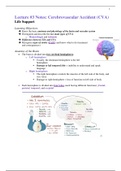
Lecture #3 Notes: Cerebrovascular Accident (CVA)
Life Support
Learning Objectives
➔ Know the basic anatomy and physiology of the brain and vascular system
➔ Distinguish and describe the two main types of CVA
o Hemorrhagic and ischemic
➔ Difference between TIA and CVA
➔ Recognize signs of stroke (FAST) and know what to do (treatment
and consequences)
Anatomy of the Brain
• The brain is divided into two cerebral hemispheres:
o Left hemisphere
▪ Usually, the dominant hemisphere is the left
hemisphere
▪ Damage to left temporal lobe = inability to understand and speak
language
o Right hemisphere
▪ The right hemisphere controls the muscles of the left side of the body, and
vice versa
▪ Damage to right hemisphere = loss of function on left side of body
• Each hemisphere is divided into four lobes (each having different functions): frontal,
parietal, temporal, and occipital
, 2
Frontal Lobe
• Controls movement, personality, and executive function (ability to make decisions)
• Motor cortex: regulates movement
o Damage causes complete loss of control of a limb (e.g. arm) or entire right/left
side of body
Parietal lobe
• Processes sensory information (e.g. touch, warmth, perception of the world)
• Information from occipital lobe is sent here to understand what you are seeing
Temporal lobe
• Hearing, smell, memory, visual recognition of faces, language
• Damage: loss of meaning of language
Occipital lobe
• Responsible for vision
Additional structures:
➔ Cerebellum → ‘small brain’, coordinates muscle movement, balance, and gait
➔ Brain stem → connects to the spinal cord, controls vital functions (e.g. heart rate, blood
pressure, breathing, gastrointestinal function, consciousness)
o Damage: lose consciousness or stop breathing
The Vascular System
• The blood supply comes from the heart
• The aorta (largest vessel in the body) supplies blood to the body + the
brain
• There are two alternate paths of blood flow to the brain:
Aorta → brachiocephalic trunk → common carotid artery → internal carotid
artery → brain
Aorta → brachiocephalic trunk → subclavian artery → vertebral artery →
basilar artery → brain (come from behind)
, 3
Circle of Willis
• A ring of blood vessels connecting the anterior and posterior circulations of the brain
• Consists of:
o Anterior cerebral artery
o Middle cerebral artery
o Internal carotid artery
o Posterior communicating artery
o Posterior cerebral artery
o Basilar artery
• If there is a problem with one artery, there is still blood supply to all over the brain
o People who do not have this: no blood supply to one part of the brain if there is
a problem with one artery
Cerebrovascular Accident
• There are two main types:
1) Hemorrhagic (bleeding)
A weakened blood vessel in the brain ruptures
Blood leaks into the surrounding brain tissue
This creates swelling and pressure, damaging cells
and tissues in the brain
Account for 25% of strokes
2) Ischemic (blood clot: no blood and oxygen to part of the brain)
Also called ‘infarction’
A clot or narrowing of a vessel that stops blood supply to an area of the brain
o The lack of blood flow causes the tissue the artery supplies to become
starved (= ischemic)
o Brain tissue dies
Causes of blockage:
o Blood clot (thrombus) that forms in an unhealthy artery of the brain
o Embolus, a blood clot formed elsewhere in the body, that travels to the
brain; lodges in an artery too narrow to let it pass, and obstructs blood
flow
Embolus:
• The lodging of an embolus, a blockage-causing piece of material, inside a blood vessel
• The embolus may be a blood clot (thrombus), a fat globule (fat embolism), a bubble of air
or other gas (gas embolism), or foreign material
Lecture #3 Notes: Cerebrovascular Accident (CVA)
Life Support
Learning Objectives
➔ Know the basic anatomy and physiology of the brain and vascular system
➔ Distinguish and describe the two main types of CVA
o Hemorrhagic and ischemic
➔ Difference between TIA and CVA
➔ Recognize signs of stroke (FAST) and know what to do (treatment
and consequences)
Anatomy of the Brain
• The brain is divided into two cerebral hemispheres:
o Left hemisphere
▪ Usually, the dominant hemisphere is the left
hemisphere
▪ Damage to left temporal lobe = inability to understand and speak
language
o Right hemisphere
▪ The right hemisphere controls the muscles of the left side of the body, and
vice versa
▪ Damage to right hemisphere = loss of function on left side of body
• Each hemisphere is divided into four lobes (each having different functions): frontal,
parietal, temporal, and occipital
, 2
Frontal Lobe
• Controls movement, personality, and executive function (ability to make decisions)
• Motor cortex: regulates movement
o Damage causes complete loss of control of a limb (e.g. arm) or entire right/left
side of body
Parietal lobe
• Processes sensory information (e.g. touch, warmth, perception of the world)
• Information from occipital lobe is sent here to understand what you are seeing
Temporal lobe
• Hearing, smell, memory, visual recognition of faces, language
• Damage: loss of meaning of language
Occipital lobe
• Responsible for vision
Additional structures:
➔ Cerebellum → ‘small brain’, coordinates muscle movement, balance, and gait
➔ Brain stem → connects to the spinal cord, controls vital functions (e.g. heart rate, blood
pressure, breathing, gastrointestinal function, consciousness)
o Damage: lose consciousness or stop breathing
The Vascular System
• The blood supply comes from the heart
• The aorta (largest vessel in the body) supplies blood to the body + the
brain
• There are two alternate paths of blood flow to the brain:
Aorta → brachiocephalic trunk → common carotid artery → internal carotid
artery → brain
Aorta → brachiocephalic trunk → subclavian artery → vertebral artery →
basilar artery → brain (come from behind)
, 3
Circle of Willis
• A ring of blood vessels connecting the anterior and posterior circulations of the brain
• Consists of:
o Anterior cerebral artery
o Middle cerebral artery
o Internal carotid artery
o Posterior communicating artery
o Posterior cerebral artery
o Basilar artery
• If there is a problem with one artery, there is still blood supply to all over the brain
o People who do not have this: no blood supply to one part of the brain if there is
a problem with one artery
Cerebrovascular Accident
• There are two main types:
1) Hemorrhagic (bleeding)
A weakened blood vessel in the brain ruptures
Blood leaks into the surrounding brain tissue
This creates swelling and pressure, damaging cells
and tissues in the brain
Account for 25% of strokes
2) Ischemic (blood clot: no blood and oxygen to part of the brain)
Also called ‘infarction’
A clot or narrowing of a vessel that stops blood supply to an area of the brain
o The lack of blood flow causes the tissue the artery supplies to become
starved (= ischemic)
o Brain tissue dies
Causes of blockage:
o Blood clot (thrombus) that forms in an unhealthy artery of the brain
o Embolus, a blood clot formed elsewhere in the body, that travels to the
brain; lodges in an artery too narrow to let it pass, and obstructs blood
flow
Embolus:
• The lodging of an embolus, a blockage-causing piece of material, inside a blood vessel
• The embolus may be a blood clot (thrombus), a fat globule (fat embolism), a bubble of air
or other gas (gas embolism), or foreign material