
Lecture 1 – cellular communication
- The epithelial lining of the skin gives the possibility for the skin to reshape, be
flexible and functions as a barrier. Cell-cell connections are essential for that
- For maintaining the internal epithelial barrier of the intestines and motility
(flexibility).
- Give muscles strength
- Heart, depends on cell-cell connections to beat as one muscle an not as many
different small muscle cells
If there are no cell-cell contact, there is no life.
The cell-cell contacts are divided into different classes:
- Occluding junctions: tight junction
- Cell-cell anchoring jucntions: junctions between the cells
o Adherens junctions
o Desmosomes
- Channel-forming junctions: Gap junctions
- Cell-matrix junctions:
o Actin-linked cell matrix adhesion
o Hemidesmosomes
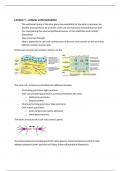
The basic structure of a cell-cell contact point:
You have 2 plasma membranes of the cells (green), transmembrane proteins (red),
adaptor proteins (pink) and the cell fibers (intercellular/actin filaments).
,You have the actin filaments, the adaptor protein complexes and the transmembrane
ones that stick through the cell membrane trying to attach the neighbour form the other
cell.
Adherens junctions connect actin filaments from one cell to the other, the connecting
parts are composed of classical cadherins:
- Cadherin E (epithelial)
- Cadherin P (placental)
- Cadherin N (neuronal)
Calcium is very important for extracellular cadherin domain interactions. Between the
“bubbles” of cadherins are the so-called Hinge regions. You need calcium to make this
hinge region stiff, because if you have stiff hinge regions you also have a stiff cadherin
protein which can interact with another stiff cadherin protein. Calcium is also very
important in relation to cell culture work, if you want to transfer cells stuck to plastic you
need to use a compound that removes calcium.
Desmosomes connect intermediate filaments in one cell to another, they are
composed of so-called non-classical cadherins (transmembrane proteins):
- Desmoglein
- Desmocolin
The adaptor proteins are:
- Plakoglobin
- Plakophilin
- Desmoplakin
,Intermediate filaments: interspersed in a cell, diameter 10nm. Different proteins and
mostly give mechanical support to the cell (connected by desmosomes).
Actin filaments: connected to adherens junctions, diameter 6nm, function in supporting
of plasma membrane; involved in cytokinesis, cell movement and signal transduction.
Microtubles: usually not connected to any cell-anchoring junctions as they are primarily
involved in transport of intracellular vesicles and have a role in chromosomal
organisation. There is not much contact with the plasma membrane.
Hemidesmosomes are located at the basolateral side of an epithelial cell connecting
this cell to the basal lamina and the extracellular matrix. They also anchor intermediate
filaments and are composed of integrin a6β4 and collagen XVII as transmembrane
proteins. The adaptor proteins:
- Plectin
- Dystonin
, -
The focal adhesions (actin-linked cell-matrix junctions) are much more complex than
the hemidesmosomes. They have transmembrane proteins: integrins, much adaptor
proteins:
- Talin
- FAK
- Tensin
- Vinculin
And this anchors the actin filaments in the cell to the extracellular matrix. The reason
why this is so complex and there are so many different adaptor proteins, is that the focal
adhesions are involved in all kind of signalling events. If you activate a certain line of the
adaptor proteins, than these together with actin fibers are able to switch on for example
the ??? pathway (slide 12) which is very important in cell signalling.
- The epithelial lining of the skin gives the possibility for the skin to reshape, be
flexible and functions as a barrier. Cell-cell connections are essential for that
- For maintaining the internal epithelial barrier of the intestines and motility
(flexibility).
- Give muscles strength
- Heart, depends on cell-cell connections to beat as one muscle an not as many
different small muscle cells
If there are no cell-cell contact, there is no life.
The cell-cell contacts are divided into different classes:
- Occluding junctions: tight junction
- Cell-cell anchoring jucntions: junctions between the cells
o Adherens junctions
o Desmosomes
- Channel-forming junctions: Gap junctions
- Cell-matrix junctions:
o Actin-linked cell matrix adhesion
o Hemidesmosomes
The basic structure of a cell-cell contact point:
You have 2 plasma membranes of the cells (green), transmembrane proteins (red),
adaptor proteins (pink) and the cell fibers (intercellular/actin filaments).
,You have the actin filaments, the adaptor protein complexes and the transmembrane
ones that stick through the cell membrane trying to attach the neighbour form the other
cell.
Adherens junctions connect actin filaments from one cell to the other, the connecting
parts are composed of classical cadherins:
- Cadherin E (epithelial)
- Cadherin P (placental)
- Cadherin N (neuronal)
Calcium is very important for extracellular cadherin domain interactions. Between the
“bubbles” of cadherins are the so-called Hinge regions. You need calcium to make this
hinge region stiff, because if you have stiff hinge regions you also have a stiff cadherin
protein which can interact with another stiff cadherin protein. Calcium is also very
important in relation to cell culture work, if you want to transfer cells stuck to plastic you
need to use a compound that removes calcium.
Desmosomes connect intermediate filaments in one cell to another, they are
composed of so-called non-classical cadherins (transmembrane proteins):
- Desmoglein
- Desmocolin
The adaptor proteins are:
- Plakoglobin
- Plakophilin
- Desmoplakin
,Intermediate filaments: interspersed in a cell, diameter 10nm. Different proteins and
mostly give mechanical support to the cell (connected by desmosomes).
Actin filaments: connected to adherens junctions, diameter 6nm, function in supporting
of plasma membrane; involved in cytokinesis, cell movement and signal transduction.
Microtubles: usually not connected to any cell-anchoring junctions as they are primarily
involved in transport of intracellular vesicles and have a role in chromosomal
organisation. There is not much contact with the plasma membrane.
Hemidesmosomes are located at the basolateral side of an epithelial cell connecting
this cell to the basal lamina and the extracellular matrix. They also anchor intermediate
filaments and are composed of integrin a6β4 and collagen XVII as transmembrane
proteins. The adaptor proteins:
- Plectin
- Dystonin
, -
The focal adhesions (actin-linked cell-matrix junctions) are much more complex than
the hemidesmosomes. They have transmembrane proteins: integrins, much adaptor
proteins:
- Talin
- FAK
- Tensin
- Vinculin
And this anchors the actin filaments in the cell to the extracellular matrix. The reason
why this is so complex and there are so many different adaptor proteins, is that the focal
adhesions are involved in all kind of signalling events. If you activate a certain line of the
adaptor proteins, than these together with actin fibers are able to switch on for example
the ??? pathway (slide 12) which is very important in cell signalling.



