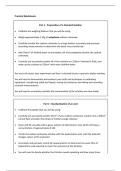
Practical Worksheets
Part 1 - Preparation of a Standard Solution
• Calibrate the weighing balance that you will be using.
• Weigh approximately 1.32g of anhydrous sodium carbonate.
• Carefully transfer the sodium carbonate to a large beaker, accurately and precisely
recording measurements to determine the exact mass transferred.
• Add 150cm3 of distilled water to the beaker, stir and completely dissolve the sodium
carbonate.
• Carefully and accurately transfer all of the solution to a 250cm3 volumetric flask, and
make up the solution to 250cm3 with more distilled water.
You must risk assess your experiment and have it checked by your supervisor before starting.
You will need to demonstrate and evidence your skills and techniques in calibrating
equipment, transferring solids and liquids, mixing of substances and taking and recording
accurate measurements.
You will need to accurately calculate the concentration of the solution you have made.
Part 2 - Standardisation of an acid
• Calibrate the pipette that you will be using.
• Carefully and accurately transfer 25cm3 of your sodium carbonate solution into a 250cm3
conical flask and add a few drops of methyl orange indicator.
• Clean and fill a burette with a given solution of hydrochloric acid, which will have a
concentration of approximately 0.1M.
• Titrate the sodium carbonate solution with the hydrochloric acid, until the indicator
changes colour at the end point.
• Accurately and precisely record all measurements to determine the exact titre of
hydrochloric acid required to reach the end point of the titration.
• You will need to decide whether the titration needs repeating and how many times.
,You must risk assess your experiment and have it checked by your supervisor before starting.
You will need to demonstrate and evidence your skills and techniques in calibrating
equipment, using volumetric glassware, transferring and mixing liquids, and taking and
recording accurate measurements.
You will need to use your results to accurately calculate the precise concentration of the
hydrochloric acid.
Part 3 - Titrations of sodium hydroxide with hydrochloric acid
You must risk assess your experiment and have it checked by your supervisor before starting.
You will need to demonstrate and evidence your skills and techniques in calibrating
equipment, using volumetric glassware, transferring and mixing liquids, and taking and
recording accurate measurements.
Part 3a - Titration of sodium hydroxide with hydrochloric acid (using an indicator)
• Calibrate the pipette that you will be using.
• Carefully and accurately transfer 25cm3 of sodium hydroxide solution (unknown
concentration) into a 250cm3 conical flask and add a few drops of methyl orange
indicator.
• Clean and fill a burette with the standardised solution of hydrochloric acid.
• Titrate the sodium hydroxide solution with the hydrochloric acid, until the indicator
changes colour at the end point.
• Accurately and precisely record all measurements to determine the exact titre of
hydrochloric acid required to reach the end point of the titration.
• You will need to decide whether the titration needs repeating and how many times.
You will need to use your results to accurately calculate the precise concentration of the
sodium hydroxide.
Part 3b - Titration of sodium hydroxide with hydrochloric acid (using a pH meter)
• Calibrate the pipette that you will be using.
• Carefully and accurately transfer 25cm3 of sodium hydroxide solution (unknown
concentration) into a small beaker (size 100cm3 or 150cm3).
,• Calibrate the pH meter that you will be using with the buffer solutions provided.
• Place the pH meter into the beaker of sodium hydroxide.
• Clean and fill a burette with the standardised solution of hydrochloric acid.
• Add hydrochloric acid from the burette to the sodium hydroxide solution in 1cm 3
portions until all of the acid has been added. Measure the pH reading on the pH meter
every 1cm3 of hydrochloric acid added.
• Accurately and precisely record all burette and pH measurements in a table.
• Plot a graph of pH against volume of acid added (burette reading) / cm3.
• You will need to decide whether the titration needs repeating and if the precision needs
to be improved.
You will need to use your graph to accurately calculate the precise concentration of the
sodium hydroxide.
Part 4 – Determining the concentration of copper(II) sulfate solution by colorimetry
• Calibrate the weighing balance that you will be using.
• Weigh 12.5g of hydrated copper(II) sulfate (CuSO4.5H2O).
• Carefully transfer the hydrated copper(II) sulfate to a beaker, accurately and precisely
recording measurements to determine the exact mass transferred.
• Add 25cm3 of hot distilled water to the beaker, stir and completely dissolve the hydrated
copper(II) sulfate.
• Carefully and accurately transfer all of the solution to a 100cm3 volumetric flask, and
make up the solution to 100cm3 with more distilled water.
• You have made a stock copper(II) sulfate solution of approximately 0.5M. Calculate the
precise concentration and label the volumetric flask.
• Using some of the stock copper(II) sulfate solution you have made, dilute so that you
have four other solutions of approximately 0.4M, 0.3M, 0.2M, 0.1M. Calculate the
precise concentration of each solution that you make.
• Perform a wavelength scan by determining the absorbance of the 0.5M sample in 50 nm
increments, remembering to calibrate the spectrometer using distilled water at each
point
• Plot a calibration curve of absorbance (or transmission) against wavelength.
,• Select 650 nm and calibrate the colorimeter (or visible spectrometer) that you will be
using with the stock solution and distilled water, according to the manufacturer’s
instructions.
• Measure and record the absorbance (or transmission) of each copper(II) sulfate solution
(approximately 0.5M, 0.4M, 0.3M, 0.2M, 0.1M) and for distilled water (0.00M) using the
calibrated colorimeter (or visible spectrometer).
• Plot a calibration curve of absorbance (or transmission) against the concentration of
copper(II) sulfate.
• Measure and record the absorbance (or transmission) of Sample A and Sample B (the
unknown concentrations of copper(II) sulfate solution) supplied by your supervisor.
• Using the calibration curve, determine the concentrations of Sample A and B.
You must risk assess your experiment and have it checked by your supervisor before starting.
You will need to demonstrate and evidence your skills and techniques in calibrating
equipment, transferring solids and liquids, mixing of substances, use of the colorimeter /
visible spectrometer, and taking and recording accurate measurements.
You will need to accurately calculate the concentration of all of the copper(II) sulfate
solutions you have made.
You will need to use your calibration curve to accurately calculate the precise concentration
of copper(II) sulfate in Samples A and B.
, The use of titrations to determine the concentration of a solution of sodium
hydroxide.
Introduction
According to Dr. Wingfield Glassey, a titration is an experiment that measures the volume of
a standard solution required to react with a known volume of solution in order to correctly
calculate the concentration of a substance in a solution. The phrase “standard solution” in
this context refers to a stable solution whose concentration has been precisely determined
(Dr. Glassey, 2017). Since a titration calculates the volume of standard solution needed to
precisely neutralise the unknown solution, it is regarded as a volumetric analysis. The titre or
titre volume refers to this necessary volume. Examples of good standard solutions that can
be used include oxalic acid, benzoic acid, anhydrous sodium carbonate and anhydrous
sodium hydrogen carbonate. In this case, we have used anhydrous sodium carbonate
(Science Ready, 2023).
In titration indicators are also implemented. Only one type of indicator is used while
performing a titration. This form of indicator that is used, unlike the universal indicator, will
tend to show a quick shift in colour when the experimental solution is added. Litmus,
phenolphthalein, and methyl orange are a few examples of single indicators that can be used
in titrations. The table below lists each indicators different colours for acids and alkalis
(Study Mind, 2023).
Different indicators for acids and alkalis (Study Mind 2023).
When preforming a titration, it is normally carried out in a lab using a burette to add a
solution with a known concentration (the titrant) to a flask containing an unknown solution
(the analyte). Until a reaction has occurred, which is indicated or by achieving an initial
endpoint, at which a reaction has completely stopped, the titrant is gradually added to the
solution (analyte). Then, the amount of titrant needed to complete the reaction is used to
determine the analyte concentration (Study Mind, 2023). Below is an image of how the
apparatus for a titration is set up.
Part 1 - Preparation of a Standard Solution
• Calibrate the weighing balance that you will be using.
• Weigh approximately 1.32g of anhydrous sodium carbonate.
• Carefully transfer the sodium carbonate to a large beaker, accurately and precisely
recording measurements to determine the exact mass transferred.
• Add 150cm3 of distilled water to the beaker, stir and completely dissolve the sodium
carbonate.
• Carefully and accurately transfer all of the solution to a 250cm3 volumetric flask, and
make up the solution to 250cm3 with more distilled water.
You must risk assess your experiment and have it checked by your supervisor before starting.
You will need to demonstrate and evidence your skills and techniques in calibrating
equipment, transferring solids and liquids, mixing of substances and taking and recording
accurate measurements.
You will need to accurately calculate the concentration of the solution you have made.
Part 2 - Standardisation of an acid
• Calibrate the pipette that you will be using.
• Carefully and accurately transfer 25cm3 of your sodium carbonate solution into a 250cm3
conical flask and add a few drops of methyl orange indicator.
• Clean and fill a burette with a given solution of hydrochloric acid, which will have a
concentration of approximately 0.1M.
• Titrate the sodium carbonate solution with the hydrochloric acid, until the indicator
changes colour at the end point.
• Accurately and precisely record all measurements to determine the exact titre of
hydrochloric acid required to reach the end point of the titration.
• You will need to decide whether the titration needs repeating and how many times.
,You must risk assess your experiment and have it checked by your supervisor before starting.
You will need to demonstrate and evidence your skills and techniques in calibrating
equipment, using volumetric glassware, transferring and mixing liquids, and taking and
recording accurate measurements.
You will need to use your results to accurately calculate the precise concentration of the
hydrochloric acid.
Part 3 - Titrations of sodium hydroxide with hydrochloric acid
You must risk assess your experiment and have it checked by your supervisor before starting.
You will need to demonstrate and evidence your skills and techniques in calibrating
equipment, using volumetric glassware, transferring and mixing liquids, and taking and
recording accurate measurements.
Part 3a - Titration of sodium hydroxide with hydrochloric acid (using an indicator)
• Calibrate the pipette that you will be using.
• Carefully and accurately transfer 25cm3 of sodium hydroxide solution (unknown
concentration) into a 250cm3 conical flask and add a few drops of methyl orange
indicator.
• Clean and fill a burette with the standardised solution of hydrochloric acid.
• Titrate the sodium hydroxide solution with the hydrochloric acid, until the indicator
changes colour at the end point.
• Accurately and precisely record all measurements to determine the exact titre of
hydrochloric acid required to reach the end point of the titration.
• You will need to decide whether the titration needs repeating and how many times.
You will need to use your results to accurately calculate the precise concentration of the
sodium hydroxide.
Part 3b - Titration of sodium hydroxide with hydrochloric acid (using a pH meter)
• Calibrate the pipette that you will be using.
• Carefully and accurately transfer 25cm3 of sodium hydroxide solution (unknown
concentration) into a small beaker (size 100cm3 or 150cm3).
,• Calibrate the pH meter that you will be using with the buffer solutions provided.
• Place the pH meter into the beaker of sodium hydroxide.
• Clean and fill a burette with the standardised solution of hydrochloric acid.
• Add hydrochloric acid from the burette to the sodium hydroxide solution in 1cm 3
portions until all of the acid has been added. Measure the pH reading on the pH meter
every 1cm3 of hydrochloric acid added.
• Accurately and precisely record all burette and pH measurements in a table.
• Plot a graph of pH against volume of acid added (burette reading) / cm3.
• You will need to decide whether the titration needs repeating and if the precision needs
to be improved.
You will need to use your graph to accurately calculate the precise concentration of the
sodium hydroxide.
Part 4 – Determining the concentration of copper(II) sulfate solution by colorimetry
• Calibrate the weighing balance that you will be using.
• Weigh 12.5g of hydrated copper(II) sulfate (CuSO4.5H2O).
• Carefully transfer the hydrated copper(II) sulfate to a beaker, accurately and precisely
recording measurements to determine the exact mass transferred.
• Add 25cm3 of hot distilled water to the beaker, stir and completely dissolve the hydrated
copper(II) sulfate.
• Carefully and accurately transfer all of the solution to a 100cm3 volumetric flask, and
make up the solution to 100cm3 with more distilled water.
• You have made a stock copper(II) sulfate solution of approximately 0.5M. Calculate the
precise concentration and label the volumetric flask.
• Using some of the stock copper(II) sulfate solution you have made, dilute so that you
have four other solutions of approximately 0.4M, 0.3M, 0.2M, 0.1M. Calculate the
precise concentration of each solution that you make.
• Perform a wavelength scan by determining the absorbance of the 0.5M sample in 50 nm
increments, remembering to calibrate the spectrometer using distilled water at each
point
• Plot a calibration curve of absorbance (or transmission) against wavelength.
,• Select 650 nm and calibrate the colorimeter (or visible spectrometer) that you will be
using with the stock solution and distilled water, according to the manufacturer’s
instructions.
• Measure and record the absorbance (or transmission) of each copper(II) sulfate solution
(approximately 0.5M, 0.4M, 0.3M, 0.2M, 0.1M) and for distilled water (0.00M) using the
calibrated colorimeter (or visible spectrometer).
• Plot a calibration curve of absorbance (or transmission) against the concentration of
copper(II) sulfate.
• Measure and record the absorbance (or transmission) of Sample A and Sample B (the
unknown concentrations of copper(II) sulfate solution) supplied by your supervisor.
• Using the calibration curve, determine the concentrations of Sample A and B.
You must risk assess your experiment and have it checked by your supervisor before starting.
You will need to demonstrate and evidence your skills and techniques in calibrating
equipment, transferring solids and liquids, mixing of substances, use of the colorimeter /
visible spectrometer, and taking and recording accurate measurements.
You will need to accurately calculate the concentration of all of the copper(II) sulfate
solutions you have made.
You will need to use your calibration curve to accurately calculate the precise concentration
of copper(II) sulfate in Samples A and B.
, The use of titrations to determine the concentration of a solution of sodium
hydroxide.
Introduction
According to Dr. Wingfield Glassey, a titration is an experiment that measures the volume of
a standard solution required to react with a known volume of solution in order to correctly
calculate the concentration of a substance in a solution. The phrase “standard solution” in
this context refers to a stable solution whose concentration has been precisely determined
(Dr. Glassey, 2017). Since a titration calculates the volume of standard solution needed to
precisely neutralise the unknown solution, it is regarded as a volumetric analysis. The titre or
titre volume refers to this necessary volume. Examples of good standard solutions that can
be used include oxalic acid, benzoic acid, anhydrous sodium carbonate and anhydrous
sodium hydrogen carbonate. In this case, we have used anhydrous sodium carbonate
(Science Ready, 2023).
In titration indicators are also implemented. Only one type of indicator is used while
performing a titration. This form of indicator that is used, unlike the universal indicator, will
tend to show a quick shift in colour when the experimental solution is added. Litmus,
phenolphthalein, and methyl orange are a few examples of single indicators that can be used
in titrations. The table below lists each indicators different colours for acids and alkalis
(Study Mind, 2023).
Different indicators for acids and alkalis (Study Mind 2023).
When preforming a titration, it is normally carried out in a lab using a burette to add a
solution with a known concentration (the titrant) to a flask containing an unknown solution
(the analyte). Until a reaction has occurred, which is indicated or by achieving an initial
endpoint, at which a reaction has completely stopped, the titrant is gradually added to the
solution (analyte). Then, the amount of titrant needed to complete the reaction is used to
determine the analyte concentration (Study Mind, 2023). Below is an image of how the
apparatus for a titration is set up.