
FC huiswerk;
H12
12.3a) The effect of cholera toxin on [cAMP] in the intestinal cells is a chronically high level of
[cAMP]. It increases [cAMP].
12.3b) [cAMP] normally functions in intestinal epithelial cells by activating PKA.
cAMP regulates Na + permeability.
12.3c) A cholera therapy could be restoring body fluids and Na+ by intake of electrolyte solution.
Replace lost body fluids and electrolytes.
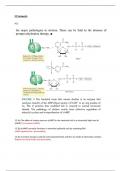
, 12.4) The R subunits of PKA inhibit the catalytic sites of the C subunits of PKA. High [cAMP]causes
[cAMP] to bind to the R subunits instead, leaving the C subunits available for substrate catalysis and
therefore activating PKA. If the R subunits of PKA do not bind inside the catalytic sites of the C
subunits of PKA, then PKA is always activated. This could be the case if the R subunit is too small or
the C subunit is too large. If the R subunit cannot bind [cAMP], the subunits won’t dissociate and PKA
is always inactive. The mutation makes R unable to bind and inhibit C, so C is constantly active. (b)
The mutation prevents cAMP binding to R, leaving C inhibited by bound R.
12.5) albuterol = ß-adrenergic agonist = ´hormone that triggers the receptor´, which is the first step
of the ß-adrenergic pathway, leading to the wished raise in [cAMP]. Side effect of too much [cAMP]
could be similar as for cholera. This medication could therefore be improved by adding cholera
medicine. Albuterol raises [cAMP], leading to relaxation and dilation of the bronchi and bronchioles.
Because β-adrenergic receptors control many other processes, this drug would have undesirable side
effects. To minimize these effects, find an agonist specific for the subtype of β-adrenergic receptors
found in bronchial smooth muscle.
12.6) – at low adrenaline blood levels hormone dissociates from its receptor, returning it to its
inactive form - hydrolysis of GTP to GDP returns the alfa subunit of the G protein to the beta and
gamma subunits, returning the inactive G protein Hormone degradation; hydrolysis of GTP bound to
a G protein; degradation, metabolism, or sequestration of second messenger; receptor
desensitization; removal of receptor from the cell surface.
H12
12.3a) The effect of cholera toxin on [cAMP] in the intestinal cells is a chronically high level of
[cAMP]. It increases [cAMP].
12.3b) [cAMP] normally functions in intestinal epithelial cells by activating PKA.
cAMP regulates Na + permeability.
12.3c) A cholera therapy could be restoring body fluids and Na+ by intake of electrolyte solution.
Replace lost body fluids and electrolytes.
, 12.4) The R subunits of PKA inhibit the catalytic sites of the C subunits of PKA. High [cAMP]causes
[cAMP] to bind to the R subunits instead, leaving the C subunits available for substrate catalysis and
therefore activating PKA. If the R subunits of PKA do not bind inside the catalytic sites of the C
subunits of PKA, then PKA is always activated. This could be the case if the R subunit is too small or
the C subunit is too large. If the R subunit cannot bind [cAMP], the subunits won’t dissociate and PKA
is always inactive. The mutation makes R unable to bind and inhibit C, so C is constantly active. (b)
The mutation prevents cAMP binding to R, leaving C inhibited by bound R.
12.5) albuterol = ß-adrenergic agonist = ´hormone that triggers the receptor´, which is the first step
of the ß-adrenergic pathway, leading to the wished raise in [cAMP]. Side effect of too much [cAMP]
could be similar as for cholera. This medication could therefore be improved by adding cholera
medicine. Albuterol raises [cAMP], leading to relaxation and dilation of the bronchi and bronchioles.
Because β-adrenergic receptors control many other processes, this drug would have undesirable side
effects. To minimize these effects, find an agonist specific for the subtype of β-adrenergic receptors
found in bronchial smooth muscle.
12.6) – at low adrenaline blood levels hormone dissociates from its receptor, returning it to its
inactive form - hydrolysis of GTP to GDP returns the alfa subunit of the G protein to the beta and
gamma subunits, returning the inactive G protein Hormone degradation; hydrolysis of GTP bound to
a G protein; degradation, metabolism, or sequestration of second messenger; receptor
desensitization; removal of receptor from the cell surface.



