CONSTRUCTING EUROPE (EUS1012)
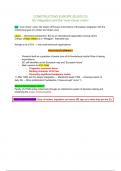
EU integration and the “ever-closer union”
Def: “ever-closer” union: the history of Europe is the history of European integration with the
overarching goal of a closer and closer union
Laczo → Alternative perspective: EU as an international organization among others
Critique of Mark Gilbert as a “Whiggish”, federalist bias
Already a lot of IO’s → only small technical organizations
Why is the EU different ?
- Presents itself as a guardian of peace (one of its foundational myths) Role of raising
expectations
- EC self-identifies as the European way and “European future”
- Main reasons for K.K. Patel
- Pragmatic economic focus
- Binding character of EU law
- Unusually significant budgetary means
⇒ After 1989: aim for deeper integration → Maastricht treaty 1992 → Growing impact on
daily life → More politicization/ backlashes (“close-enough” union ?)
What is the European Union ?
Family of 27 MS acting collectively through an institutional system of decision-making and
endorsing the acquis communautaire
Acquis communautaire: Body of treaties, legislation and norms MS sign up to when they join the EU
,MS share a set of shared common values based on democracy, human rights,.. (art.2 TEU)
, The Lisbon Treaty
Failure of the CT
- Failure of Dutch and French referenda
- More media coverage → more referendums because “hot topic”
- National and social worries for the voters (>< to a liberal and supranational EU)
- Compromise document → hard to sell
- People rejected parts that were already in the treaties
- Broader malaise and dissatisfaction with governments
Not that different treaty → still, only 18 ratified while 25 signed
⇒ We need a treaty though ! → How can we pass it and avoid referendas ?
How to avoid a referendum ?
Opperman factors
- European-level collusion between governments
- Changes in the domestic contexts of ratification during the “period of reflection”
- Different governments for the CT and Lisbon
- Gave time to discuss ratification out of electoral periods
- Lisbon attracted less media attention thanks to de-constitutionalization
strategies
- Governing strategies of depoliticisation
- Judicial: invoke court decision/advice to argue that it is bounded by law
- Rule-based: governments commit to certain objectives and argue that no
referendum is needed if they are met
- Compartmentalisation: Separate touchy issues from the Treaty (Danish
opt-outs; France and Turkish accession)
Impact of Lisbon Treaty
Institutions - More power to the EP (control over budget): categorized as
exclusive, shared and supportive
- European Citizen Initiative to tackle democratic deficit
- QMV extended/simplified to the whole Council (55% MS representing
65% of the population)
- Renaming of co-decision into the Ordinary Legislative procedure
- European Council and ECB become formal institutions
- EU is based on powers conferred by MS, enshrined in the treaties
and subject to subsidiarity and proportionality
⇒ MS have a right of action, consultation, support, recognition and
withdrawal
Policies - Every competences are communautarized (JHA, Energy, Tourism) →
End of the pillar structure
- CFSP as the only remaining intergovernmental pillar
- Charter of Fundamental Rights becomes binding
- Introduction of the function of High Representative for Foreign Affairs
(extension of the Minister of Foreign Affairs created in Amsterdam)
, Enlargement
EU integration and the “ever-closer union”
Def: “ever-closer” union: the history of Europe is the history of European integration with the
overarching goal of a closer and closer union
Laczo → Alternative perspective: EU as an international organization among others
Critique of Mark Gilbert as a “Whiggish”, federalist bias
Already a lot of IO’s → only small technical organizations
Why is the EU different ?
- Presents itself as a guardian of peace (one of its foundational myths) Role of raising
expectations
- EC self-identifies as the European way and “European future”
- Main reasons for K.K. Patel
- Pragmatic economic focus
- Binding character of EU law
- Unusually significant budgetary means
⇒ After 1989: aim for deeper integration → Maastricht treaty 1992 → Growing impact on
daily life → More politicization/ backlashes (“close-enough” union ?)
What is the European Union ?
Family of 27 MS acting collectively through an institutional system of decision-making and
endorsing the acquis communautaire
Acquis communautaire: Body of treaties, legislation and norms MS sign up to when they join the EU
,MS share a set of shared common values based on democracy, human rights,.. (art.2 TEU)
, The Lisbon Treaty
Failure of the CT
- Failure of Dutch and French referenda
- More media coverage → more referendums because “hot topic”
- National and social worries for the voters (>< to a liberal and supranational EU)
- Compromise document → hard to sell
- People rejected parts that were already in the treaties
- Broader malaise and dissatisfaction with governments
Not that different treaty → still, only 18 ratified while 25 signed
⇒ We need a treaty though ! → How can we pass it and avoid referendas ?
How to avoid a referendum ?
Opperman factors
- European-level collusion between governments
- Changes in the domestic contexts of ratification during the “period of reflection”
- Different governments for the CT and Lisbon
- Gave time to discuss ratification out of electoral periods
- Lisbon attracted less media attention thanks to de-constitutionalization
strategies
- Governing strategies of depoliticisation
- Judicial: invoke court decision/advice to argue that it is bounded by law
- Rule-based: governments commit to certain objectives and argue that no
referendum is needed if they are met
- Compartmentalisation: Separate touchy issues from the Treaty (Danish
opt-outs; France and Turkish accession)
Impact of Lisbon Treaty
Institutions - More power to the EP (control over budget): categorized as
exclusive, shared and supportive
- European Citizen Initiative to tackle democratic deficit
- QMV extended/simplified to the whole Council (55% MS representing
65% of the population)
- Renaming of co-decision into the Ordinary Legislative procedure
- European Council and ECB become formal institutions
- EU is based on powers conferred by MS, enshrined in the treaties
and subject to subsidiarity and proportionality
⇒ MS have a right of action, consultation, support, recognition and
withdrawal
Policies - Every competences are communautarized (JHA, Energy, Tourism) →
End of the pillar structure
- CFSP as the only remaining intergovernmental pillar
- Charter of Fundamental Rights becomes binding
- Introduction of the function of High Representative for Foreign Affairs
(extension of the Minister of Foreign Affairs created in Amsterdam)
, Enlargement