Chapter 12 Operations strategy and international
operations
The purpose and nature of strategy
Achieving competitive advantage
Competitive advantage = way in which a firm designs its operation, or other activities, so that it
maintains a revenue streams and sustains its position relative to other firms in the same marketplace
Cash flow = rate at which money is flowing into the firm from customers and flowing out of the firm
to debtors (such as suppliers, employees and landlords)
The role of operations is therefore to make sure processes are as efficient as possible, to maximize
the margin between direct costs and sales price and create profit
Operations need to operate sufficiently well to get the basics right (positive cash flow and sufficiently
high margin) & support competitive advantage through the delivery of order winners (either by
delivering these order winners better than competitors, or by delivering a different set of order
winners or a combi of these)
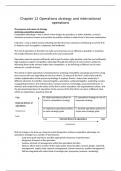
The extent to which operations is fundamental to achieving competitive advantage and a firm’s long
term success will vary depending on two key criteria: (1) nature of the firm’s value chain and the
relative sophistication of the process technology it employs (Porter’s value chain model has 9
different elements (5 activities: inbound logistics, operations, outbound logistics, marketing, service;
4 supporting functions: firm infrastructure, human resources, technology, procurement)) & (2) is
internal, and compromises the values of the firm’s senior executives, the organizational culture, and
the perceived importance of operations to the success of the firm (firms can have 4 different roles
within an organization: quadrant A,B,C,D)
High B: adapt operations policies to D: operations strategy at core of
react to competitors strategy corporate strategy
External drivers of
operations
A: implement operations policies C: develop operations policies to
(Importance) to meet strategic goals create new strategic goals
Low
Low Internal drivers of operations High
(Importance)
Role of strategy is to draw up a long-term plan designed to achieve competitive advantage. An
operations strategy has a number of key features:
- Long-term goals and hence specifies appropriate measures of performance
- Integrates all aspect of the operation
- Involves all levels of management within the operations function
- Likely to affect and/or involve all the major policy areas (location, process design, materials
management, supply chain, capacity management, human resources, quality management)
- Will be integrated with other kinds of strategic plan (corporate, business, marketing)
, Levels of strategic planning and implementation
At 3 levels:
- Corporate strategy – devised by a large organizations in order to provide an overall plan
- Business strategy – different companies within one big organization have different business
strategies
- Functional strategy – for example marketing strategy, operations strategy, human resource
strategy
Small businesses do not always engage in all three levels of planning, do mostly do not have
the different departments such as marketing and HR, so functional strategy is not necessary
Manufacturing strategy
Berry and Hill propose that manufacturing strategy is essentially an approach to manufacturing
planning and control that integrates market objectives, process choice and the organizations
infrastructure. Hence they identify elements of manufacturing strategy as:
- Process choice issues (choice of job-shop, batch or mass production; process positioning;
capacity decisions; role of inventory)
- Infrastructure issues (role of support functions; planning and control systems; quality
assurance and control; systems engineering; clerical processes; payment systems; work
scheduling; organizational structure)
Academic perspectives on strategic operations
Market-driven view
Strategy is largely driven by the market and external, environmental influences (rivalry between
firms, the power of customers and suppliers, the threat of new entrants into the market and threat
of new products)
Resource-based view
Strategy is largely determined from within the organization, due to the resources that it has under its
control. So firms develop competitive advantage from a set of particular resources – such as assets,
processes or knowledge – that acquire value and become difficult to imitate
Within the industry and commerce, most managers adopt both viewpoints and develop
strategies based on market analysis and their core competencies
Business models
Business model = all the factors that describe a business, included the market served, how it creates
value, and the factors that will sustain it over the long term
The best way to differentiate between a business model and strategy, is that a business model is
planned while business strategies are emergent and/or dynamic
Christensen (2016) states that the business model is made out of 4 elements:
1. Customer value proposition -what the company provides that meets specific customer needs
(in effect their order winners)
2. Profit formula – how the company makes money out of delivering the proposition (includes
how it manages its inventory and capacity)
3. Key processes – the way in which the firm operates in order to deliver the proposition to the
customer (what processes its adopts, how it manages the service encounter, and manages
quality)
operations
The purpose and nature of strategy
Achieving competitive advantage
Competitive advantage = way in which a firm designs its operation, or other activities, so that it
maintains a revenue streams and sustains its position relative to other firms in the same marketplace
Cash flow = rate at which money is flowing into the firm from customers and flowing out of the firm
to debtors (such as suppliers, employees and landlords)
The role of operations is therefore to make sure processes are as efficient as possible, to maximize
the margin between direct costs and sales price and create profit
Operations need to operate sufficiently well to get the basics right (positive cash flow and sufficiently
high margin) & support competitive advantage through the delivery of order winners (either by
delivering these order winners better than competitors, or by delivering a different set of order
winners or a combi of these)
The extent to which operations is fundamental to achieving competitive advantage and a firm’s long
term success will vary depending on two key criteria: (1) nature of the firm’s value chain and the
relative sophistication of the process technology it employs (Porter’s value chain model has 9
different elements (5 activities: inbound logistics, operations, outbound logistics, marketing, service;
4 supporting functions: firm infrastructure, human resources, technology, procurement)) & (2) is
internal, and compromises the values of the firm’s senior executives, the organizational culture, and
the perceived importance of operations to the success of the firm (firms can have 4 different roles
within an organization: quadrant A,B,C,D)
High B: adapt operations policies to D: operations strategy at core of
react to competitors strategy corporate strategy
External drivers of
operations
A: implement operations policies C: develop operations policies to
(Importance) to meet strategic goals create new strategic goals
Low
Low Internal drivers of operations High
(Importance)
Role of strategy is to draw up a long-term plan designed to achieve competitive advantage. An
operations strategy has a number of key features:
- Long-term goals and hence specifies appropriate measures of performance
- Integrates all aspect of the operation
- Involves all levels of management within the operations function
- Likely to affect and/or involve all the major policy areas (location, process design, materials
management, supply chain, capacity management, human resources, quality management)
- Will be integrated with other kinds of strategic plan (corporate, business, marketing)
, Levels of strategic planning and implementation
At 3 levels:
- Corporate strategy – devised by a large organizations in order to provide an overall plan
- Business strategy – different companies within one big organization have different business
strategies
- Functional strategy – for example marketing strategy, operations strategy, human resource
strategy
Small businesses do not always engage in all three levels of planning, do mostly do not have
the different departments such as marketing and HR, so functional strategy is not necessary
Manufacturing strategy
Berry and Hill propose that manufacturing strategy is essentially an approach to manufacturing
planning and control that integrates market objectives, process choice and the organizations
infrastructure. Hence they identify elements of manufacturing strategy as:
- Process choice issues (choice of job-shop, batch or mass production; process positioning;
capacity decisions; role of inventory)
- Infrastructure issues (role of support functions; planning and control systems; quality
assurance and control; systems engineering; clerical processes; payment systems; work
scheduling; organizational structure)
Academic perspectives on strategic operations
Market-driven view
Strategy is largely driven by the market and external, environmental influences (rivalry between
firms, the power of customers and suppliers, the threat of new entrants into the market and threat
of new products)
Resource-based view
Strategy is largely determined from within the organization, due to the resources that it has under its
control. So firms develop competitive advantage from a set of particular resources – such as assets,
processes or knowledge – that acquire value and become difficult to imitate
Within the industry and commerce, most managers adopt both viewpoints and develop
strategies based on market analysis and their core competencies
Business models
Business model = all the factors that describe a business, included the market served, how it creates
value, and the factors that will sustain it over the long term
The best way to differentiate between a business model and strategy, is that a business model is
planned while business strategies are emergent and/or dynamic
Christensen (2016) states that the business model is made out of 4 elements:
1. Customer value proposition -what the company provides that meets specific customer needs
(in effect their order winners)
2. Profit formula – how the company makes money out of delivering the proposition (includes
how it manages its inventory and capacity)
3. Key processes – the way in which the firm operates in order to deliver the proposition to the
customer (what processes its adopts, how it manages the service encounter, and manages
quality)