

BUSINESS
DATE: WEEK 1
ANALYTICS
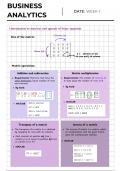
1.Introduction to matrices and systems of linear equations
Columns (n)
Size of the matrix:
Rows (m)
X ij - element on the
i-th row and j-th column
Matrix operations
Addition and subtraction Matrix multiplication
Requirements: Matrices must have the Requirements: The number of columns in
same dimensions (same number of rows A must equal the number of rows in B.
and columns)
By hand:
By hand:
MATLAB
MATLAB
Transpose of a matrix Inverse of a matrix
The transpose of a matrix A is obtained The inverse of matrix is a matrix, which
by swapping its rows with its columns. on multiplication with the given matrix
gives the multiplicative identity
Each element at position aij (row i,
column j) in A moves to position aji (row
j), column (i) in AT MATLAB
MATLAB
, BUSINESS
DATE: WEEK 2
ANALYTICS
2. Solution to systems of linear equations
System of Geometric Number of
Case
Equations Interpretation Solutions
This system consists
of two independent
linear equations.
One Solution The two equations Unique solution
represent two lines
that intersect at
exactly one point
The second equation
is just a multiple of Since every point on
the first equation this line is a
Infinitely
(i.e., it's not solution, there are
Many
independent). infinitely many
Solutions
This means both solutions.
equations represent
the same line.
Here, both equations
represent parallel
lines with different
Therefore, this
intercepts
No Solution system has no
Parallel lines never
solution
intersect, meaning
there is no common
solution
2.1 Reduction of systems of linear equations
Reducing a system of linear equations
means transforming it into a simpler
equivalent system that is easier to solve.
This is typically done using row operations
to bring the system into a more
manageable form, such as row echelon
form (REF) or reduced row echelon form
(RREF).
DATE: WEEK 1
ANALYTICS
1.Introduction to matrices and systems of linear equations
Columns (n)
Size of the matrix:
Rows (m)
X ij - element on the
i-th row and j-th column
Matrix operations
Addition and subtraction Matrix multiplication
Requirements: Matrices must have the Requirements: The number of columns in
same dimensions (same number of rows A must equal the number of rows in B.
and columns)
By hand:
By hand:
MATLAB
MATLAB
Transpose of a matrix Inverse of a matrix
The transpose of a matrix A is obtained The inverse of matrix is a matrix, which
by swapping its rows with its columns. on multiplication with the given matrix
gives the multiplicative identity
Each element at position aij (row i,
column j) in A moves to position aji (row
j), column (i) in AT MATLAB
MATLAB
, BUSINESS
DATE: WEEK 2
ANALYTICS
2. Solution to systems of linear equations
System of Geometric Number of
Case
Equations Interpretation Solutions
This system consists
of two independent
linear equations.
One Solution The two equations Unique solution
represent two lines
that intersect at
exactly one point
The second equation
is just a multiple of Since every point on
the first equation this line is a
Infinitely
(i.e., it's not solution, there are
Many
independent). infinitely many
Solutions
This means both solutions.
equations represent
the same line.
Here, both equations
represent parallel
lines with different
Therefore, this
intercepts
No Solution system has no
Parallel lines never
solution
intersect, meaning
there is no common
solution
2.1 Reduction of systems of linear equations
Reducing a system of linear equations
means transforming it into a simpler
equivalent system that is easier to solve.
This is typically done using row operations
to bring the system into a more
manageable form, such as row echelon
form (REF) or reduced row echelon form
(RREF).



