LECTURE II.1
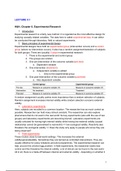
H&H, Chapter 8, Experimental Research
1. Introduction
Experimental research is a fairly new method. It is regarded as the most effective design for
studying causally related variables. The data here is called experimental data. It can either
be conducted through laboratory, field or natural experiments.
2. Basic principles of experimental design
Experimental designs have both an experimental group (intervention occurs) and a control
group (where no intervention occurs). It also has a random assignment/selection of subjects
for both groups. There are (usually) 5 steps in experimental research:
1. There is the experimental and control group
2. The groups are random
3. One pre-intervention of the outcome variable (pre-test)
a. Dependent variable
4. One intervention (treatment)
a. Independent variable is added
i. Only to the experimental group
5. One post-intervention of the outcome variable (post-test)
a. Also dependent variable
A random assignment usually carries more importance than a random selection of subjects.
Random assignment increases internal validity while random selection concerns external
validity.
3. Laboratory experiments
Here, subjects are recruited to a common location. The researcher has as much control as
possible. Researcher can hold many stimuli constant. The researcher can also explore
phenomena that do not exist in the real world. Survey experiments (also with the use of two
groups) and laboratory experiments are becoming blurred. Laboratory experiments are
usually criticised for having high internal validity while having low external validity (causal
relationship cannot be generalised to real-world) => low ecological validity. Reactivity also
threatens the ecological validity => Does the study only apply to people who know they are
being observed?
4. Field experiments
These involve close-to-real-world settings. This increases the external
validity/generalisability. Sometimes they are termed as controlled interventions. They are
usually effective for policy initiatives and pilot programmes. The experimental research can
help uncover the chicken-egg problem. In field-experiments, the researcher exerts less
control and this threatens the internal validity; a lot of stimuli can be found in the real world.
All in all, there is a trade-off between internal and external validity - depending on whether it
1
,is field or laboratory research design. One should, therefore, use both laboratory and field
experiments to ensure both external and internal validity.
5. Natural experiments
This research relies on naturally occurring events - thus, not controlled by the researcher. An
example is the attitude of affluent people on estate tax and redistribution. Experiments of this
type is discovered rather than designed. The artificiality and some ethical issues are
eliminated through this approach. True randomization (of allocation to groups) occurs only
with a randomisation device with a known probability distribution (an example is the lottery
studies - think the conscription study) => True randomization is not used in natural
experiments - rather as-if randomization is used.
6. Issues with experimental research
It is the most scientific approach, however, not always suited because of ethical and
practical (because of the political science complexity) issues. It is better for political scientists
to answer narrow and traceable questions through the experimental design. Professional
considerations must also be taken into account. This is best aided through reliability and
verification (allowing transparency). Also, one must strive to eliminate publication bias - the
bias towards significant results. Null results can be equally important!
LECTURE II.2
Gerring - What is a case study?
There is much confusion concerning the meaning of a case study research.
1. Definitions
(19) A case connotes a spatially delimited phenomenon - either at one point in time or over
some period in time. It must have identifiable boundaries. (20) Some times the temporal and
spatial boundaries of a case can be more or less defined. A cross-case is the focus on a
sample of cases rather than an individual case (here, individual cases are not studied
intensively). The units of a case study is not perfectly representative. An observation is the
element of empirical endeavour. An observation may have several dimension; each which
may be measured as a variable. (21) In a case study, there is always more than one
observation. There is a distinction between a sample of cases and a series of cases. A
sample of cases is usually larger, the individual cases are studied less intensively and their
objective is usually representation. (22) One can use both a single case and a sample of
cases simultaneously. A population is the breadth and scope of a proposition of which the
sample of cases is drawn (although a sample and population may be identical). (26) To
know whether something is a case study or cross-case study it may be useful to ask (a) how
many cases are being studied and (b) how intensively are the cases studied.
2. A typology of covariational research design
(27) The ones shaded in grey are types of case study:
2
, => (29) What you use
always depend on the proposition/hypothesis
3. The N-Question
(30) N=number of observation, or the number of cases. The fewer cases usually the more
observations are being studied. The case study is open to both qualitative and quantitative
methods.
4. The style of analysis
(33) A non-case study is quantitative (statistical) by nature. Case studies are usually
qualitative. (36) By definition, large-N-cross-case is quantitative. The qualitative methods has
methodological affinity to case studies, however, it is not a definitional entailment - case
studies may use both quantitative and qualitative methods or both.
H&H, Chapter 9, Comparative Research
1. Introduction
Comparative politics is a methodological approach. There are three main approaches:
large-N, small-N and single-N studies.
2. The principles of comparison
All empirical research is comparative. However, the comparative method usually refers to
social or political aggregates (as points of comparison) rather than individuals. Comparison
is useful if it can be theoretically justified. Comparative methods can be used in three ways:
to test a theory, to apply new cases to theory, or to develop new theories/hypothesis. There
is a twin danger of which comparative methods is an advantage: false uniqueness and false
universalism. False uniqueness refers to when the case in question is actually not as unique
as the researcher claims. False universalism refers to when the researcher claims a broader
(but false) applicability of the theory tested. Comparison can be descriptive: in which cases
does the theory apply?
3. How we compare
Small-N is better for generating a hypothesis, while large-N can also (better) test these
hypotheses.
4. Case study
By studying on a single case the case can be intensively examined. They are (the good
ones) nearly always situated in a comparative context. Also, good ones say something
meaningful for a more general context/phenomena. Good case studies must be both
3
H&H, Chapter 8, Experimental Research
1. Introduction
Experimental research is a fairly new method. It is regarded as the most effective design for
studying causally related variables. The data here is called experimental data. It can either
be conducted through laboratory, field or natural experiments.
2. Basic principles of experimental design
Experimental designs have both an experimental group (intervention occurs) and a control
group (where no intervention occurs). It also has a random assignment/selection of subjects
for both groups. There are (usually) 5 steps in experimental research:
1. There is the experimental and control group
2. The groups are random
3. One pre-intervention of the outcome variable (pre-test)
a. Dependent variable
4. One intervention (treatment)
a. Independent variable is added
i. Only to the experimental group
5. One post-intervention of the outcome variable (post-test)
a. Also dependent variable
A random assignment usually carries more importance than a random selection of subjects.
Random assignment increases internal validity while random selection concerns external
validity.
3. Laboratory experiments
Here, subjects are recruited to a common location. The researcher has as much control as
possible. Researcher can hold many stimuli constant. The researcher can also explore
phenomena that do not exist in the real world. Survey experiments (also with the use of two
groups) and laboratory experiments are becoming blurred. Laboratory experiments are
usually criticised for having high internal validity while having low external validity (causal
relationship cannot be generalised to real-world) => low ecological validity. Reactivity also
threatens the ecological validity => Does the study only apply to people who know they are
being observed?
4. Field experiments
These involve close-to-real-world settings. This increases the external
validity/generalisability. Sometimes they are termed as controlled interventions. They are
usually effective for policy initiatives and pilot programmes. The experimental research can
help uncover the chicken-egg problem. In field-experiments, the researcher exerts less
control and this threatens the internal validity; a lot of stimuli can be found in the real world.
All in all, there is a trade-off between internal and external validity - depending on whether it
1
,is field or laboratory research design. One should, therefore, use both laboratory and field
experiments to ensure both external and internal validity.
5. Natural experiments
This research relies on naturally occurring events - thus, not controlled by the researcher. An
example is the attitude of affluent people on estate tax and redistribution. Experiments of this
type is discovered rather than designed. The artificiality and some ethical issues are
eliminated through this approach. True randomization (of allocation to groups) occurs only
with a randomisation device with a known probability distribution (an example is the lottery
studies - think the conscription study) => True randomization is not used in natural
experiments - rather as-if randomization is used.
6. Issues with experimental research
It is the most scientific approach, however, not always suited because of ethical and
practical (because of the political science complexity) issues. It is better for political scientists
to answer narrow and traceable questions through the experimental design. Professional
considerations must also be taken into account. This is best aided through reliability and
verification (allowing transparency). Also, one must strive to eliminate publication bias - the
bias towards significant results. Null results can be equally important!
LECTURE II.2
Gerring - What is a case study?
There is much confusion concerning the meaning of a case study research.
1. Definitions
(19) A case connotes a spatially delimited phenomenon - either at one point in time or over
some period in time. It must have identifiable boundaries. (20) Some times the temporal and
spatial boundaries of a case can be more or less defined. A cross-case is the focus on a
sample of cases rather than an individual case (here, individual cases are not studied
intensively). The units of a case study is not perfectly representative. An observation is the
element of empirical endeavour. An observation may have several dimension; each which
may be measured as a variable. (21) In a case study, there is always more than one
observation. There is a distinction between a sample of cases and a series of cases. A
sample of cases is usually larger, the individual cases are studied less intensively and their
objective is usually representation. (22) One can use both a single case and a sample of
cases simultaneously. A population is the breadth and scope of a proposition of which the
sample of cases is drawn (although a sample and population may be identical). (26) To
know whether something is a case study or cross-case study it may be useful to ask (a) how
many cases are being studied and (b) how intensively are the cases studied.
2. A typology of covariational research design
(27) The ones shaded in grey are types of case study:
2
, => (29) What you use
always depend on the proposition/hypothesis
3. The N-Question
(30) N=number of observation, or the number of cases. The fewer cases usually the more
observations are being studied. The case study is open to both qualitative and quantitative
methods.
4. The style of analysis
(33) A non-case study is quantitative (statistical) by nature. Case studies are usually
qualitative. (36) By definition, large-N-cross-case is quantitative. The qualitative methods has
methodological affinity to case studies, however, it is not a definitional entailment - case
studies may use both quantitative and qualitative methods or both.
H&H, Chapter 9, Comparative Research
1. Introduction
Comparative politics is a methodological approach. There are three main approaches:
large-N, small-N and single-N studies.
2. The principles of comparison
All empirical research is comparative. However, the comparative method usually refers to
social or political aggregates (as points of comparison) rather than individuals. Comparison
is useful if it can be theoretically justified. Comparative methods can be used in three ways:
to test a theory, to apply new cases to theory, or to develop new theories/hypothesis. There
is a twin danger of which comparative methods is an advantage: false uniqueness and false
universalism. False uniqueness refers to when the case in question is actually not as unique
as the researcher claims. False universalism refers to when the researcher claims a broader
(but false) applicability of the theory tested. Comparison can be descriptive: in which cases
does the theory apply?
3. How we compare
Small-N is better for generating a hypothesis, while large-N can also (better) test these
hypotheses.
4. Case study
By studying on a single case the case can be intensively examined. They are (the good
ones) nearly always situated in a comparative context. Also, good ones say something
meaningful for a more general context/phenomena. Good case studies must be both
3