Lean Manufacturing lecture 1 (chapter 2+3) – introduction,
value and waste
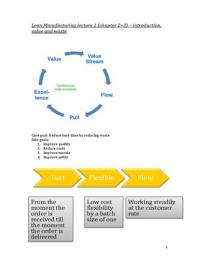
Value
Value
Stream
Continuous
improvement
Excel-
Flow
lence
Pull
Core goal: Reduce lead-time by reducing waste
Side goals:
1. Improve quality
2. Reduce costs
3. Improve morale
4. Improve safety
Fast Flexible Flow
From the Low cost Working steadily
moment the flexibility at the customer
order is by a batch rate
received till size of one
the moment
the order is
delivered
1
,Lean – eliminating wastes => typically 95% of total lead time is non-value added
7 wastes (TIMWOOD) => Muda’s (Type I: Necessary, Type II: avoidable)
1. Transportation
2. Inventory
3. Motion
4. Waiting
5. Overproduction -> Worst wastes since it includes all others
6. (Over) processing
7. Defects
5 lean principles:
1. Specify the value by the point of view of the customer
2. Value stream (map and measure performance of the value stream end-to-
end, you’re only as good as the weakest link in the supply chain).
3. Flow (make value flow, avoid batch and queue or parallel batches/queues
4. Pull (short-term response to customer, only operate when needed)
5. Excellence (continuously improve).
Lean terms:
Mura -> unevenness is the process
Muri -> heavy burden (unreasonableness)
Muda -> unnecessary/waste (can be objects, opposite of
gembutsu/gemba, or steps in the process)
Gemba -> place where value is added (production plant)
4 steps: Focused on actuals from the workplace (gemba) rather than opinions
gathered from the office:
1. Go to the actual workplace
2. Look at the actual process
3. Observe what is actually happening
4. Collect the actual data
Gembutsu -> tangible objects at the gemba (machinery, tools, etc.)
Toyota way
Jidoka:
1. Automation with a human touch
2. Quality is built in during the process
3. When a problem occurs, the equipment stops immediately to prevent
defective products
4. Prerequisite for Just-in-Time to work
5. Problem communication board (andon)
Just-in-Time:
1. Make only what is needed
2
, 2. Minimize presence of non-value-adding operations
3. Optimize kanban systems
Kaizen: Continuous improvement
Reduction of lead time by applying these rules:
1. 0.05 to 5 rule: many industries value is added for between 0.05 to 5% of
the time
2. 3/3 rule: Wait time is split in three ways;
a. Waiting for completion of batch
b. Waiting for rework
c. Waiting for management decisions
3. The ¼-2-20 rule: every quartering of total completion time there is
doubling of productivity and 20% cost reduction
4. 3 x 2 rule: time based competitors enjoy 3x the average growth rate and
2x the average profit margins
Lean manufacturing lecture 2 (chapter 5) – strategy, planning
and deployment
Product process matrix page 50!
Manufacturing strategies:
1. Make-to-Stock (MTS) => cookies, chocolate bars
a. Produce to keep inventory at a satisfactory level
b. Forecasting is extremely important
c. Lead-time= order processing + delivery time
2. Assemble-to-Order/Built-to-Order (ATO/BTO) => Dell
a. Receive order before assembling the product from components
b. Lead-time= order processing + assembling time + delivery
3. Make-to-Order => packaging machines
a. Receive an order before producing the product
b. Lead-time: order processing + production + delivery
4. Engineer-to-Order => luxury yachts
a. Design, engineer and produce the product to customer specs
after receiving the order
b. Lead-time: order processing + engineering + ordering (materials)
+ manufacturing + installation/delivery
3
, Customer Order Decoupling Point (CODP
Moment in the process where the product becomes customer specific.
Kano analysis – measurement tool to prioritize customer requirements
1. ‘Surprise & delight’ factors => make your product stand out
2. More is better
3. Must be things => internet, camera, etc. on phones
4. Dissatisfiers
4
value and waste
Value
Value
Stream
Continuous
improvement
Excel-
Flow
lence
Pull
Core goal: Reduce lead-time by reducing waste
Side goals:
1. Improve quality
2. Reduce costs
3. Improve morale
4. Improve safety
Fast Flexible Flow
From the Low cost Working steadily
moment the flexibility at the customer
order is by a batch rate
received till size of one
the moment
the order is
delivered
1
,Lean – eliminating wastes => typically 95% of total lead time is non-value added
7 wastes (TIMWOOD) => Muda’s (Type I: Necessary, Type II: avoidable)
1. Transportation
2. Inventory
3. Motion
4. Waiting
5. Overproduction -> Worst wastes since it includes all others
6. (Over) processing
7. Defects
5 lean principles:
1. Specify the value by the point of view of the customer
2. Value stream (map and measure performance of the value stream end-to-
end, you’re only as good as the weakest link in the supply chain).
3. Flow (make value flow, avoid batch and queue or parallel batches/queues
4. Pull (short-term response to customer, only operate when needed)
5. Excellence (continuously improve).
Lean terms:
Mura -> unevenness is the process
Muri -> heavy burden (unreasonableness)
Muda -> unnecessary/waste (can be objects, opposite of
gembutsu/gemba, or steps in the process)
Gemba -> place where value is added (production plant)
4 steps: Focused on actuals from the workplace (gemba) rather than opinions
gathered from the office:
1. Go to the actual workplace
2. Look at the actual process
3. Observe what is actually happening
4. Collect the actual data
Gembutsu -> tangible objects at the gemba (machinery, tools, etc.)
Toyota way
Jidoka:
1. Automation with a human touch
2. Quality is built in during the process
3. When a problem occurs, the equipment stops immediately to prevent
defective products
4. Prerequisite for Just-in-Time to work
5. Problem communication board (andon)
Just-in-Time:
1. Make only what is needed
2
, 2. Minimize presence of non-value-adding operations
3. Optimize kanban systems
Kaizen: Continuous improvement
Reduction of lead time by applying these rules:
1. 0.05 to 5 rule: many industries value is added for between 0.05 to 5% of
the time
2. 3/3 rule: Wait time is split in three ways;
a. Waiting for completion of batch
b. Waiting for rework
c. Waiting for management decisions
3. The ¼-2-20 rule: every quartering of total completion time there is
doubling of productivity and 20% cost reduction
4. 3 x 2 rule: time based competitors enjoy 3x the average growth rate and
2x the average profit margins
Lean manufacturing lecture 2 (chapter 5) – strategy, planning
and deployment
Product process matrix page 50!
Manufacturing strategies:
1. Make-to-Stock (MTS) => cookies, chocolate bars
a. Produce to keep inventory at a satisfactory level
b. Forecasting is extremely important
c. Lead-time= order processing + delivery time
2. Assemble-to-Order/Built-to-Order (ATO/BTO) => Dell
a. Receive order before assembling the product from components
b. Lead-time= order processing + assembling time + delivery
3. Make-to-Order => packaging machines
a. Receive an order before producing the product
b. Lead-time: order processing + production + delivery
4. Engineer-to-Order => luxury yachts
a. Design, engineer and produce the product to customer specs
after receiving the order
b. Lead-time: order processing + engineering + ordering (materials)
+ manufacturing + installation/delivery
3
, Customer Order Decoupling Point (CODP
Moment in the process where the product becomes customer specific.
Kano analysis – measurement tool to prioritize customer requirements
1. ‘Surprise & delight’ factors => make your product stand out
2. More is better
3. Must be things => internet, camera, etc. on phones
4. Dissatisfiers
4