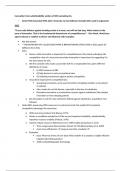
Innovation from substitutability section of Wk3 sustaining CA.
- Some FMA (innovate)/SMA (don't innovate, be fast follower instead) often used in arguments
2022
“If your only defence against invading armies is a moat, you will not last long. What matters is the
pace of innovation. That is the fundamental determinant of competitiveness” – Elon Musk. Would you
agree? Discuss in relation to theory and illustrate with examples.
Not bad answer
**PLEASE REVIEW MY COLLECTIONS PAPER & BRAINSTORMED STRUCTURE of 2022 paper Q4
(different from this)
Intro:
o Stance: while innovation is important for competitiveness, Elon Musk underplays the
competitive value of a moat and overstates innovation's importance by suggesting it is
the only means for SCA.
o We first consider why moats can provide SCA for a respectable time, given different
definitions of moats
(i) VRIN resource in RBV
(ii) high barriers to entry in positional view
(iii) isolating mechanisms against perfect competition
o Innovation important for competitiveness:
Sustaining innovation can be used to further strengthen position as incumbent
in industry
Also, moats do not last forever, especially in the face of substitutes
Disruptive innovation as a protection measure against substitutes (then deploy
innovation or have sleeping patent)
o But innovation is not the only method to defend against substitutes: acquisitions, fast
follower
Under RBV, possessing VRIN resources is an inherent moat that enable SCA (sustained
competitive advantage) for some time
o VRIN resources produce SCA (Barney 1991)
o Moats as conditions needed for CA like ex post imperfect imitability, substitutability;
imperfect resource mobility (Peteraf, 1993)
o Hard to imitate resources (Dierickx & Cool, 1989) enable persistence in rents
Time compression diseconomies: Brand, US CPG (Bronnenberg et al. 2009)
Asset mass efficiencies: VC Sequoia and a16z, incubator YC
o Examples:
Data: Meta has troves of user data which enables it to produce a highly effective
targeted advertising product
ASML's photolithography technology
, Da Beer's diamond mine control
Samsung's OLED displays to smartphone market
GE's power generator and jet engine business require advanced materials and
turbine engineering
Under positional view, moat is high barriers to entry to a profitable industry with favourable
market structure
o Porter's 5 forces (Porter, 1979)
o Inter-industry variation (McGahan & Porter 1997)
o Persistence of performance higher in some industries given industry structure like high
R&D intensity, EoS, switching costs, skill, few firms (Waring 1996)
o Examples:
Profitable pharma vs unprofitable airlines
Aerospace: high capital requirements, regulatory hurdles, IP and expertise
needed to build a SpaceX competitor
Predatory pricing: Lawsuit filed by traditional taxi company Flywheel Taxi in San
Francisco against Uber for predatory pricing, offering rides at a loss to dominate
the market and chase out competitors
More generally, moats as isolating mechanisms that impede perfect competition
o Barriers to imitation: legal restrictions, superior access to scarce input/ customers, EoS
and limited market size, intangible barriers like historical circumstance, social
complexity, Early mover advantages: learning curve, brand, switching costs, network
effects (Besanko et al, 2007)
o Examples:
Superior access to scarce input:
De Beers historically had superior access to scarce diamond mines,
allowing them to control a significant portion of the global diamond
supply
Spotify’s deals and relationships with large music labels, especially in
the early days where music labels were hesitant to allow their music to
be streamed enabled Spotify to gain dominance.
Switching costs: Enterprise software Oracle/ SAP/ Salesforce
Superior access to scarce customers: Coca-Cola's retail partnerships, global
distribution network enables it to put new products in front of customers at
scale more cheaply and quickly.
Legal examples: patents in pharmaceuticals, legal route rights for airlines
EoS and limited market size: Walmart in rural towns that can only support one
large supermarket
Network effects: social media companies TikTok
Superior access to scarce input: D&B credit information in 19 th century
But sustaining innovation can be used to further strengthen position as incumbent in industry
o Same as below
- Some FMA (innovate)/SMA (don't innovate, be fast follower instead) often used in arguments
2022
“If your only defence against invading armies is a moat, you will not last long. What matters is the
pace of innovation. That is the fundamental determinant of competitiveness” – Elon Musk. Would you
agree? Discuss in relation to theory and illustrate with examples.
Not bad answer
**PLEASE REVIEW MY COLLECTIONS PAPER & BRAINSTORMED STRUCTURE of 2022 paper Q4
(different from this)
Intro:
o Stance: while innovation is important for competitiveness, Elon Musk underplays the
competitive value of a moat and overstates innovation's importance by suggesting it is
the only means for SCA.
o We first consider why moats can provide SCA for a respectable time, given different
definitions of moats
(i) VRIN resource in RBV
(ii) high barriers to entry in positional view
(iii) isolating mechanisms against perfect competition
o Innovation important for competitiveness:
Sustaining innovation can be used to further strengthen position as incumbent
in industry
Also, moats do not last forever, especially in the face of substitutes
Disruptive innovation as a protection measure against substitutes (then deploy
innovation or have sleeping patent)
o But innovation is not the only method to defend against substitutes: acquisitions, fast
follower
Under RBV, possessing VRIN resources is an inherent moat that enable SCA (sustained
competitive advantage) for some time
o VRIN resources produce SCA (Barney 1991)
o Moats as conditions needed for CA like ex post imperfect imitability, substitutability;
imperfect resource mobility (Peteraf, 1993)
o Hard to imitate resources (Dierickx & Cool, 1989) enable persistence in rents
Time compression diseconomies: Brand, US CPG (Bronnenberg et al. 2009)
Asset mass efficiencies: VC Sequoia and a16z, incubator YC
o Examples:
Data: Meta has troves of user data which enables it to produce a highly effective
targeted advertising product
ASML's photolithography technology
, Da Beer's diamond mine control
Samsung's OLED displays to smartphone market
GE's power generator and jet engine business require advanced materials and
turbine engineering
Under positional view, moat is high barriers to entry to a profitable industry with favourable
market structure
o Porter's 5 forces (Porter, 1979)
o Inter-industry variation (McGahan & Porter 1997)
o Persistence of performance higher in some industries given industry structure like high
R&D intensity, EoS, switching costs, skill, few firms (Waring 1996)
o Examples:
Profitable pharma vs unprofitable airlines
Aerospace: high capital requirements, regulatory hurdles, IP and expertise
needed to build a SpaceX competitor
Predatory pricing: Lawsuit filed by traditional taxi company Flywheel Taxi in San
Francisco against Uber for predatory pricing, offering rides at a loss to dominate
the market and chase out competitors
More generally, moats as isolating mechanisms that impede perfect competition
o Barriers to imitation: legal restrictions, superior access to scarce input/ customers, EoS
and limited market size, intangible barriers like historical circumstance, social
complexity, Early mover advantages: learning curve, brand, switching costs, network
effects (Besanko et al, 2007)
o Examples:
Superior access to scarce input:
De Beers historically had superior access to scarce diamond mines,
allowing them to control a significant portion of the global diamond
supply
Spotify’s deals and relationships with large music labels, especially in
the early days where music labels were hesitant to allow their music to
be streamed enabled Spotify to gain dominance.
Switching costs: Enterprise software Oracle/ SAP/ Salesforce
Superior access to scarce customers: Coca-Cola's retail partnerships, global
distribution network enables it to put new products in front of customers at
scale more cheaply and quickly.
Legal examples: patents in pharmaceuticals, legal route rights for airlines
EoS and limited market size: Walmart in rural towns that can only support one
large supermarket
Network effects: social media companies TikTok
Superior access to scarce input: D&B credit information in 19 th century
But sustaining innovation can be used to further strengthen position as incumbent in industry
o Same as below