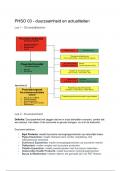
Kidneys Hormones Reproduction Nervous Systems Cardiovascular Systems
Explain the mechanisms utilised by the kidney to maintain potassium homeostasis (Q2,
2018)
Potassium ions in the highest concentration in the intracellular areas (150 mEq/L)
o Established by sodium-potassium ATPase
o 3 sodium out for every 2 potassium in using ATP
o Maintains concentrations that are disrupted by leaky channels
o Also establishes resting potential
Normal extracellular potassium concentrations are between 3.5-5.5 mEq/L
Kidneys reabsorb 95% of filtered potassium ions
o Filtered in the Bowman’s capsule
o Majority is reabsorbed in the proximal convoluted tubule
o Most of the reabsorption is sodium-dependent
Controlled by aldosterone
Increased natriuretic peptide secretion leads to decreased aldosterone
concentrations which leads to decreased sodium reabsorption and
increased potassium reabsorption
o Reabsorbed in proximal convoluted tubule due to the positioning of the leaky
channels on the interstitial side
Mainly regulated by tubular secretion by principle cells in distal convoluted tubule and
collecting duct
o Via potassium ion channels and potassium chloride co-transporters
o Driven by electrochemical potential
o Secreted in distal convoluted tubule due to the positioning of the leaky
channels on the luminal side
Increased luminal flow leads to increased potassium secretion
o Luminal flow is increased by vasodilation or diuretics
This is why K+ sparing diuretics are often necessary
Increased luminal sodium ions lead to increased potassium secretion
o Sodium ion reabsorption is under the control of aldosterone in the renin-
angiotensin-aldosterone system (RAAS)
o High levels of sodium in the blood plasma lead to increased aldosterone
secretion which leads to increased K+ secretion and increased Na+
reabsorption
o Aldosterone increases epithelial sodium channel activity
Discuss the role the functional unit of the kidney plays in regulating urine volume and
osmolarity. (2017, Q5)
Functional unit of the kidney is the nephron
Reabsorbing sodium and potassium ions decreases urine osmolarity
o Reabsorbed in the proximal convoluted tubule
o Under the control of aldosterone
o Increased renin secretion leads to increased aldosterone concentration and
increased sodium reabsorption (decreased osmolarity) and potassium
secretion (increased osmolarity)
o Increased natriuretic peptide secretion leads to decreased aldosterone
concentration and increased potassium reabsorption (decreased osmolarity)
Reabsorbing glucose decreases urine osmolarity
, o Glucose reabsorbed in the proximal convoluted tubule
o Via co-transport with sodium ions via SGLT protein and GLUT protein
o Active transport of sodium ions into the lateral space
o Allows transport of glucose against concentration gradient through SGLT
o Transported through GLUT into plasma
o Less glucose in the urine, therefore decreased osmolarity
Control of water reabsorption regulates urine volume and osmolarity
o Water follows sodium ions in the proximal convoluted tubule until isotonic with
the plasma
o Active transport of sodium ions in the ascending limb of the loop of Henle
decreases water potential of the interstitial fluid
o Water reabsorbed in the descending limb of the loop of Henle down water
potential gradient (counter current multiplication)
o Allows production of urine more concentrated than the plasma (decreased
urine volume and increased urine osmolarity)
Water reabsorbed through aquaporins
o AQP-1 always found in proximal convoluted tubule
o AQP-2 found in distal convoluted tubule under the control of ADH
o Increased renin production increases aldosterone concentration and
increased vasopressin secretion
Vasopressin binds to V2 receptors in kidneys which activates cAMP
second messenger system
o Sodium reabsorption increased which decreases water potential of blood
plasma and increases water reabsorption
Increased AQP-2 inserted into the distal convoluted tubule membrane
o Decreases urine osmolarity and urine volume
Where in the nephron of the kidney does water reabsorption occur and how is this process
regulated? (2015, Q2)
After filtration, water is first reabsorbed in the proximal convoluted tubule
o Follows sodium reabsorption down osmotic gradient through AQP-1
o Reabsorbed until it is isotonic with blood plasma (no more water potential
gradient)
In the loop of Henle, water is only reabsorbed in the descending limb
o Ascending limb is impermeable to water, sodium is reabsorbed in the
ascending limb and decreases the water potential of the interstitial fluid
o Allows water to be reabsorbed down osmotic gradient in the descending limb
with impermeable to sodium ions
o Counter current multiplication allows urine more concentrated than the blood
plasma to be produced
In the distal convoluted tubule, water is reabsorbed through AQP-2
o This is under control of the renin-angiotensin-aldosterone system
o Osmoreceptors detect high blood osmolarity and signal the kidneys
o Kidneys increase production of renin which promotes the conversion of
angiotensinogen to angiotensin II
o Angiotensin II promotes the release of vasopressin (ADH) from the posterior
pituitary glands which increases the insertion of AQP-2 into the membrane of
the distal convoluted tubule
, ADH binds to V2 receptor in kidneys which activates cAMP second
messenger system
o Angiotensin II also promotes the release of aldosterone which increases
sodium reabsorption and therefore the reabsorption of water
o When blood osmolarity is back to normal, natriuretic peptides are released to
inhibit the production of aldosterone
Blood pressure can also play a role in the control of water reabsorption
o If blood pressure falls, the decreased stretch is detected by baroreceptors in
the aortic arch and carotid arteries
o Sends a signal to the brain which integrates the signal and signals the
kidneys via the renal sympathetic nerves
o Kidneys release more renin which leads to higher angiotensin II and
aldosterone concentrations and therefore higher water reabsorption
o Higher blood volume therefore higher blood pressure
Explain how kidneys regulate acid-base balance
H+ ions can be put into the body by diet or metabolism and removed by respiration or
renal function
Buffers are present in the extracellular fluid (HCO3-), cells (proteins and phosphates)
and urine (ammonia)
Intercalated cells are responsible for acid-base regulation in the kidneys
o Located amongst principle cells
o Type A: secrete H+, reabsorb HCO3- (increase pH)
o Type B: secrete HCO3-, reabsorb H+ (decrease pH)
Acidosis is when there is increased H+ in the blood
o More HCO3- reabsorbed by Type A intercalated cells and added to
extracellular fluid
o Respiratory acidosis is caused by hypoventilation
o Metabolic acidosis is caused by increased dietary or metabolic H+ input
(outweighs H+ excretion)
Alkalosis is when there is decreased H+ in the blood
o More H+ reabsorbed by Type B intercalated cells and added to extracellular
fluid
o Respiratory alkalosis is caused by hyperventilation
o Metabolic alkalosis is caused by excessive vomiting or ingestion of antacids
Transporters involved in acid-base regulation
o Apical Na+/H+ exchanger: Na+ into epithelial cell, H+ against concentration
gradient out of epithelial cell
o Basolateral Na+/HCO3- symport: HCO3- diffuses down concentration
gradient into extracellular fluid, Na+ brought with it
o H+ ATPase: uses ATP to transport H+ into lumen of distal nephron
o H+/K+ ATPase: uses ATP to transport H+ into lumen of distal nephron in
exchange for reabsorbed K+ (contributes to K+ imbalance)
o Na+/NH4+ antiport: transports NH4+ to lumen in exchange for Na+ into cells
Explain the mechanisms utilised by the kidney to maintain potassium homeostasis (Q2,
2018)
Potassium ions in the highest concentration in the intracellular areas (150 mEq/L)
o Established by sodium-potassium ATPase
o 3 sodium out for every 2 potassium in using ATP
o Maintains concentrations that are disrupted by leaky channels
o Also establishes resting potential
Normal extracellular potassium concentrations are between 3.5-5.5 mEq/L
Kidneys reabsorb 95% of filtered potassium ions
o Filtered in the Bowman’s capsule
o Majority is reabsorbed in the proximal convoluted tubule
o Most of the reabsorption is sodium-dependent
Controlled by aldosterone
Increased natriuretic peptide secretion leads to decreased aldosterone
concentrations which leads to decreased sodium reabsorption and
increased potassium reabsorption
o Reabsorbed in proximal convoluted tubule due to the positioning of the leaky
channels on the interstitial side
Mainly regulated by tubular secretion by principle cells in distal convoluted tubule and
collecting duct
o Via potassium ion channels and potassium chloride co-transporters
o Driven by electrochemical potential
o Secreted in distal convoluted tubule due to the positioning of the leaky
channels on the luminal side
Increased luminal flow leads to increased potassium secretion
o Luminal flow is increased by vasodilation or diuretics
This is why K+ sparing diuretics are often necessary
Increased luminal sodium ions lead to increased potassium secretion
o Sodium ion reabsorption is under the control of aldosterone in the renin-
angiotensin-aldosterone system (RAAS)
o High levels of sodium in the blood plasma lead to increased aldosterone
secretion which leads to increased K+ secretion and increased Na+
reabsorption
o Aldosterone increases epithelial sodium channel activity
Discuss the role the functional unit of the kidney plays in regulating urine volume and
osmolarity. (2017, Q5)
Functional unit of the kidney is the nephron
Reabsorbing sodium and potassium ions decreases urine osmolarity
o Reabsorbed in the proximal convoluted tubule
o Under the control of aldosterone
o Increased renin secretion leads to increased aldosterone concentration and
increased sodium reabsorption (decreased osmolarity) and potassium
secretion (increased osmolarity)
o Increased natriuretic peptide secretion leads to decreased aldosterone
concentration and increased potassium reabsorption (decreased osmolarity)
Reabsorbing glucose decreases urine osmolarity
, o Glucose reabsorbed in the proximal convoluted tubule
o Via co-transport with sodium ions via SGLT protein and GLUT protein
o Active transport of sodium ions into the lateral space
o Allows transport of glucose against concentration gradient through SGLT
o Transported through GLUT into plasma
o Less glucose in the urine, therefore decreased osmolarity
Control of water reabsorption regulates urine volume and osmolarity
o Water follows sodium ions in the proximal convoluted tubule until isotonic with
the plasma
o Active transport of sodium ions in the ascending limb of the loop of Henle
decreases water potential of the interstitial fluid
o Water reabsorbed in the descending limb of the loop of Henle down water
potential gradient (counter current multiplication)
o Allows production of urine more concentrated than the plasma (decreased
urine volume and increased urine osmolarity)
Water reabsorbed through aquaporins
o AQP-1 always found in proximal convoluted tubule
o AQP-2 found in distal convoluted tubule under the control of ADH
o Increased renin production increases aldosterone concentration and
increased vasopressin secretion
Vasopressin binds to V2 receptors in kidneys which activates cAMP
second messenger system
o Sodium reabsorption increased which decreases water potential of blood
plasma and increases water reabsorption
Increased AQP-2 inserted into the distal convoluted tubule membrane
o Decreases urine osmolarity and urine volume
Where in the nephron of the kidney does water reabsorption occur and how is this process
regulated? (2015, Q2)
After filtration, water is first reabsorbed in the proximal convoluted tubule
o Follows sodium reabsorption down osmotic gradient through AQP-1
o Reabsorbed until it is isotonic with blood plasma (no more water potential
gradient)
In the loop of Henle, water is only reabsorbed in the descending limb
o Ascending limb is impermeable to water, sodium is reabsorbed in the
ascending limb and decreases the water potential of the interstitial fluid
o Allows water to be reabsorbed down osmotic gradient in the descending limb
with impermeable to sodium ions
o Counter current multiplication allows urine more concentrated than the blood
plasma to be produced
In the distal convoluted tubule, water is reabsorbed through AQP-2
o This is under control of the renin-angiotensin-aldosterone system
o Osmoreceptors detect high blood osmolarity and signal the kidneys
o Kidneys increase production of renin which promotes the conversion of
angiotensinogen to angiotensin II
o Angiotensin II promotes the release of vasopressin (ADH) from the posterior
pituitary glands which increases the insertion of AQP-2 into the membrane of
the distal convoluted tubule
, ADH binds to V2 receptor in kidneys which activates cAMP second
messenger system
o Angiotensin II also promotes the release of aldosterone which increases
sodium reabsorption and therefore the reabsorption of water
o When blood osmolarity is back to normal, natriuretic peptides are released to
inhibit the production of aldosterone
Blood pressure can also play a role in the control of water reabsorption
o If blood pressure falls, the decreased stretch is detected by baroreceptors in
the aortic arch and carotid arteries
o Sends a signal to the brain which integrates the signal and signals the
kidneys via the renal sympathetic nerves
o Kidneys release more renin which leads to higher angiotensin II and
aldosterone concentrations and therefore higher water reabsorption
o Higher blood volume therefore higher blood pressure
Explain how kidneys regulate acid-base balance
H+ ions can be put into the body by diet or metabolism and removed by respiration or
renal function
Buffers are present in the extracellular fluid (HCO3-), cells (proteins and phosphates)
and urine (ammonia)
Intercalated cells are responsible for acid-base regulation in the kidneys
o Located amongst principle cells
o Type A: secrete H+, reabsorb HCO3- (increase pH)
o Type B: secrete HCO3-, reabsorb H+ (decrease pH)
Acidosis is when there is increased H+ in the blood
o More HCO3- reabsorbed by Type A intercalated cells and added to
extracellular fluid
o Respiratory acidosis is caused by hypoventilation
o Metabolic acidosis is caused by increased dietary or metabolic H+ input
(outweighs H+ excretion)
Alkalosis is when there is decreased H+ in the blood
o More H+ reabsorbed by Type B intercalated cells and added to extracellular
fluid
o Respiratory alkalosis is caused by hyperventilation
o Metabolic alkalosis is caused by excessive vomiting or ingestion of antacids
Transporters involved in acid-base regulation
o Apical Na+/H+ exchanger: Na+ into epithelial cell, H+ against concentration
gradient out of epithelial cell
o Basolateral Na+/HCO3- symport: HCO3- diffuses down concentration
gradient into extracellular fluid, Na+ brought with it
o H+ ATPase: uses ATP to transport H+ into lumen of distal nephron
o H+/K+ ATPase: uses ATP to transport H+ into lumen of distal nephron in
exchange for reabsorbed K+ (contributes to K+ imbalance)
o Na+/NH4+ antiport: transports NH4+ to lumen in exchange for Na+ into cells