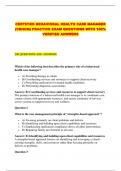
CERTIFIED BEHAVIORAL HEALTH CASE MANAGER
(CBHCM) PRACTICE EXAM QUESTIONS WITH 100%
VERIFIED ANSWERS
200 QUESTIONS AND ANSWERS
Which of the following best describes the primary role of a behavioral
health case manager?
• A) Providing therapy to clients
• B) Coordinating services and resources to support client recovery
• C) Prescribing medication for mental health conditions
• D) Performing diagnostic assessments
Answer: B) Coordinating services and resources to support client recovery
The primary function of a behavioral health case manager is to coordinate care,
connect clients with appropriate resources, and ensure continuity of services
across systems to support recovery and wellness.
Question 2
What is the case management principle of "strengths-based approach"?
• A) Focusing primarily on client problems and deficits
• B) Identifying and building upon client capabilities and resources
• C) Emphasizing medication compliance above all other interventions
• D) Requiring family involvement in all cases
Answer: B) Identifying and building upon client capabilities and resources
A strengths-based approach focuses on identifying and leveraging a client's
existing strengths, skills, and resources rather than focusing primarily on
deficits or problems.
Question 3
,Which case management model emphasizes intensive community-based
services with small caseloads and 24/7 availability?
• A) Broker model
• B) Clinical case management
• C) Assertive Community Treatment (ACT)
• D) Generalist model
Answer: C) Assertive Community Treatment (ACT) ACT is an intensive
case management model characterized by multidisciplinary teams, small
caseloads, community-based services, and 24/7 availability for high-need
clients.
Question 4
What is the purpose of a caseload ratio in behavioral health case
management?
• A) To establish the minimum number of contacts required per client
• B) To ensure equitable distribution of resources
• C) To maintain manageable workloads for case managers
• D) To determine client eligibility for services
Answer: C) To maintain manageable workloads for case managers
Caseload ratios help organizations establish appropriate workloads for case
managers based on client acuity and service needs, preventing burnout and
ensuring quality care.
Question 5
Which of the following is NOT typically a core function of case
management?
• A) Assessment
• B) Service planning
• C) Psychotherapy
• D) Monitoring and evaluation
Answer: C) Psychotherapy While case managers may use therapeutic
communication techniques, providing formal psychotherapy is not a core
function of case management and typically requires additional clinical training
and credentials.
Question 6
,The "brokerage model" of case management primarily focuses on:
• A) Building therapeutic relationships with clients
• B) Connecting clients to existing community resources
• C) Providing direct clinical services
• D) Family therapy interventions
Answer: B) Connecting clients to existing community resources The
brokerage model focuses primarily on identifying client needs and linking them
to appropriate community services rather than providing direct clinical services.
Question 7
What does the principle of "person-centered care" mean in behavioral
health case management?
• A) Services are organized around the preferences and needs of the client
• B) All decisions are made by the case manager
• C) Care focuses exclusively on psychiatric symptoms
• D) Services are determined by insurance limitations
Answer: A) Services are organized around the preferences and needs of the
client Person-centered care places the client's preferences, goals, and unique
needs at the center of service planning and delivery.
Question 8
Which of the following represents the correct sequence of the case
management process?
• A) Treatment, assessment, evaluation, planning
• B) Assessment, planning, implementation, evaluation
• C) Diagnosis, treatment, follow-up, discharge
• D) Referral, assessment, treatment, discharge
Answer: B) Assessment, planning, implementation, evaluation The typical
case management process follows this sequence: assessment of needs,
development of a service plan, implementation of the plan, and ongoing
evaluation of outcomes.
Question 9
What is the primary purpose of case management outreach?
• A) To bill for additional services
, • B) To engage difficult-to-reach populations
• C) To fulfill grant requirements
• D) To increase caseload numbers
Answer: B) To engage difficult-to-reach populations Outreach is essential for
identifying and engaging individuals who may not access traditional services
due to barriers such as stigma, lack of transportation, distrust, or limited
awareness of available resources.
Question 10
Which of the following best describes the medical model of case
management?
• A) A focus on social determinants of health
• B) An emphasis on diagnosis, treatment, and symptom management
• C) Prioritizing client self-determination
• D) Community-based rehabilitation approaches
Answer: B) An emphasis on diagnosis, treatment, and symptom
management The medical model focuses on clinical diagnosis, treatment
adherence, symptom management, and coordination with medical providers.
Question 11
What is a key difference between case management and care management?
• A) There is no difference between the terms
• B) Care management typically involves more clinical oversight and
medical coordination
• C) Case management is only for mental health while care management is
for physical health
• D) Care management is only used in hospital settings
Answer: B) Care management typically involves more clinical oversight
and medical coordination While the terms are sometimes used
interchangeably, care management often involves greater emphasis on clinical
oversight, medical care coordination, and integration of physical and behavioral
health.
Question 12
Which of the following is a key principle of the recovery model in
behavioral health?
(CBHCM) PRACTICE EXAM QUESTIONS WITH 100%
VERIFIED ANSWERS
200 QUESTIONS AND ANSWERS
Which of the following best describes the primary role of a behavioral
health case manager?
• A) Providing therapy to clients
• B) Coordinating services and resources to support client recovery
• C) Prescribing medication for mental health conditions
• D) Performing diagnostic assessments
Answer: B) Coordinating services and resources to support client recovery
The primary function of a behavioral health case manager is to coordinate care,
connect clients with appropriate resources, and ensure continuity of services
across systems to support recovery and wellness.
Question 2
What is the case management principle of "strengths-based approach"?
• A) Focusing primarily on client problems and deficits
• B) Identifying and building upon client capabilities and resources
• C) Emphasizing medication compliance above all other interventions
• D) Requiring family involvement in all cases
Answer: B) Identifying and building upon client capabilities and resources
A strengths-based approach focuses on identifying and leveraging a client's
existing strengths, skills, and resources rather than focusing primarily on
deficits or problems.
Question 3
,Which case management model emphasizes intensive community-based
services with small caseloads and 24/7 availability?
• A) Broker model
• B) Clinical case management
• C) Assertive Community Treatment (ACT)
• D) Generalist model
Answer: C) Assertive Community Treatment (ACT) ACT is an intensive
case management model characterized by multidisciplinary teams, small
caseloads, community-based services, and 24/7 availability for high-need
clients.
Question 4
What is the purpose of a caseload ratio in behavioral health case
management?
• A) To establish the minimum number of contacts required per client
• B) To ensure equitable distribution of resources
• C) To maintain manageable workloads for case managers
• D) To determine client eligibility for services
Answer: C) To maintain manageable workloads for case managers
Caseload ratios help organizations establish appropriate workloads for case
managers based on client acuity and service needs, preventing burnout and
ensuring quality care.
Question 5
Which of the following is NOT typically a core function of case
management?
• A) Assessment
• B) Service planning
• C) Psychotherapy
• D) Monitoring and evaluation
Answer: C) Psychotherapy While case managers may use therapeutic
communication techniques, providing formal psychotherapy is not a core
function of case management and typically requires additional clinical training
and credentials.
Question 6
,The "brokerage model" of case management primarily focuses on:
• A) Building therapeutic relationships with clients
• B) Connecting clients to existing community resources
• C) Providing direct clinical services
• D) Family therapy interventions
Answer: B) Connecting clients to existing community resources The
brokerage model focuses primarily on identifying client needs and linking them
to appropriate community services rather than providing direct clinical services.
Question 7
What does the principle of "person-centered care" mean in behavioral
health case management?
• A) Services are organized around the preferences and needs of the client
• B) All decisions are made by the case manager
• C) Care focuses exclusively on psychiatric symptoms
• D) Services are determined by insurance limitations
Answer: A) Services are organized around the preferences and needs of the
client Person-centered care places the client's preferences, goals, and unique
needs at the center of service planning and delivery.
Question 8
Which of the following represents the correct sequence of the case
management process?
• A) Treatment, assessment, evaluation, planning
• B) Assessment, planning, implementation, evaluation
• C) Diagnosis, treatment, follow-up, discharge
• D) Referral, assessment, treatment, discharge
Answer: B) Assessment, planning, implementation, evaluation The typical
case management process follows this sequence: assessment of needs,
development of a service plan, implementation of the plan, and ongoing
evaluation of outcomes.
Question 9
What is the primary purpose of case management outreach?
• A) To bill for additional services
, • B) To engage difficult-to-reach populations
• C) To fulfill grant requirements
• D) To increase caseload numbers
Answer: B) To engage difficult-to-reach populations Outreach is essential for
identifying and engaging individuals who may not access traditional services
due to barriers such as stigma, lack of transportation, distrust, or limited
awareness of available resources.
Question 10
Which of the following best describes the medical model of case
management?
• A) A focus on social determinants of health
• B) An emphasis on diagnosis, treatment, and symptom management
• C) Prioritizing client self-determination
• D) Community-based rehabilitation approaches
Answer: B) An emphasis on diagnosis, treatment, and symptom
management The medical model focuses on clinical diagnosis, treatment
adherence, symptom management, and coordination with medical providers.
Question 11
What is a key difference between case management and care management?
• A) There is no difference between the terms
• B) Care management typically involves more clinical oversight and
medical coordination
• C) Case management is only for mental health while care management is
for physical health
• D) Care management is only used in hospital settings
Answer: B) Care management typically involves more clinical oversight
and medical coordination While the terms are sometimes used
interchangeably, care management often involves greater emphasis on clinical
oversight, medical care coordination, and integration of physical and behavioral
health.
Question 12
Which of the following is a key principle of the recovery model in
behavioral health?