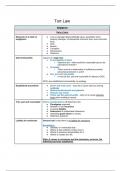
Tort Law
Negligence
Duty of care
Elements of a claim in ● Loss or damage (physical/bodily injury, psychiatric harm,
negligence property damage, consequential economic loss, pure economic
loss)
● Duty
● Breach
● Causation
● Remoteness
● Defences
Determining DOC Caparo 3 - stage test:
● Foreseeability of harm
○ Objective test - what would the reasonable person be
expected to foresee?
● Proximity
○ There must be a relationship of sufficient proximity
(closeness) between C and D
● Fair, just and reasonable
○ It must be fair, just and reasonable to impose a DOC
DOCs are established incrementally, by analogy.
Established precedents ● Driver and road users - duty not to cause injury by driving
recklessly
● Medical professionals and patients
● Rescuer and victim
● Police and the general public - duty not to cause physical
injury when making an arrest
‘Fair, just and reasonable’ Policy considerations will determine this
● Floodgates argument
● Whether D has insurance
● Crushing liability
● Deterrence of undesirable behaviours
● Upholding good values in society
● Defensive practices
Liability for omissions General rule is that there is no liability for omissions
Exceptions:
● Statutory or contractual duty
● Where D has sufficient control over C
● Where D assumes responsibility for C
● Where D creates the risk
When it comes to omissions and the emergency services, the
following has been established
, ● The ambulance service owes a DOC to respond to a 999 call
within a reasonable time
● Fire brigade does not owe a DOC to attend a fire, but they must
not make the situation worse through a positive act
● Police do not owe a DOC to respond to emergency calls
Liability for the acts of General rule is that there is no liability for the acts of third parties
third parties
Exceptions:
● Where there is sufficient proximity between C and D
○ E.g. where C is an identifiable victim over and above the
public at large, and D has assumed responsibility for
C’s safety
● Where this a special relationship between D and the third party
that caused the harm
○ Where D has a responsibility to control/supervise the
third party
● Where D creates the danger
● The risk (created by a third party) was on D’s premises
○ But the risk must still be foreseeable
Public bodies and DOCs Starting point is that the same principles apply to public bodies as
private individuals. However, note the following:
● If the public body’s power derives from statute, parliamentary
sovereignty will be given effect - if the act is authorised by
statute, this prevails
● Policy considerations are stronger here, e.g.
○ Taxpayer would ultimately pay for damage
○ Public bodies might be restricted due to fear of litigation
○ Courts will generally only interfere with operational, not
policy, matters
Examples of duties ● Local authority liable for misdiagnosing dyslexia as they had
imposed on public bodies assumed responsibility for C’s educational services
● MOD liable for injuring a drunk soldier as they assumed
responsibility for his safety by helping him
○ Note however the army does not owe a DOC to soldiers
in battle conditions
Breach
2 stages of determining ● Standard of care (question of law)
breach ● Whether D fell below the standard (question of fact)
Standard of care (regular General rule is that D must behave as a reasonable person would in
people) all the circumstances (no duty to do everything possible - only
reasonable)
● Determined objectively
The test is based on the act, not the actor
● E.g. learner driver is held to the standard of the ordinary
competent driver
● E.g. normal person doing carpentry will be held to standard of
reasonable amateur carpenter
● Lower standard of care does not apply to those training in a
, profession
Standard of care Bolam test: professionals are assessed against the standard of the
(professionals) ‘ordinary reasonable man, exercising and professing to have that
special skill’
● Does not need to have the highest expert skill
● It is irrelevant what seniority the person is within an organisation
as the standard of care attaches to the ‘act not the actor’ and is
objective
Standard of care The standard of care required of a child will be that of the reasonable
(children) child of the defendant’s age carrying out that act.
Standard of care (illness Courts may modify the standard to account for characteristics of D
and disability) ● E.g. where D unknowingly suffers hypoglycaemia - standard
adjusted to the reasonable man who does not know they are
suffering from a condition
● Does not apply where D suspects they are suffering from a
condition but does not know for sure - the regular standard
applies here notwithstanding their
Establishing breach The courts will consider the following
● Likelihood of harm
○ The more likely someone is to get injured, the more likely
there is a breach
● Magnitude of harm
○ If any injury that may occur would be serious, greater
care would be needed than if there was a minor injury
● Practicality of precautions
○ D only needs to act reasonably - courts will not impose
liability if the cost or practicality of precautions are
unreasonable (even if the risk is clearly foreseeable)
● Benefit of D’s conduct
○ If D has taken a risk with the aim of preserving life, limb
or property then this may be justified
● Common practice
○ If D can show they acted in accordance with a practice
usually followed by others in that field, they may escape
liability
● State of the art defence
○ The courts must assess D’s actions against the
knowledge in the profession, or accepted practice at the
time of the alleged breach – unforeseeable risks cannot
be anticipated and thus will not give rise to negligence
● Sport
○ Higher risks are generally accepted in sport, but there
will still be liability if the reasonable participant of D’s
level would have known that there was a significant risk
that their actions could result in serious injury.
Proof of breach On the balance of probabilities that C has to prove - but if D’s action
led to criminal prosecution, C can rely on the conviction to help if the
conviction is evidence of careless conduct
Exception:
Negligence
Duty of care
Elements of a claim in ● Loss or damage (physical/bodily injury, psychiatric harm,
negligence property damage, consequential economic loss, pure economic
loss)
● Duty
● Breach
● Causation
● Remoteness
● Defences
Determining DOC Caparo 3 - stage test:
● Foreseeability of harm
○ Objective test - what would the reasonable person be
expected to foresee?
● Proximity
○ There must be a relationship of sufficient proximity
(closeness) between C and D
● Fair, just and reasonable
○ It must be fair, just and reasonable to impose a DOC
DOCs are established incrementally, by analogy.
Established precedents ● Driver and road users - duty not to cause injury by driving
recklessly
● Medical professionals and patients
● Rescuer and victim
● Police and the general public - duty not to cause physical
injury when making an arrest
‘Fair, just and reasonable’ Policy considerations will determine this
● Floodgates argument
● Whether D has insurance
● Crushing liability
● Deterrence of undesirable behaviours
● Upholding good values in society
● Defensive practices
Liability for omissions General rule is that there is no liability for omissions
Exceptions:
● Statutory or contractual duty
● Where D has sufficient control over C
● Where D assumes responsibility for C
● Where D creates the risk
When it comes to omissions and the emergency services, the
following has been established
, ● The ambulance service owes a DOC to respond to a 999 call
within a reasonable time
● Fire brigade does not owe a DOC to attend a fire, but they must
not make the situation worse through a positive act
● Police do not owe a DOC to respond to emergency calls
Liability for the acts of General rule is that there is no liability for the acts of third parties
third parties
Exceptions:
● Where there is sufficient proximity between C and D
○ E.g. where C is an identifiable victim over and above the
public at large, and D has assumed responsibility for
C’s safety
● Where this a special relationship between D and the third party
that caused the harm
○ Where D has a responsibility to control/supervise the
third party
● Where D creates the danger
● The risk (created by a third party) was on D’s premises
○ But the risk must still be foreseeable
Public bodies and DOCs Starting point is that the same principles apply to public bodies as
private individuals. However, note the following:
● If the public body’s power derives from statute, parliamentary
sovereignty will be given effect - if the act is authorised by
statute, this prevails
● Policy considerations are stronger here, e.g.
○ Taxpayer would ultimately pay for damage
○ Public bodies might be restricted due to fear of litigation
○ Courts will generally only interfere with operational, not
policy, matters
Examples of duties ● Local authority liable for misdiagnosing dyslexia as they had
imposed on public bodies assumed responsibility for C’s educational services
● MOD liable for injuring a drunk soldier as they assumed
responsibility for his safety by helping him
○ Note however the army does not owe a DOC to soldiers
in battle conditions
Breach
2 stages of determining ● Standard of care (question of law)
breach ● Whether D fell below the standard (question of fact)
Standard of care (regular General rule is that D must behave as a reasonable person would in
people) all the circumstances (no duty to do everything possible - only
reasonable)
● Determined objectively
The test is based on the act, not the actor
● E.g. learner driver is held to the standard of the ordinary
competent driver
● E.g. normal person doing carpentry will be held to standard of
reasonable amateur carpenter
● Lower standard of care does not apply to those training in a
, profession
Standard of care Bolam test: professionals are assessed against the standard of the
(professionals) ‘ordinary reasonable man, exercising and professing to have that
special skill’
● Does not need to have the highest expert skill
● It is irrelevant what seniority the person is within an organisation
as the standard of care attaches to the ‘act not the actor’ and is
objective
Standard of care The standard of care required of a child will be that of the reasonable
(children) child of the defendant’s age carrying out that act.
Standard of care (illness Courts may modify the standard to account for characteristics of D
and disability) ● E.g. where D unknowingly suffers hypoglycaemia - standard
adjusted to the reasonable man who does not know they are
suffering from a condition
● Does not apply where D suspects they are suffering from a
condition but does not know for sure - the regular standard
applies here notwithstanding their
Establishing breach The courts will consider the following
● Likelihood of harm
○ The more likely someone is to get injured, the more likely
there is a breach
● Magnitude of harm
○ If any injury that may occur would be serious, greater
care would be needed than if there was a minor injury
● Practicality of precautions
○ D only needs to act reasonably - courts will not impose
liability if the cost or practicality of precautions are
unreasonable (even if the risk is clearly foreseeable)
● Benefit of D’s conduct
○ If D has taken a risk with the aim of preserving life, limb
or property then this may be justified
● Common practice
○ If D can show they acted in accordance with a practice
usually followed by others in that field, they may escape
liability
● State of the art defence
○ The courts must assess D’s actions against the
knowledge in the profession, or accepted practice at the
time of the alleged breach – unforeseeable risks cannot
be anticipated and thus will not give rise to negligence
● Sport
○ Higher risks are generally accepted in sport, but there
will still be liability if the reasonable participant of D’s
level would have known that there was a significant risk
that their actions could result in serious injury.
Proof of breach On the balance of probabilities that C has to prove - but if D’s action
led to criminal prosecution, C can rely on the conviction to help if the
conviction is evidence of careless conduct
Exception: