SECTION A
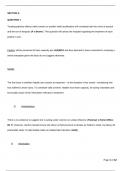
QUESTION 1
Treating patients without valid consent or another lawful justification will constitute both the crime of assault
and the tort of trespass (R v Brown). This question will advise the hospital regarding the treatment of each
patient in turn.
Padme: will be presumed to have capacity per s1(2)MCA and thus deemed to have consented to receiving a
womb transplant given the facts do not suggest otherwise.
Natalie
The first issue is whether Natalie can consent to treatment – to the donation of her womb– considering she
has suffered a brain injury. To constitute valid consent, Natalie must have capacity, be acting voluntarily and
be broadly aware of the information relevant to treatment.
(i) Voluntariness
There is no evidence to suggest she is acting under coercion or undue influence (Freeman v Home Office;
Re T). However, doctors should ensure she does not feel pressure to donate as Padme’s sister, by taking ‘all
practicable steps’ to help Natalie make an independent decision (s1(3)).
(i) Information
Page 1 of 12
, Natalie must be broadly aware of the nature and consequences of the treatment (Chatterton v Gerson
[1981]) Based on her watching, understanding, and retaining the information from the documentary, this is
assumed to be satisfied.
(ii) Capacity
Natalie is presumed to have capacity (s1(2)MCA). However, her brain injury may constitute an ‘impairment’ or
‘disturbance in the functioning of the mind or brain’ potentially failing the diagnostic test (s2(1)). Nonetheless,
s2(3)MCA stipulates that incapacity cannot be established merely by referring to a patient’s condition or
behaviour, rather the functional test under s3(1) must be satisfied (Re C). Natalie must be able to understand,
retain, weigh, and communicate her decision. This appears satisfied under the information requirement, noting
that she expressed a continual expression of consent over a period of a ‘few months’. However, doubt is
caused by her mother’s claim she “does not fully understand such things.” Therefore, the doctors are advised
to ensure they have taken all reasonable steps to determine capacity (s5(1)(a)) and if not rely on another
lawful jurisdiction.
GLA
Natalie doesn’t have a court-appointed deputy (ss16-20) or LPA (ss9-14). Therefore, treatment must be in her
best interests (s1(5)MCA) with the test under s4MCA requiring it to: reflect all relevant circumstances (s4(2)),
the likelihood of regaining capacity (s4(3)), the patient’s past and present wishes (s4(6)), and insights from
consultations with relevant parties (s4(7)). If her brain injury constitutes incapacity (above) and is permanent,
Natalie is unlikely to regain capacity. While it could be argued that her best interests could be informed by her
relationship with her sister per Re Y, this case is distinguished as it concerned a sibling suffering from the
other’s death. Whereas Natalie’s donation will not be life-saving and indeed Connell J said Re Y was fact-
based and should not be considered a precedent for more invasive donations.
Page 2 of 12
QUESTION 1
Treating patients without valid consent or another lawful justification will constitute both the crime of assault
and the tort of trespass (R v Brown). This question will advise the hospital regarding the treatment of each
patient in turn.
Padme: will be presumed to have capacity per s1(2)MCA and thus deemed to have consented to receiving a
womb transplant given the facts do not suggest otherwise.
Natalie
The first issue is whether Natalie can consent to treatment – to the donation of her womb– considering she
has suffered a brain injury. To constitute valid consent, Natalie must have capacity, be acting voluntarily and
be broadly aware of the information relevant to treatment.
(i) Voluntariness
There is no evidence to suggest she is acting under coercion or undue influence (Freeman v Home Office;
Re T). However, doctors should ensure she does not feel pressure to donate as Padme’s sister, by taking ‘all
practicable steps’ to help Natalie make an independent decision (s1(3)).
(i) Information
Page 1 of 12
, Natalie must be broadly aware of the nature and consequences of the treatment (Chatterton v Gerson
[1981]) Based on her watching, understanding, and retaining the information from the documentary, this is
assumed to be satisfied.
(ii) Capacity
Natalie is presumed to have capacity (s1(2)MCA). However, her brain injury may constitute an ‘impairment’ or
‘disturbance in the functioning of the mind or brain’ potentially failing the diagnostic test (s2(1)). Nonetheless,
s2(3)MCA stipulates that incapacity cannot be established merely by referring to a patient’s condition or
behaviour, rather the functional test under s3(1) must be satisfied (Re C). Natalie must be able to understand,
retain, weigh, and communicate her decision. This appears satisfied under the information requirement, noting
that she expressed a continual expression of consent over a period of a ‘few months’. However, doubt is
caused by her mother’s claim she “does not fully understand such things.” Therefore, the doctors are advised
to ensure they have taken all reasonable steps to determine capacity (s5(1)(a)) and if not rely on another
lawful jurisdiction.
GLA
Natalie doesn’t have a court-appointed deputy (ss16-20) or LPA (ss9-14). Therefore, treatment must be in her
best interests (s1(5)MCA) with the test under s4MCA requiring it to: reflect all relevant circumstances (s4(2)),
the likelihood of regaining capacity (s4(3)), the patient’s past and present wishes (s4(6)), and insights from
consultations with relevant parties (s4(7)). If her brain injury constitutes incapacity (above) and is permanent,
Natalie is unlikely to regain capacity. While it could be argued that her best interests could be informed by her
relationship with her sister per Re Y, this case is distinguished as it concerned a sibling suffering from the
other’s death. Whereas Natalie’s donation will not be life-saving and indeed Connell J said Re Y was fact-
based and should not be considered a precedent for more invasive donations.
Page 2 of 12