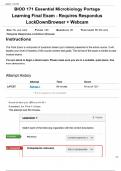
BIOD 171 Essential Microbiology Portage learning
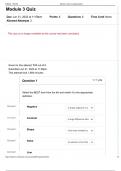
Due No due date Points 120 Questions 30 Time Limit 90 Minutes Requires Respondus LockDown Browser Instructions The Final Exam is composed of questions based upon material presented in the entire course. It will assess your level of mastery of the course content and goals. The format of the exam is similar to past module exams. You are about to begin a timed exam. Please make sure you are in a suitable, quiet place, free from distraction. Attempt History Attempt Time Score LATEST Attempt 1 89 minutes 45 out of 120 * * Some questions not yet graded Score for this quiz: 45 out of 120 * Submitted Jun 20 at 11:41pm This attempt took 89 minutes. 6/20/22, 11:47 PM 2/20 Answer: An image is formed from the interactions of electrons as they reflect off (not through) the surface of the specimen. Samples are coated in either gold or palladium to enhance electron reflections. The reflection is seen in 3-D rendering. Your Answer: The SEM is an instrument that produces a largely magnified image by using electrons instead of light, in the formation of an image Briefly explain how a Scanning Electron Microscope (SEM) forms an image of subcellular organelles, substrates, and viral particles. Question 2 Not yet graded / 4 pts Question 3 2 / 4 pts Correctt Answer Series of membrane-enclosed sacs and interconnected tubes Correctt! Lysosomes ou Answered Chloroplasts Correctt Answer Site of photosynthesis Series of membran Contain hydrolytic e 6/20/22, 11:47 PM 3/20 Identify each of the following microorganisms as either a Prokaryote or a Eukaryote. 1. E. Coli 2. Archaeons Question 4 4 / 4 pts [ Select ] [ Select ] Match each of the following diseases to the correct bacterial family. ou Answered Scalded Skin Syndrome Correctt Answer Staph aureus Correctt! Bubonic plague ou Answered Opthalmia Neonatorium Correctt Answer Staphylococcus Correctt! Legionnaires Legionella Staph aureus Yersina pestis Staphylococcus 6/20/22, 11:47 PM 4/20 Match each of the following terms with the correct description. Correctt! Phototroph ou Answered Lithotroph Correctt Answer Remove electrons from inorganic molecules Question 5 2 / 4 pts Obtain their source Utilize photons to g 3. Yeast 4. Amoeba Answer 1: Correctt! Prokaryote Answer 2: Correctt! Prokaryote Answer 3: Correctt! Eukaryote Answer 4: Correctt! Eukaryote [ Select ] [ Select ] 6/20/22, 11:47 PM 5/20 A researcher is looking to determine the source of contamination of a patient that presented with symptoms of food poisoning. To best determine between E. coli or Salmonella as the cause, what type of agar will be used to isolate the growth of each? orrect Answer Differential Media Enriched Media Selective Media ou Answered Selective and Differential Media Question 6 0 / 4 pts Place the following viral life cycle steps in order beginning with viral attachment (3points) and provide a description of “ENTRY” (1 point). Question 7 Not yet graded / 4 pts ou Answered Autotroph Correctt Answer Obtain their source of carbon from inorganic molecules Correctt! Chemotroph Acquire energy from Remove electrons f 6/20/22, 11:47 PM 6/20 Question 8 4 / 4 pts Uncoating: Release: Replication: Attachment: Entry: New infection: Your Answer: 1. Attachment: This is where the virus attaches to the host cell 2. Entry: The virus pushes through, to enter the host cell 3. Uncoating: The virus breaks apart, while entering ito thr cytoplasm 4. Replication: The virus does through the process of reproducing new viral proteins 5. Release: The new formed viruses are released 6. New infection: New viruses are formed and vacate the host cell Answer: 1-Attachment 2- Entry: the virus fuses with the host membrane and enters the cell 3- Uncoating 4-Replication 5-Release 6-New infection 6/20/22, 11:47 PM 7/20 Correctt! Rheumatic fever occurs in approximately three percent of untreated cases of Streptococcal pharyngitis, presenting approximately 2 to 3 weeks post-infection. Rheumatic fever Laryngitis Conjunctivitis Klebsiella pneumonia Left untreated, three percent of cases of Streptococcal pharyngitis will progress to which of the following? Question 9 4 / 4 pts Describe TWO differences between DNA and RNA. Question 10 Not yet graded / 4 pts The Gram stain differentiates between bacteria based on the composition of their . Cell Membrane Nucleus Mitochondria Correctt! Cell Wall 6/20/22, 11:47 PM 8/20 Answer: True; Alpha hemolysis presents as a greenish-brown color due to partial lysis of red blood cells. Your Answer: True True or False. If the statement is false, change it to make it true. When grown on Blood Agar Plates (BAP), microbes capable of alpha hemolysis present as greenish-brown color colonies due to incomplete (partial) lysis of red blood cells. Question 11 Not yet graded / 4 pts Your Answer: 1. DNA contains thymine, while RNA has the nucleobase uracil 2. DNA stores and transmits genetic information, while RNA acts as a template for making proteins Answer: Any of the following are acceptable answers: RNA contains the sugar ribose rather than deoxyribose. RNA is always single-stranded, whereas DNA is double-stranded. While RNA contains the bases adenine, guanine, and cytosine, it does not utilize the pyrimidine base thymine. Instead, RNA contains uracil (U), which still pairs with adenine (A). 6/20/22, 11:47 PM 9/20 Describe the ONE main differences between lytic and temperate phages. Your Answer: Lytic phages does not lyse the host cell immediately and replicate using only the lytic cycle, while temperate phages replicate using both lytic and lysogenic cycles Question 13 Not yet graded / 4 pts Correctt! Products include pyruvate, NADH, ATP, and H+ The net gain is 4 ATP 2 molecules of ATP are required as reactants Reactants include glucose, NAD, and ATP Each of the following statements about glycolysis is true, except: Question 12 4 / 4 pts 6/20/22, 11:47 PM 10/20 Answer: Vibrio Your Answer: Vibrio Bacteria that have a curved rod morphology are referred to as . Question 14 Not yet graded / 4 pts You want to observe the movement of microorganisms that are present in a sample of cheek cells obtained on a patient. Briefly explain the technique that you would use and how it is performed. Your Answer: Darkfield microscopy

Geschreven voor
- Instelling
- Portage Learning
- Vak
- BIOD 171 Essential Microbiology
Documentinformatie
- Geüpload op
- 11 april 2025
- Aantal pagina's
- 20
- Geschreven in
- 2024/2025
- Type
- Tentamen (uitwerkingen)
- Bevat
- Vragen en antwoorden
Onderwerpen
-
biod
-
1essential microbiology
-
biod 171 essential microbiology

Ook beschikbaar in voordeelbundel