

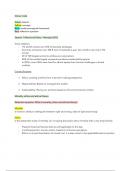
Colour code
Green: session
Yellow: concept
Blue: mode/conceptual framework
Red: reflection question
Session 1 Moral and Ethics - Monday 03/02
Some statistics:
- 1% world’s richest own 43% of business landscape
- Economy consumes over 100 B tons of materials a year. Our world is now only 7.2%
circular
- 69 of 100 largest economic entities are corporations
- 96% of the worlds largest companies produces sustainability reports
- In 2018, more CEOs were fired for ethical lapses than financial challenges or board
conflicts
Course Structure
1. Ethics: Looking at ethics from a decision making perspective
2. Responsibility: Based on management studies
3. Sustainability: Placing our activities based on this environmental context
Morality, ethics and ethical theory
Reflection question: What is morality, ethics and ethical theory?
Morality
is humans’ ability to distinguish between right and wrong. (idea of right and wrong)
Ethics
is the systematic study of morality. (an on-going discussion about morality with a very long history).
- Presents historical theories that are still applicable to this day
- Is anthropocentric: human centric, based on of human perceptive
- Ethics is not just theorization of morals, but it is also meant to be applicable/used in practice
, - Key questions include:
1. What kind of moral principles should guide our actions?
2. What kind of outcomes should we aim for?
Ethical theories
are principles and rules that determine right and wrong in (rule or approach we can apply
to particular situations) different situations. Ethical theories can give contradictory solutions
to the same problem.
Business ethics
The study of business situations, activities, and decisions where issues of right
wrongs are addressed. For instance, issues such corporate governance, including insider tra
bribery, discrimination, corporate social responsibility, fiduciary responsibilities, ethical responsibilities
of social, environmental and economic impacts.
Today we focus on normative ethics i.e. the study of how we ought to behave.
Reflection question: What is the difference between ethics and the law?
LAW AND ETHICS
Do we need ethics when we have the law?
In society, morality is the foundation of the law.
• Law and ethics are partly overlapping.
Nonetheless:
1. The law does not cover all ethical issues (e.g. cheating on your partner).
2. Not all legal issues are ethical (e.g. driving on the right side of the road) – don’t relate to something bein
Right or wrong
3. Law and ethics can involve contradictions (e.g. Apartheid). - law is not always right.
Apartheid in South Africa is a prime example: the law supported racial segregation,
deeming it legal to treat people differently based on race. However, ethically, this was widely
recognized as unjust and discriminatory.
The fact that something is legal does not automatically make it moral, and conversely,
illegal actions can sometimes be morally justified (e.g., civil disobedience against unjust laws).
• The road from unethical to illegal is short and slippery.
• Companies can operate in locations lacking legal infrastructure.
,Moral Orientations
Which moral principle do you think is the best to
distinguish right from wrong:
• Follow the moral guidance of your religion.
• Follow your conscience.
• Aim at your own benefit.
• Do your duty.
• Respect yourself and others.
• Do not violate human rights.
• Support the common good.
• Act with fairness and justice.
• Be a good person - a lot of subjectivity
“The Trolley Dilemma” - intersection between ethics and psychology: a series of thought experiments in
ethics, psychology, and artificial intelligence involving stylized ethical dilemmas of whether to sacrifice
one person to save a larger number. (either trolley or train situation)
Case: “Moral Machine”
Character Dimensions:
- Gender
- Physical fitness
- Social status
- Species
- number
Which dimensions of the Moral Machine experience more agreement?
Answer: See Awad et al. 2018 and slides; There is variance in agreement across different
dimensions, but some receive more agreement are:
- sparing humans instead of pets
- sparing more characters instead of fewer
- sparing the young instead of the old
Result: Noticeable differences in terms of differences according to culture
Normative Ethical Theories
What are the core normative theories in Modernist Western thinking? What are the key
ideas of each?
, Consequentialism: about outcomes of our actions (utilitarianism and ethical egoism are
consequentialist theories)
1. Ethical Egoism
Usually not considered as an ethical theory, although this view is
very influential in economics. Not a consistent theory but a preference
● An action is morally right if the decision-maker freely decides in order to pursue either
their (short-term) desires or their (long-term) interests.
● Key is free will
● Authors: Thomas Hobbes (1588-1679), Adam Smith (1723-1790), popularized by Ayn
Rand (1905-1982).
● The influence of egoism is related to the perception of ideal markets and (a limited
reading of ) Adam Smith’s ”invisible hand”: this metaphor suggests that individuals
pursuing their own self-interest unintentionally creates a positive outcome on/naturally
guides the economy, as if guided by an unseen force. The results seem to happen
organically without any central coordination.
In short:
- Rational decision makers trying to maximise our preferences
- The idea that everybody goes for their own interest
Self Driving car: What would an ethical egoist do?
If an ethical egoist is buying a car,they would protect the people inside the car. If an ethical
egoist is manufacturing the car, they would likely aim to serve egoist customers to sell more
cars.
Problems:
• Inconsistent as it ”condones blatant immoral wrongs, since 'anything goes'-violence against
the vulnerable, theft, even murder-as long as the egoist's needs are served” (Crane et al.,
2019,96)
• Thus, a moral view based on short term satisfaction of needs is contradictory with our moral
principles.
• Enlightened egoism focuses on the meeting of long-term human interests.
• Enlightened egoism does not take a stance on the nature of the interests and desires of
individuals, which can still lead to problems due to conflicting interests.
• Although taking care of your needs and interests is morally important, the theory needs to be
complemented by more developed ethical theories.
Green: session
Yellow: concept
Blue: mode/conceptual framework
Red: reflection question
Session 1 Moral and Ethics - Monday 03/02
Some statistics:
- 1% world’s richest own 43% of business landscape
- Economy consumes over 100 B tons of materials a year. Our world is now only 7.2%
circular
- 69 of 100 largest economic entities are corporations
- 96% of the worlds largest companies produces sustainability reports
- In 2018, more CEOs were fired for ethical lapses than financial challenges or board
conflicts
Course Structure
1. Ethics: Looking at ethics from a decision making perspective
2. Responsibility: Based on management studies
3. Sustainability: Placing our activities based on this environmental context
Morality, ethics and ethical theory
Reflection question: What is morality, ethics and ethical theory?
Morality
is humans’ ability to distinguish between right and wrong. (idea of right and wrong)
Ethics
is the systematic study of morality. (an on-going discussion about morality with a very long history).
- Presents historical theories that are still applicable to this day
- Is anthropocentric: human centric, based on of human perceptive
- Ethics is not just theorization of morals, but it is also meant to be applicable/used in practice
, - Key questions include:
1. What kind of moral principles should guide our actions?
2. What kind of outcomes should we aim for?
Ethical theories
are principles and rules that determine right and wrong in (rule or approach we can apply
to particular situations) different situations. Ethical theories can give contradictory solutions
to the same problem.
Business ethics
The study of business situations, activities, and decisions where issues of right
wrongs are addressed. For instance, issues such corporate governance, including insider tra
bribery, discrimination, corporate social responsibility, fiduciary responsibilities, ethical responsibilities
of social, environmental and economic impacts.
Today we focus on normative ethics i.e. the study of how we ought to behave.
Reflection question: What is the difference between ethics and the law?
LAW AND ETHICS
Do we need ethics when we have the law?
In society, morality is the foundation of the law.
• Law and ethics are partly overlapping.
Nonetheless:
1. The law does not cover all ethical issues (e.g. cheating on your partner).
2. Not all legal issues are ethical (e.g. driving on the right side of the road) – don’t relate to something bein
Right or wrong
3. Law and ethics can involve contradictions (e.g. Apartheid). - law is not always right.
Apartheid in South Africa is a prime example: the law supported racial segregation,
deeming it legal to treat people differently based on race. However, ethically, this was widely
recognized as unjust and discriminatory.
The fact that something is legal does not automatically make it moral, and conversely,
illegal actions can sometimes be morally justified (e.g., civil disobedience against unjust laws).
• The road from unethical to illegal is short and slippery.
• Companies can operate in locations lacking legal infrastructure.
,Moral Orientations
Which moral principle do you think is the best to
distinguish right from wrong:
• Follow the moral guidance of your religion.
• Follow your conscience.
• Aim at your own benefit.
• Do your duty.
• Respect yourself and others.
• Do not violate human rights.
• Support the common good.
• Act with fairness and justice.
• Be a good person - a lot of subjectivity
“The Trolley Dilemma” - intersection between ethics and psychology: a series of thought experiments in
ethics, psychology, and artificial intelligence involving stylized ethical dilemmas of whether to sacrifice
one person to save a larger number. (either trolley or train situation)
Case: “Moral Machine”
Character Dimensions:
- Gender
- Physical fitness
- Social status
- Species
- number
Which dimensions of the Moral Machine experience more agreement?
Answer: See Awad et al. 2018 and slides; There is variance in agreement across different
dimensions, but some receive more agreement are:
- sparing humans instead of pets
- sparing more characters instead of fewer
- sparing the young instead of the old
Result: Noticeable differences in terms of differences according to culture
Normative Ethical Theories
What are the core normative theories in Modernist Western thinking? What are the key
ideas of each?
, Consequentialism: about outcomes of our actions (utilitarianism and ethical egoism are
consequentialist theories)
1. Ethical Egoism
Usually not considered as an ethical theory, although this view is
very influential in economics. Not a consistent theory but a preference
● An action is morally right if the decision-maker freely decides in order to pursue either
their (short-term) desires or their (long-term) interests.
● Key is free will
● Authors: Thomas Hobbes (1588-1679), Adam Smith (1723-1790), popularized by Ayn
Rand (1905-1982).
● The influence of egoism is related to the perception of ideal markets and (a limited
reading of ) Adam Smith’s ”invisible hand”: this metaphor suggests that individuals
pursuing their own self-interest unintentionally creates a positive outcome on/naturally
guides the economy, as if guided by an unseen force. The results seem to happen
organically without any central coordination.
In short:
- Rational decision makers trying to maximise our preferences
- The idea that everybody goes for their own interest
Self Driving car: What would an ethical egoist do?
If an ethical egoist is buying a car,they would protect the people inside the car. If an ethical
egoist is manufacturing the car, they would likely aim to serve egoist customers to sell more
cars.
Problems:
• Inconsistent as it ”condones blatant immoral wrongs, since 'anything goes'-violence against
the vulnerable, theft, even murder-as long as the egoist's needs are served” (Crane et al.,
2019,96)
• Thus, a moral view based on short term satisfaction of needs is contradictory with our moral
principles.
• Enlightened egoism focuses on the meeting of long-term human interests.
• Enlightened egoism does not take a stance on the nature of the interests and desires of
individuals, which can still lead to problems due to conflicting interests.
• Although taking care of your needs and interests is morally important, the theory needs to be
complemented by more developed ethical theories.



