OVERVIEW
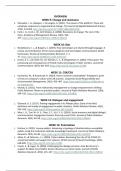
WEEK 9: Change and resistance
1. Stensaker, I. G., Balogun, J., & Langley, A. (2021). The power of the platform: Place and
employee responses to organizational change. The Journal of Applied Behavioral Science,
57(2), 174-203. http://dx.doi.org/10.1177/0021886320933736
2. Ford, J. D., Ford, L. W., & D’Amelio, A. (2008). Resistance to change: The rest of the
story. Academy of Management Review, 33(2), 362–
377. https://doi.org/10.5465/amr.2008.31193235
WEEK 10: Bias
1. Beukeboom, C. J., & Burgers, C. (2019). How stereotypes are shared through language: A
review and introduction of the social categories and stereotypes communication (SCSC)
framework. Review of Communication Research, 7, 1-
37. https://doi.org/10.12840/issn.2255-4165.017
2. Kroon, A. C., van Selm, M., ter Hoeven, C. L., & Vliegenthart, R. (2016). Poles apart: The
processing and consequences of mixed media stereotypes of older workers. Journal of
Communication, 66(5), 811-833. https://doi.org/10.1111/jcom.12249
WEEK 11: CSR/CSA
1. Kucharska, W., & Kowalczyk, R. (2019). How to achieve sustainability? Employee’s point
of view on company’s culture and CSR practice. Corporate Social Responsibility and
Environmental Management, 26(2), 453–467. https://doi.org/10.1002/csr.1696Links to
an external site.
2. Mundy, D. (2021). From relationship management to change empowerment: Shifting
Public Relations Theory to prioritize publics. Journal of Public Relations Research, 33(6),
504–525. https://doi.org/10.1080/1062726X.2022.2053856
WEEK 12: Dialogue and engagement
1. Dhanesh, G. S. (2017). Putting engagement in its PRoper place: State of the field,
definition and model of engagement in public relations. Public Relations Review, 43(5),
925–933. https://doi.org/10.1016/j.pubrev.2017.04.001
2. Men, L. R., Tsai, W.-H. S., Chen, Z. F., & Ji, Y. G. (2018). Social presence and digital dialogic
communication: Engagement lessons from top social CEOs. Journal of Public Relations
Research, 30(3), 83–99. https://doi.org/10.1080/1062726X.2018.1498341
WEEK 13: Polarization
1. Krishna, A. (2021). Lacuna publics: Advancing a typology of disinformation-susceptible
publics using the motivation-attitude-knowledge framework. Journal of Public Relations
Research, 33(2), 63–85. https://doi.org/10.1080/1062726X.2021.1944155
2. Jolley, D., & Paterson, J. L. (2020). Pylons ablaze: Examining the role of 5G COVID‐19
conspiracy beliefs and support for violence. British Journal of Social Psychology, 59(3),
628-640. https://doi.org/10.1111/bjso.12394
3. Ciszek, E., & Logan, N. (2018). Challenging the dialogic promise: How Ben & Jerry’s
support for Black Lives Matter fosters dissensus on social media. Journal of Public
Relations Research, 30(3), 115–127. https://doi.org/10.1080/1062726X.2018.1498342
,
, WEEK 9: Change and resistance
STENSAKER, BALOGUN & LANGLEY (2021)
• This study explores how place influences collective sensemaking and employee
responses during organizational change > the setting is offshore oil platforms
undergoing changes that involve standardizing operational practices and relocating
personnel as two organizations merge
• This paper analyses the narratives of two employee groups and show how
employees onshore construct progressive change narratives, enabling them to adapt
to change while offshore ones construct regressive narratives romanticizing the past
and struggling to accept change > findings show how manipulation, reconfiguration,
and exploitation of place has implications for employees’ capacities to accept and
adapt to change
Introduction
• Employees play an essential role in organizational change; their behavioral responses
can make or break a planned change initiative > studies suggest how sensemaking
can lead groups to develop collective responses that influence the change process
and outcomes > employees attempt to create plausible explanations and accounts
by discussing and interacting with others > they change narratives to guide their
behaviors, thus social interaction and communication is a central component of
sensemaking
• Physical context can have a significant impact on social interaction during
organizational change > limiting access to specific locations and people can affect the
availability of spaces for individuals and groups to exchange change narratives > this
study focuses on how physical surroundings affect employees’ collective
sensemaking, their change narratives and their responses to change
• Three aspects of place matter in this research: physical features, opportunities for
interpersonal interaction, and symbolic value associated with a place
Collective sensemaking and construction of change narratives
• Organizational change triggers sensemaking processes at all levels within an
organization > senior management makes sense and gives sense during the initiation
of change, but there is no reason to expect change recipients to interpret and
experience change similarly to senior management > these can differ due to personal
experiences and backgrounds that shape the identity that affects the process of
sensemaking on individuals
• In this study, they focus on sensemaking on a collective level (instead of individual)
and how social interactions affect employee sensemaking > employees share
interpretations and stories, and a shared understanding may emerge > this makes
the emotional and social aspects of sensemaking surface in the narratives people tell
• Narratives constitute a device for making sense of ambiguous organizational
situations > employees construct change narratives to communicate about the
world, as well as to interpret and make sense of their behaviors > change narratives
are constructed through a continuous process of conversation, which are based on
temporality, and can be backward or forward-looking
, o Progressive narratives - portraying improvements due to change; linked to
change acceptance
o Regressive narratives - depict negative consequences of change; tied to
resistance to change
• Change narratives inform and constrain behavior, while also incorporating identity
and power issues > these narratives can also be used as political levers within and
across groups
• Previous research shows how collective sensemaking is a social process involving the
construction of narratives where descriptive constructions of reality embody
possible and plausible (not necessarily accurate) interpretations of events and
situations
The role of place
• Physical context can be a powerful resource in the narrative shaping of collective
identities > identity is an essential compost of sensemaking, hence key features of
the workplace may also carry symbolic value and thus shape change narratives
• Places create physical boundaries that enable or restrict interactions between
organization members > specific places can also create opportunities for resisting
change or enabling change > peer-based interactions tend to lead to group-based
interpretation of change with implications for the group’s response to change
Research setting
In-depth case study of corporate restricting triggered by the merger of two previous
competitors in the Nordic oil and energy industry > separation between offshore and
onshore workers to explore the collective narratives of employees in the face of change
RQ: How does place influence collective employee sensemaking and response to
organizational change?
Sensemaking for change – platform employees and onshore employees
Method
• Drew on documents, observations and interviews collected at Earlybird in 2009 > the
goal is to capture collective sensemaking through the change narratives constructed
by Earlybird organization members > narratives organize our experience and
memory and resemble stories with plots involving a number of people with various
interests and motives
• The source of data is 24 interviews with employees working on both offshore and
onshore facilities > also interviewed 5 managers
• Examined how individuals describe their understanding of the change, as well as
their behaviors and role in the change process
Place, collective sensemaking, and response to change
• Analysis showed that offshore employees adopt a regressive narrative and struggle
to accept change, while onshore employees construct a more progressive narrative,
allowing the to adapt to change > their physical location affects their sensemaking
and capacity to adapt to change
• Three determinative aspects of place for sensemaking narratives: physical features,
interpersonal interactions, and symbolic value
WEEK 9: Change and resistance
1. Stensaker, I. G., Balogun, J., & Langley, A. (2021). The power of the platform: Place and
employee responses to organizational change. The Journal of Applied Behavioral Science,
57(2), 174-203. http://dx.doi.org/10.1177/0021886320933736
2. Ford, J. D., Ford, L. W., & D’Amelio, A. (2008). Resistance to change: The rest of the
story. Academy of Management Review, 33(2), 362–
377. https://doi.org/10.5465/amr.2008.31193235
WEEK 10: Bias
1. Beukeboom, C. J., & Burgers, C. (2019). How stereotypes are shared through language: A
review and introduction of the social categories and stereotypes communication (SCSC)
framework. Review of Communication Research, 7, 1-
37. https://doi.org/10.12840/issn.2255-4165.017
2. Kroon, A. C., van Selm, M., ter Hoeven, C. L., & Vliegenthart, R. (2016). Poles apart: The
processing and consequences of mixed media stereotypes of older workers. Journal of
Communication, 66(5), 811-833. https://doi.org/10.1111/jcom.12249
WEEK 11: CSR/CSA
1. Kucharska, W., & Kowalczyk, R. (2019). How to achieve sustainability? Employee’s point
of view on company’s culture and CSR practice. Corporate Social Responsibility and
Environmental Management, 26(2), 453–467. https://doi.org/10.1002/csr.1696Links to
an external site.
2. Mundy, D. (2021). From relationship management to change empowerment: Shifting
Public Relations Theory to prioritize publics. Journal of Public Relations Research, 33(6),
504–525. https://doi.org/10.1080/1062726X.2022.2053856
WEEK 12: Dialogue and engagement
1. Dhanesh, G. S. (2017). Putting engagement in its PRoper place: State of the field,
definition and model of engagement in public relations. Public Relations Review, 43(5),
925–933. https://doi.org/10.1016/j.pubrev.2017.04.001
2. Men, L. R., Tsai, W.-H. S., Chen, Z. F., & Ji, Y. G. (2018). Social presence and digital dialogic
communication: Engagement lessons from top social CEOs. Journal of Public Relations
Research, 30(3), 83–99. https://doi.org/10.1080/1062726X.2018.1498341
WEEK 13: Polarization
1. Krishna, A. (2021). Lacuna publics: Advancing a typology of disinformation-susceptible
publics using the motivation-attitude-knowledge framework. Journal of Public Relations
Research, 33(2), 63–85. https://doi.org/10.1080/1062726X.2021.1944155
2. Jolley, D., & Paterson, J. L. (2020). Pylons ablaze: Examining the role of 5G COVID‐19
conspiracy beliefs and support for violence. British Journal of Social Psychology, 59(3),
628-640. https://doi.org/10.1111/bjso.12394
3. Ciszek, E., & Logan, N. (2018). Challenging the dialogic promise: How Ben & Jerry’s
support for Black Lives Matter fosters dissensus on social media. Journal of Public
Relations Research, 30(3), 115–127. https://doi.org/10.1080/1062726X.2018.1498342
,
, WEEK 9: Change and resistance
STENSAKER, BALOGUN & LANGLEY (2021)
• This study explores how place influences collective sensemaking and employee
responses during organizational change > the setting is offshore oil platforms
undergoing changes that involve standardizing operational practices and relocating
personnel as two organizations merge
• This paper analyses the narratives of two employee groups and show how
employees onshore construct progressive change narratives, enabling them to adapt
to change while offshore ones construct regressive narratives romanticizing the past
and struggling to accept change > findings show how manipulation, reconfiguration,
and exploitation of place has implications for employees’ capacities to accept and
adapt to change
Introduction
• Employees play an essential role in organizational change; their behavioral responses
can make or break a planned change initiative > studies suggest how sensemaking
can lead groups to develop collective responses that influence the change process
and outcomes > employees attempt to create plausible explanations and accounts
by discussing and interacting with others > they change narratives to guide their
behaviors, thus social interaction and communication is a central component of
sensemaking
• Physical context can have a significant impact on social interaction during
organizational change > limiting access to specific locations and people can affect the
availability of spaces for individuals and groups to exchange change narratives > this
study focuses on how physical surroundings affect employees’ collective
sensemaking, their change narratives and their responses to change
• Three aspects of place matter in this research: physical features, opportunities for
interpersonal interaction, and symbolic value associated with a place
Collective sensemaking and construction of change narratives
• Organizational change triggers sensemaking processes at all levels within an
organization > senior management makes sense and gives sense during the initiation
of change, but there is no reason to expect change recipients to interpret and
experience change similarly to senior management > these can differ due to personal
experiences and backgrounds that shape the identity that affects the process of
sensemaking on individuals
• In this study, they focus on sensemaking on a collective level (instead of individual)
and how social interactions affect employee sensemaking > employees share
interpretations and stories, and a shared understanding may emerge > this makes
the emotional and social aspects of sensemaking surface in the narratives people tell
• Narratives constitute a device for making sense of ambiguous organizational
situations > employees construct change narratives to communicate about the
world, as well as to interpret and make sense of their behaviors > change narratives
are constructed through a continuous process of conversation, which are based on
temporality, and can be backward or forward-looking
, o Progressive narratives - portraying improvements due to change; linked to
change acceptance
o Regressive narratives - depict negative consequences of change; tied to
resistance to change
• Change narratives inform and constrain behavior, while also incorporating identity
and power issues > these narratives can also be used as political levers within and
across groups
• Previous research shows how collective sensemaking is a social process involving the
construction of narratives where descriptive constructions of reality embody
possible and plausible (not necessarily accurate) interpretations of events and
situations
The role of place
• Physical context can be a powerful resource in the narrative shaping of collective
identities > identity is an essential compost of sensemaking, hence key features of
the workplace may also carry symbolic value and thus shape change narratives
• Places create physical boundaries that enable or restrict interactions between
organization members > specific places can also create opportunities for resisting
change or enabling change > peer-based interactions tend to lead to group-based
interpretation of change with implications for the group’s response to change
Research setting
In-depth case study of corporate restricting triggered by the merger of two previous
competitors in the Nordic oil and energy industry > separation between offshore and
onshore workers to explore the collective narratives of employees in the face of change
RQ: How does place influence collective employee sensemaking and response to
organizational change?
Sensemaking for change – platform employees and onshore employees
Method
• Drew on documents, observations and interviews collected at Earlybird in 2009 > the
goal is to capture collective sensemaking through the change narratives constructed
by Earlybird organization members > narratives organize our experience and
memory and resemble stories with plots involving a number of people with various
interests and motives
• The source of data is 24 interviews with employees working on both offshore and
onshore facilities > also interviewed 5 managers
• Examined how individuals describe their understanding of the change, as well as
their behaviors and role in the change process
Place, collective sensemaking, and response to change
• Analysis showed that offshore employees adopt a regressive narrative and struggle
to accept change, while onshore employees construct a more progressive narrative,
allowing the to adapt to change > their physical location affects their sensemaking
and capacity to adapt to change
• Three determinative aspects of place for sensemaking narratives: physical features,
interpersonal interactions, and symbolic value