100% tevredenheidsgarantie Direct beschikbaar na je betaling Lees online óf als PDF Geen vaste maandelijkse kosten 4.2 TrustPilot
logo-home
Samenvatting

Summary engineering assignment 2 unit 10

Beoordeling
4,0
(2)
Verkocht
7
Pagina's
10
Geüpload op
08-07-2020
Geschreven in
2019/2020

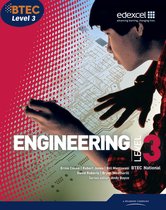
You will receive 8 pages fully detailed assignment answer to the following question: P3 Describe mechanical, physical, thermal and electrical and magnetic properties and state one practical application of each property in an engineering context P4 :Describe the effects on the properties and behaviour of processing metals, polymers, ceramics and composites and of post-production use of smart materials. P5Use information sources to select a different material for two given applications, describing the criteria considered in the selection process. D1:Justify your selection of an engineering material for one given application describing the reasons the selection meets the criteria. Describe a different process of degradation associated with each of metals, polymers and ceramics. Part of Assignment 2 - Failure and Degradation of Engineering Materials BTEC Level 3 Extended Diploma in Engineering: Unit 10 – Properties and Applications of Engineering Systems Know the structure of and classify engineering materials Atomic structure: element; atom eg nucleus, electron; compound; molecule; mixture; bonding mechanisms eg covalent, ionic, metallic Structure of metals: lattice structure; grain structure; crystals; crystal growth; alloying eg interstitial, substitutional; phase equilibrium diagrams eg eutectic, solid solution, combination; intermetallic compounds Structure of polymeric materials: monomer; polymer; polymer chains eg linear, branched, cross-linked; crystallinity; glass transition temperature Structure of ceramics: amorphous; crystalline; bonded Structure of composites: particulate; fibrous; laminated Structure of smart materials: crystalline; amorphous; metallic Classification of metals: ferrous eg plain carbon steel, cast iron (grey, white, malleable, wrought iron), stainless and heat-resisting steels (austenitic, martensitic, ferritic); non-ferrous eg aluminium, copper, gold, lead, silver, titanium, zinc; non-ferrous alloys eg aluminium-copper heat treatable – wrought and cast, non-heat-treatable – wrought and cast, copper-zinc (brass), copper-tin (bronze), nickel-titanium alloy. Classification of non-metals (synthetic): thermoplastic polymeric materials eg acrylic, polytetrafluoroethylene (PTFE), polythene, polyvinyl chloride (PVC), nylon, polystyrene; thermosetting polymeric materials eg phenol-formaldehyde, melamine formaldehyde, urea-formaldehyde; elastomers; ceramics eg glass, porcelain, cemented carbides; composites eg laminated, fibre reinforced (carbon fibre, glass reinforced plastic (GRP)), concrete, particle reinforced, sintered; smart materials eg electro rheostatic (ER) fluids, magneto-rheostatic (MR) fluids, piezoelectric crystals. Classification of non-metals (natural): eg wood, rubber, diamond Know material properties and the effects of processing on the structure and behaviour of engineering materials Mechanical properties: strength (tensile, shear, compressive); hardness; toughness; ductility; malleability; elasticity; brittleness Physical properties: density; melting temperature Thermal properties: expansivity; conductivity Electrical and magnetic properties: conductivity; resistivity; permeability; permittivity Effects of processing metals: recrystallisation temperature; grain structure eg hot working, cold working, grain growth; alloying elements in steel eg manganese, phosphorous, silicon, sulphur, chromium, nickel Effects of processing thermoplastic polymers: polymer processing temperature; process parameters eg mould temperature, injection pressure, injection speed, mould clamping force, mould open and closed time Effects of processing thermoplastic polymers: polymer processing temperature; process parameters eg mould temperature, injection pressure, injection speed, mould clamping force, mould open and closed time Effects of processing thermosetting polymers: process parameters eg moulding pressure and time, mould temperature, curing Effects of processing ceramics: eg water content of clay, sintering pressing force, firing temperature Effects of processing composites: fibres eg alignment to the direction of stress, ply direction; de-lamination; matrix/reinforcement ratio on tensile strength; particle reinforcement on cermets Effects of post-production use: smart materials eg impact (piezoelectric), electric field (electro-rheostatic), magnetic field (magneto-rheostatic), temperature (shape memory alloys), colour change (temperature or viscosity) Be able to use information sources to select materials for engineering uses Information sources: relevant standard specifications eg British Standards (BS), European Standards (EN), International Standards (ISO); material manufacturers’ and stockholders’ information eg data sheets, catalogues, websites, CD ROMs Design criteria: properties eg mechanical, physical, thermal, electrical and magnetic; surface finish; durability eg corrosion resistance, solvent resistance, impact resistance, wear resistance Cost criteria: initial cost eg raw material, processing, environmental impact, energy requirements; processing eg forming, machining, casting, joining (thermal, adhesive, mechanical); quantity; mode of delivery eg bulk, just-in-time (JIT); recycling Availability criteria: standard forms eg sheet and plate, bar-stock, pipe and tube, sectional, extrusions, ingots, castings, forgings, pressings, granular, powder, liquid Know about the modes of failure of engineering materials Principles of ductile and brittle fracture: effects of gradual and impact loading eg tensile, compressive, shear; effects of grain size; transition temperature; appearance of fracture surfaces Principles of fatigue: cyclic loading; effects of stress concentrations eg internal, external; effects of surface finish; appearance of fracture surfaces Principles of creep: primary; secondary; tertiary; effects of temperature; strain versus time curve; creep limit; effect of grain size; effect of variations in the applied stress Tests: destructive eg tensile, hardness, impact, ductility, fatigue, creep; non-destructive eg dye penetrant, ultrasonic, radiographic (x-ray, gamma ray), magnetic powder, visual Degradation processes: on metals eg oxidation, erosion, stress corrosion; on polymers eg solvent attack, radiation and ageing; on ceramics eg thermal shock, sustained high temperature

Meer zien Lees minder
Instelling
Vak


Oeps! We kunnen je document nu niet laden. Probeer het nog eens of neem contact op met support.

Gekoppeld boek

Geschreven voor

Study Level
Publisher
Subject
Course

Documentinformatie

Heel boek samengevat?
Ja
Geüpload op
8 juli 2020
Bestand laatst geupdate op
8 juli 2020
Aantal pagina's
10
Geschreven in
2019/2020
Type
Samenvatting

Onderwerpen

Voorbeeld van de inhoud

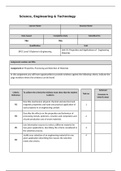
Science, Engineering & Technology


Learner Name Assessor Name


Date Issued Completion Date Submitted On

TBA TBA

Qualification Unit

Unit 10: Properties and Applications of Engineering
BTEC Level 3 Diploma in Engineering
Materials


Assignment number and title:


Assignment 2: Properties, Processing and Selection of Materials

In this assignment you will have opportunities to provide evidence against the following criteria, Indicate the
page numbers where the evidence can be found


Achieved
Criteria To achieve the criteria the evidence must show that the student
Task no. (Assessor to
Reference is able to
initial & date)

Describe mechanical, physical, thermal and electrical and
P3 magnetic properties and state one practical application of 1
each property in an engineering context

Describe the effects on the properties and behaviour of
P4 processing metals, polymers, ceramics and composites and 2
of post-production use of smart materials.

Use information sources to select a different material for
P5 two given applications, describing the criteria considered in 3
the selection process.

Justify your selection of an engineering material for one 4
given application describing the reasons the selection
D1
meets the criteria.

€5,89
Krijg toegang tot het volledige document:

100% tevredenheidsgarantie
Direct beschikbaar na je betaling
Lees online óf als PDF
Geen vaste maandelijkse kosten


Ook beschikbaar in voordeelbundel

Beoordelingen van geverifieerde kopers

Alle 2 reviews worden weergegeven
2 jaar geleden

4 jaar geleden

4,0

2 beoordelingen

5
1
4
0
3
1
2
0
1
0
Betrouwbare reviews op Stuvia

Alle beoordelingen zijn geschreven door echte Stuvia-gebruikers na geverifieerde aankopen.

Maak kennis met de verkoper

Seller avatar
De reputatie van een verkoper is gebaseerd op het aantal documenten dat iemand tegen betaling verkocht heeft en de beoordelingen die voor die items ontvangen zijn. Er zijn drie niveau’s te onderscheiden: brons, zilver en goud. Hoe beter de reputatie, hoe meer de kwaliteit van zijn of haar werk te vertrouwen is.
itslalawork The University of Nottingham
Volgen Je moet ingelogd zijn om studenten of vakken te kunnen volgen
Verkocht
31
Lid sinds
5 jaar
Aantal volgers
22
Documenten
8
Laatst verkocht
11 maanden geleden

4,0

8 beoordelingen

5
4
4
0
3
4
2
0
1
0

Recent door jou bekeken

Waarom studenten kiezen voor Stuvia

Gemaakt door medestudenten, geverifieerd door reviews

Kwaliteit die je kunt vertrouwen: geschreven door studenten die slaagden en beoordeeld door anderen die dit document gebruikten.

Niet tevreden? Kies een ander document

Geen zorgen! Je kunt voor hetzelfde geld direct een ander document kiezen dat beter past bij wat je zoekt.

Betaal zoals je wilt, start meteen met leren

Geen abonnement, geen verplichtingen. Betaal zoals je gewend bent via iDeal of creditcard en download je PDF-document meteen.

Student with book image

“Gekocht, gedownload en geslaagd. Zo makkelijk kan het dus zijn.”

Alisha Student

Veelgestelde vragen