WGU C713 Business Law Exam Study Guide 2025
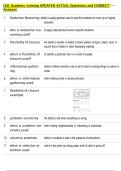
the tendency to decide current rulings based on previous cases, only binding in lower courts - precedent judge made law, often created through many precedents - common law gives the right to interpret laws and determine their validity - judicial power legislature to become a law - statutes bill (congress), simple majority in house and senate -> president (veto power) -> 2/3 in house and senate -> statute - laws order to stop doing something - injunction most government agencies are created by congress - true laws created by government agencies - regulations made by the president, ratified by senate by 2/3rds - treaties let the decision stand - stare decisis Law is what the ruling power says it is. - Legal Positivism It does not matter what is written as law, only those who enforce the law and how they enforce it. - Legal Realism A body of unchanging moral principles regarded as a basis for all human conduct - Natural Law laws made by an administrative agencies - administrative law New issue, unpopular judicial ruling, criminal law. - Reasons for a new law Plain meaning rule, Legislative history and intent, Public policy - Three steps in statutory interpretation ICC Interstate Commerce Commission (trains) - first administrative agency federal agencies, under the president's control - executive agencies agencies not under presidential control - independent agencies Congress passing enabling legislation - How is an agency created? agency rules that act as statutes - Legislative rules agency rules that are an interpretation of what the law already requires - Interpretive rules Notice and comment method - Informal Rulemaking Congress requires an agency to hold a public hearing where affected parties can question agency experts. - Formal Rulemaking An agency employee who acts as an impartial decision maker - administrative law judge Negligence that leads to injury, property damage, or financial loss. - unintentional tort Duty of care, breach, factual cause, proximate cause, damages - elements a plaintiff must prove to win negligence Each of us has a duty to behave as a reasonable person would under the circumstances - duty of care if a legal duty of care exists, then a plaintiff must show that the defendant did not meet it - breach of duty When a legislature sets a minimum standard of care for a particular activity, in order to protect a certain group of people, and a violation of the statute injures a member of that group, the defendant has committed negligence per se. A plaintiff that can show this need not prove breach of duty - negligence per se If the defendant's breach led to the ultimate harm - factual cause For the defendant to be liable, the type of harm must have been reasonably foreseeable - proximate cause "the thing speaks for itself" the facts imply that the defendant's negligence caused the accident, unless the defendant can prove otherwise - res ipsa loquitur to speak the truth - voir dire A person who voluntarily enters a situation that has an obvious danger cannot complain if she is injured - assumption of risk if the plaintiff is even slightly negligent, they recover nothng - contributory negligence a plaintiff may generally recover even if they are partially responsible - comparative negligence A branch of tort law that imposes a much higher level of liability when harm results from ultra hazardous acts or defective products - strict liability a defendant engaging in this activity is almost always liable for any harm that results and plaintiffs do not have to prove duty or breach or foreseeable harm - ultrahazardous activity claiming a juror has demonstrated probable bias - challenges for cause The right to excuse a juror for for virtually any reason - peremptory challenges Used in civil courts, this is used to show that there is a greater than 50% chance, based upon all of the reasonable evidence, that the defendant did wrong and caused damage. - preponderance of the evidence a ruling that the plaintiff has entirely failed to prove some aspect of her case - directed verdict a mistake by the trial judge that was too minor to affect the outcome - harmless error a neutral third party that has the power to impose an award - arbitration Offer, acceptance, consideration, legality, capacity, consent, writing - Elements required to create a contract both parties make a promise - bilateral contract one party makes a promise that the other party can accept only by actually doing something - unilateral contract a contract that has been made but the conditions have not yet been fulfilled - executory contract when all parties have fulfilled their obligations - executed contract satisfies all of the law's requirements. - valid contract occurs when the parties intend to form a valid bargain, but a court declares that some rule of law prevents enforcing it - unenforceable agreement A contract that can be enforced, usually used when only one party is bound to the contract. - voidable contract Agreements that are contrary to law. - void agreement A promise is enforceable by law, even if made without formal consideration. - promissory estoppel An obligation that one party has to another, as determined by a court, when an actual contract does not exist. - quasi-contract governs many aspects of commerce, trade, negotiable instruments, bank deposits, letters of credit, investment securities, secured transactions, and other commercial matters - Uniform Commercial Code two parties explicitly state all the important terms of their agreement - express contract the words and conduct of the parties indicate that they intended an agreement - implied contract as much as he deserves - quantum meruit a promise that doesn't really promise anything - illusory promise the legal ability to enter a contract - capacity contracts created with minors are generally voidable - true disaffirm or rescind - options available to minors Necessaries (must pay for the value of the benefit received), Misrepresentation of Age - exceptions to contracts with minors type of contract created with a mentally impaired person - usually a voidable contract a void contract with a mentally impaired person - adjudicated incompetent the defendant knew the statement was false or that he made the statement recklessly and without knowledge of whether it was false; the false statement was material; and the injured party justifiably relied on the statement. - three things a party must show to rescind a contract based on fraud or misrepresentations rescinding the contract or suing for damages or both - plaintiff's remedies fraud was not intentionally or recklessly made - innocent misrepresentation nondisclosure of fact amounts to misrepresentation in four cases: where disclosure is necessary to correct a previous assertion, a basic mistaken assumption that the other party is relying on, the other party's mistaken understanding about a writing, or where there is a relationship of trust between two parties - special problem of silence when one party enters a contract under a mistaken assumption; the other is not mistaken - unilateral mistake when both parties share the same mistake, the contract is voidable by either party - mutual mistake a relationship between two parties either of trust or of domination and improper persuasion by the stronger party - undue influence

Geschreven voor
- Instelling
- Western Governors University
- Vak
- WGU C713 (C713)
Documentinformatie
- Geüpload op
- 25 maart 2025
- Aantal pagina's
- 14
- Geschreven in
- 2024/2025
- Type
- Tentamen (uitwerkingen)
- Bevat
- Vragen en antwoorden
Onderwerpen
-
wgu
-
c713
-
wgu c713
-
wgu c713 business law exam
-
wgu c713 business law exam study guide 2025