Week 1: Media Systems Characteristics
Definitions
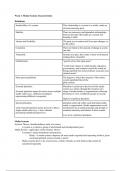
Irreducibility of a system This relationship is a system is a whole, made up
of interconnecting parts
Stability There are necessary and dependent relationships
between the parts that make up a system and
keeping it stable
Variety and flexibility The parts are in motion and if one part changes, so
do the others
Constraint There are limits to the amount of change a system
can take
Vulnerable Systems are open, they relate to their environment
making them vulnerable
Globalization “growth of ties that span space”
“world wide climate in which people, industries,
governments, and countries across the world are
being propelled into closer political, economic and
cultural union”.
Party-press parallelism The degree to which the structure of the media
system paralleled that of the
party system.
External pluralism Pluralism is achieved at the level of the media
system as a whole, through the existence of a
External pluralism means diversity across multiple range of media outlets or organizations reflecting
media outlets (e.g., different newspapers the points of view of different groups in society.
representing different viewpoints),
High level political pluralism
Internal pluralism pluralism achieved within each individual media
outlet or organization. Media organizations avoid
while internal pluralism means diversity within a institutional ties to political groups and attempt to
single media outlet (e.g., a news channel maintain neutrality and balance in their content.
presenting multiple perspectives).
Low level of political pluralism
Media Systems
Systems Theory: Interdisciplinary study of systems.
- A system is a cohesive group of interrelated and interdependent parts
Media System - application of the Systems Theory:
- A country’s media institutions and practices.
- Hardy: “a media system comprises all mass media organized and operating within a given
social and political system (usually a state)”.
- Media systems have to be conceived as a whole; includes several features that cannot be
considered separately
, - Includes procedures, routines and cultures that connect these media outlets to the surrounding
context
- They recreate and modify themselves through reactions to changes in other social systems.
Systems maintain coherence while continuously adapting to the external influences
- A system is a methodological tool, used for comparative research
Hallin & Mancini
“A media system is a country’s complex structure of media institutions and practices that interact with and
shape one another, and which is structurally and historically linked to the political and economic system”.
1. There are characteristic patterns of relationships between media, political and economic systems
2. not homogenous, not the result of a single ideology
3. Composed of many elements, differing in normative expectations and regulations
4. Results from path dependency: meaningful patterns of historical development (the outcome
depends on the historical path of developments)
5. National media systems are subject to change = globalisation
Assessing a media system: There are four dimensions that classify individual countries’ media systems.
- Useful to understand the dynamics of media and politics in different contexts
- These dimensions create particular constellations (models).
Media Markets: Political Parallelism:
How is media produced, financed, consumed? Media’s engagement and alliances with
particular social groups/ideologies
Media System
Media Professionalization: Role of the State (State intervention in the
Level of professionalism we see in the media. media):
Rules and norms of operation and evaluation Media’s relations with actors and institutions
of media outputs of political power.
(professional autonomy, routines, norms, (Media policies, censorship, regulation)
associations)
Issues of instrumentalisation: the control of
media by political or outside actors.
Example to Media System:
Media Markets:
Italian audiences rely heavily on TV for news, satellite subscriptions are popular. Another leader wants
in on the market.
Political Parallelism:
Most TV channels follow the opinions of the party in charge. Newspapers are more independent.
Media Professionalisation:
Journalists follow the network policy, not independent. Reporting is influenced by the owner of the
network.
Role of the State:
Party in charge is using state regulations to stop another leader from entering the Italian market.
Global Comparison of Media Systems
,Relevance of (cross-national) comparison?
- Comparison is a basic social-scientific research activity
- Research is always comparative
- Cross national comparison is methodological tool
- Comparison is always done across variables
Hallin & Mancini:
- Basic functions of comparative analysis: Concept formation, clarification
- Explaining casual interference
Comparative analysis makes us understand variation and similarity in media systems:
- We notice the unnoticed before and hence had not been conceptualized
- Forces us to clarify the scope and applicability of the concepts we employ
Aims of cross-national comparisons:
1. Seeks distinctions, identify similarities/differences
2. Enhance the understanding of phenomena
3. Search for how and why differences occur
BUT when dealing with cross-national comparisons, we need to abandon subjective arguments, cultural
bias and ethnocentrism.
Mainly make comparisons between countries but also compare 3 main sub sectors:
1. News and Journalism
2. TV
3. Digital (internet) Media
All have a massive impact.
Why is the internet different from the two other subsectors?
Most global, common source for information, has effects that go beyond national boundaries.
Media systems are affected by globalization.
Drivers of globalisation:
- Main driver is economics. Central impetus is corporate profit marketing
- International travel: trend to travel
- Communication technology: facilitate international communication, more foreign content
- Global media conglomerates: giant parent corporation, amalgamation of subsidiaries, companies
that are scattered access the world, have great local autonomy within individual countries
- They are very complex organizations that have been greatly diversified through
consolidation.
- Audience curiosity: changing consumption patterns.
- People become more interested in foreign cultures and media content, increase in
consumerism
Theorists of globalisation: “diminishment of national boundaries and the increase of nation state
powers.”
Globalisation & Commercialisation of Media: led to convergence and homogenisation of media
systems
Are we moving towards a global media system?
, NO
- Continues to be shaped by national characteristics (traditions, language, geography, economics,
powers etc.)
- Remains to a big degree national in organisation and orientation
- Nation states still determine to a high degree how media industries and markets are organised and
what media services are provided/received
Comparative analysis can help traditional studies and new media and globalization perspectives.
- Nation-states should not be displaced too readily in the study of contemporary media systems.
- A majority of media sites are still nationally based
- A lot of global content is nationalized
- People actually prefer local content
- Traditionally, loyalty, geography, economics, political systems, power structure and international
relations.
- Media systems remain to a significant degree national in organization and orientation.
1. The development of media markets and mass press – influence on media systems
Audiences addressed:
- South EU: small elite group, educated, politically active, horizontal, low circulation, subsidized
by government.
- North EU, USA: mass public, not engaged with political world, high circulation, strong
commercial media enterprises
Horizontal Process Vertical Process
Interelite communication, more influenced by Mediation between political elite and ordinary
political factors (Southern EU), discussion among citizens
elites Less political influence (North EU, USA)
Gender Differences in media consumption:
- South EU: large gender difference, women were excluded from the political world and never had
a habit of newspaper reading.
- Other influences (readership, local, regional, and national newspapers, etc.)
Quality newspapers: The New York Times, objective, no effect of commercial interest
2. Political parallelism:
Degree to which media outlets reflect and reinforce political divisions in society, describes the extent to
which the press or other media are aligned with specific political parties, ideologies, or viewpoints.
- Journalism will never be neutral (objective) because there is always a bias
- Political orientation of the media: Influence of political parties on the media
High: Biased, subjective
Low: Unbiased, objective
Definitions
Irreducibility of a system This relationship is a system is a whole, made up
of interconnecting parts
Stability There are necessary and dependent relationships
between the parts that make up a system and
keeping it stable
Variety and flexibility The parts are in motion and if one part changes, so
do the others
Constraint There are limits to the amount of change a system
can take
Vulnerable Systems are open, they relate to their environment
making them vulnerable
Globalization “growth of ties that span space”
“world wide climate in which people, industries,
governments, and countries across the world are
being propelled into closer political, economic and
cultural union”.
Party-press parallelism The degree to which the structure of the media
system paralleled that of the
party system.
External pluralism Pluralism is achieved at the level of the media
system as a whole, through the existence of a
External pluralism means diversity across multiple range of media outlets or organizations reflecting
media outlets (e.g., different newspapers the points of view of different groups in society.
representing different viewpoints),
High level political pluralism
Internal pluralism pluralism achieved within each individual media
outlet or organization. Media organizations avoid
while internal pluralism means diversity within a institutional ties to political groups and attempt to
single media outlet (e.g., a news channel maintain neutrality and balance in their content.
presenting multiple perspectives).
Low level of political pluralism
Media Systems
Systems Theory: Interdisciplinary study of systems.
- A system is a cohesive group of interrelated and interdependent parts
Media System - application of the Systems Theory:
- A country’s media institutions and practices.
- Hardy: “a media system comprises all mass media organized and operating within a given
social and political system (usually a state)”.
- Media systems have to be conceived as a whole; includes several features that cannot be
considered separately
, - Includes procedures, routines and cultures that connect these media outlets to the surrounding
context
- They recreate and modify themselves through reactions to changes in other social systems.
Systems maintain coherence while continuously adapting to the external influences
- A system is a methodological tool, used for comparative research
Hallin & Mancini
“A media system is a country’s complex structure of media institutions and practices that interact with and
shape one another, and which is structurally and historically linked to the political and economic system”.
1. There are characteristic patterns of relationships between media, political and economic systems
2. not homogenous, not the result of a single ideology
3. Composed of many elements, differing in normative expectations and regulations
4. Results from path dependency: meaningful patterns of historical development (the outcome
depends on the historical path of developments)
5. National media systems are subject to change = globalisation
Assessing a media system: There are four dimensions that classify individual countries’ media systems.
- Useful to understand the dynamics of media and politics in different contexts
- These dimensions create particular constellations (models).
Media Markets: Political Parallelism:
How is media produced, financed, consumed? Media’s engagement and alliances with
particular social groups/ideologies
Media System
Media Professionalization: Role of the State (State intervention in the
Level of professionalism we see in the media. media):
Rules and norms of operation and evaluation Media’s relations with actors and institutions
of media outputs of political power.
(professional autonomy, routines, norms, (Media policies, censorship, regulation)
associations)
Issues of instrumentalisation: the control of
media by political or outside actors.
Example to Media System:
Media Markets:
Italian audiences rely heavily on TV for news, satellite subscriptions are popular. Another leader wants
in on the market.
Political Parallelism:
Most TV channels follow the opinions of the party in charge. Newspapers are more independent.
Media Professionalisation:
Journalists follow the network policy, not independent. Reporting is influenced by the owner of the
network.
Role of the State:
Party in charge is using state regulations to stop another leader from entering the Italian market.
Global Comparison of Media Systems
,Relevance of (cross-national) comparison?
- Comparison is a basic social-scientific research activity
- Research is always comparative
- Cross national comparison is methodological tool
- Comparison is always done across variables
Hallin & Mancini:
- Basic functions of comparative analysis: Concept formation, clarification
- Explaining casual interference
Comparative analysis makes us understand variation and similarity in media systems:
- We notice the unnoticed before and hence had not been conceptualized
- Forces us to clarify the scope and applicability of the concepts we employ
Aims of cross-national comparisons:
1. Seeks distinctions, identify similarities/differences
2. Enhance the understanding of phenomena
3. Search for how and why differences occur
BUT when dealing with cross-national comparisons, we need to abandon subjective arguments, cultural
bias and ethnocentrism.
Mainly make comparisons between countries but also compare 3 main sub sectors:
1. News and Journalism
2. TV
3. Digital (internet) Media
All have a massive impact.
Why is the internet different from the two other subsectors?
Most global, common source for information, has effects that go beyond national boundaries.
Media systems are affected by globalization.
Drivers of globalisation:
- Main driver is economics. Central impetus is corporate profit marketing
- International travel: trend to travel
- Communication technology: facilitate international communication, more foreign content
- Global media conglomerates: giant parent corporation, amalgamation of subsidiaries, companies
that are scattered access the world, have great local autonomy within individual countries
- They are very complex organizations that have been greatly diversified through
consolidation.
- Audience curiosity: changing consumption patterns.
- People become more interested in foreign cultures and media content, increase in
consumerism
Theorists of globalisation: “diminishment of national boundaries and the increase of nation state
powers.”
Globalisation & Commercialisation of Media: led to convergence and homogenisation of media
systems
Are we moving towards a global media system?
, NO
- Continues to be shaped by national characteristics (traditions, language, geography, economics,
powers etc.)
- Remains to a big degree national in organisation and orientation
- Nation states still determine to a high degree how media industries and markets are organised and
what media services are provided/received
Comparative analysis can help traditional studies and new media and globalization perspectives.
- Nation-states should not be displaced too readily in the study of contemporary media systems.
- A majority of media sites are still nationally based
- A lot of global content is nationalized
- People actually prefer local content
- Traditionally, loyalty, geography, economics, political systems, power structure and international
relations.
- Media systems remain to a significant degree national in organization and orientation.
1. The development of media markets and mass press – influence on media systems
Audiences addressed:
- South EU: small elite group, educated, politically active, horizontal, low circulation, subsidized
by government.
- North EU, USA: mass public, not engaged with political world, high circulation, strong
commercial media enterprises
Horizontal Process Vertical Process
Interelite communication, more influenced by Mediation between political elite and ordinary
political factors (Southern EU), discussion among citizens
elites Less political influence (North EU, USA)
Gender Differences in media consumption:
- South EU: large gender difference, women were excluded from the political world and never had
a habit of newspaper reading.
- Other influences (readership, local, regional, and national newspapers, etc.)
Quality newspapers: The New York Times, objective, no effect of commercial interest
2. Political parallelism:
Degree to which media outlets reflect and reinforce political divisions in society, describes the extent to
which the press or other media are aligned with specific political parties, ideologies, or viewpoints.
- Journalism will never be neutral (objective) because there is always a bias
- Political orientation of the media: Influence of political parties on the media
High: Biased, subjective
Low: Unbiased, objective