3. Substantive Rights: Equality and Non
Discrimination
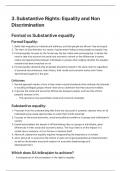
Formal vs Substantive equality
Formal Equality:
1. Belief that inequality is irrational and arbitrary, and that people are all born free and equal.
2. The harm of discrimination is a result of government failing to treat people as equally free.
3. Formal equality focuses on the formal way the law treats each person/group. It denies the
need to take into account the social and economic context or the differences in power,
status and opportunities between individuals or groups when judging whether the equality
standard has been breached or not.
4. Formal equality demands that all people should be treated in the same manner regardless
of personal circumstances, their history, their social and economic status and if been
discriminated against in the past
Criticisms
1. Neutral approach masks a form of bias where neutral standards often embody the interests
of socially privileged groups whose views are so dominant that they become invisible.
2. It ignores the social and economic differences between people, and how this affects
people’s chances in life.
• This ignorance may exacerbate social and economic inequality
Substantive equality:
1. Proceeds from the understanding that there are structural or systemic reasons why not all
individuals enjoy equal opportunities to reach their full life potential.
2. Focuses on the actual economic, social and political conditions of groups and individuals in
society
3. Examines/considers the impact of differentiating rules on groups or individuals, given
differences in their social and economic status. The focus here is on the impact of a
certain law or measure, not on the law or measure itself.
4. Above all, substantive equality requires foregrounding the importance of context.
5. Aims, above all, to overcome the effects of past and ongoing prejudice and discrimination
as well as the broader structural reasons for economic disadvantage and
disempowerment.
Which does SA follow/aim to achieve?
• Consequences of this conception of the right to equality:
, ◦ The right cannot entail a guarantee that all people should be treated identically at
times. The right should be viewed as entailing more than a formal prohibition against
discrimination
◦ Right must guarantee more than equality before the law and must focus on the effect
or impact of legal rules or other differentiating treatment on individuals. The idea of
substantive equality best captures this approach to equality jurisprudence
• Courts have to apply a contextual analysis. Focus on the impact of the treatment itself.
◦ Values underlying the right to equality is dignity and equality
◦ Hugo: Court placed human dignity at the heart of its equality enquiry
◦ Dignity at the heart of s 9
◦ Criticism: too much emphasis on prejudice, not enough emphasis on economic and
other structural inequality? Too much on individual
◦ Can get around this if you define dignity in the second sense. Not in individual terms.
Equal opportunity to make meaningful life choices community based
ATTACKING THE CONSTITUTIONALITY OF A
LEGISLATIVE PROVISION:
SECTION 9
• When a distinction between different people stems from a legislative provision and the
litigant asks a court to declare the provision invalid, the court has to rely directly on s
9(1), 9(2) or 9(3) of the C – these apply in different situations and require different tests
• Direct reliance on s 9 is needed because legislation can only be invalidated by invoking
the Constitution itself
• Where a litigant attacks the actions of a public official or private entity on equality
grounds, but this attack doesn’t relate to the possible invalidation of a provision, the
litigant will rely on the relevant provisions of PEPUDA
• This is because of the principle subsidiarity: requires that a litigant who claims their right
to be infringed to rely on a legislative provision if there is one
• 9(1) CASES OF DIFFERENTIATION: cases where the legislative provision differentiates
between people or groups but this differentiation is not based on one of the grounds
listed in s 9(3) or an analogous ground that is similar to the grounds explicitly listed in
9(3)
◦ Difference between differentiation and discrimination? Arbitrary distinctions (e.g.
tattoos). Law is about making distinctions, not all speak to injustice/unfairness in the
past or present.
◦ Use rationality test: what is the purpose for distinction? Means used? Rational
connection? (Note, the question is not asking if it is wise or if there is better reasons)
2
Discrimination
Formal vs Substantive equality
Formal Equality:
1. Belief that inequality is irrational and arbitrary, and that people are all born free and equal.
2. The harm of discrimination is a result of government failing to treat people as equally free.
3. Formal equality focuses on the formal way the law treats each person/group. It denies the
need to take into account the social and economic context or the differences in power,
status and opportunities between individuals or groups when judging whether the equality
standard has been breached or not.
4. Formal equality demands that all people should be treated in the same manner regardless
of personal circumstances, their history, their social and economic status and if been
discriminated against in the past
Criticisms
1. Neutral approach masks a form of bias where neutral standards often embody the interests
of socially privileged groups whose views are so dominant that they become invisible.
2. It ignores the social and economic differences between people, and how this affects
people’s chances in life.
• This ignorance may exacerbate social and economic inequality
Substantive equality:
1. Proceeds from the understanding that there are structural or systemic reasons why not all
individuals enjoy equal opportunities to reach their full life potential.
2. Focuses on the actual economic, social and political conditions of groups and individuals in
society
3. Examines/considers the impact of differentiating rules on groups or individuals, given
differences in their social and economic status. The focus here is on the impact of a
certain law or measure, not on the law or measure itself.
4. Above all, substantive equality requires foregrounding the importance of context.
5. Aims, above all, to overcome the effects of past and ongoing prejudice and discrimination
as well as the broader structural reasons for economic disadvantage and
disempowerment.
Which does SA follow/aim to achieve?
• Consequences of this conception of the right to equality:
, ◦ The right cannot entail a guarantee that all people should be treated identically at
times. The right should be viewed as entailing more than a formal prohibition against
discrimination
◦ Right must guarantee more than equality before the law and must focus on the effect
or impact of legal rules or other differentiating treatment on individuals. The idea of
substantive equality best captures this approach to equality jurisprudence
• Courts have to apply a contextual analysis. Focus on the impact of the treatment itself.
◦ Values underlying the right to equality is dignity and equality
◦ Hugo: Court placed human dignity at the heart of its equality enquiry
◦ Dignity at the heart of s 9
◦ Criticism: too much emphasis on prejudice, not enough emphasis on economic and
other structural inequality? Too much on individual
◦ Can get around this if you define dignity in the second sense. Not in individual terms.
Equal opportunity to make meaningful life choices community based
ATTACKING THE CONSTITUTIONALITY OF A
LEGISLATIVE PROVISION:
SECTION 9
• When a distinction between different people stems from a legislative provision and the
litigant asks a court to declare the provision invalid, the court has to rely directly on s
9(1), 9(2) or 9(3) of the C – these apply in different situations and require different tests
• Direct reliance on s 9 is needed because legislation can only be invalidated by invoking
the Constitution itself
• Where a litigant attacks the actions of a public official or private entity on equality
grounds, but this attack doesn’t relate to the possible invalidation of a provision, the
litigant will rely on the relevant provisions of PEPUDA
• This is because of the principle subsidiarity: requires that a litigant who claims their right
to be infringed to rely on a legislative provision if there is one
• 9(1) CASES OF DIFFERENTIATION: cases where the legislative provision differentiates
between people or groups but this differentiation is not based on one of the grounds
listed in s 9(3) or an analogous ground that is similar to the grounds explicitly listed in
9(3)
◦ Difference between differentiation and discrimination? Arbitrary distinctions (e.g.
tattoos). Law is about making distinctions, not all speak to injustice/unfairness in the
past or present.
◦ Use rationality test: what is the purpose for distinction? Means used? Rational
connection? (Note, the question is not asking if it is wise or if there is better reasons)
2