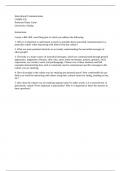
Intercultural Communication
COMM 335
Professor Diane Carter
University of Idaho
Instructions:
Create a 400- 800--word blog post in which you address the following:
1. Why is it important to understand as much as possible about nonverbal communication in a
particular culture when interacting with others from that culture?
2. What are some potential obstacles to accurately understanding the nonverbal messages of
other people?
3. The body is a major source of nonverbal messages, which are communicated through general
appearance, judgments of beauty, skin color, attire, body movements, posture, gestures, facial
expressions, eye contact, touch, and paralanguage. Choose two of these elements and find
examples demonstrating how each is commonly used to communicate specific messages in the
culture you are studying.
4. How do people in the culture you are studying use personal space? How comfortable do you
think you would be interacting with others using their cultural norms for sitting, standing in line,
etc.?
5. How does the culture you are studying organize time? In other words, is it a monochronic or
polychronic culture? How important is punctuality? Why is it important to know the answers to
these questions?
COMM 335
Professor Diane Carter
University of Idaho
Instructions:
Create a 400- 800--word blog post in which you address the following:
1. Why is it important to understand as much as possible about nonverbal communication in a
particular culture when interacting with others from that culture?
2. What are some potential obstacles to accurately understanding the nonverbal messages of
other people?
3. The body is a major source of nonverbal messages, which are communicated through general
appearance, judgments of beauty, skin color, attire, body movements, posture, gestures, facial
expressions, eye contact, touch, and paralanguage. Choose two of these elements and find
examples demonstrating how each is commonly used to communicate specific messages in the
culture you are studying.
4. How do people in the culture you are studying use personal space? How comfortable do you
think you would be interacting with others using their cultural norms for sitting, standing in line,
etc.?
5. How does the culture you are studying organize time? In other words, is it a monochronic or
polychronic culture? How important is punctuality? Why is it important to know the answers to
these questions?