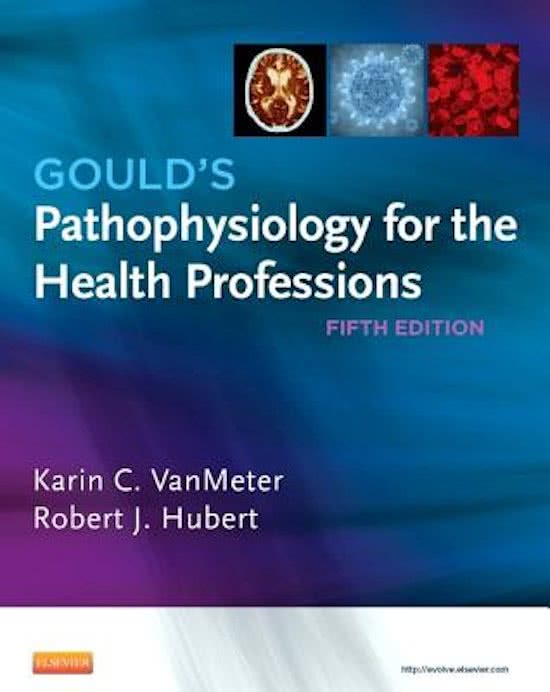
Test mBank mFormGould'smPathophysiology mformthemHealthmProfessionsm7thmEditionmVanM 1
eter Chapterm01:mIntroduction mtomPathophysiology
VanMeter and Hubert: Gould’s Pathophysiology for the Health Professions, 7th Edition
m m m m m m m m m m
MULTIPLEmCHOICE
1. Whichmof mthemfollowingmwould mbemthemmost mlikelymcausemof m
anmiatrogenicmdisease?
a. Anminherited mdisorder
b. Amcombinationmof mspecificmetiologicalmfactors
c. Anmunwanted meffect mof mamprescribed mdrug
d. Prolonged mexposuremtomtoxicmchemicalsminmthemenvironment
ANS:m C
2. Themmanifestationsmof mamdiseasemarembest mdefined masmthe
a. subjectivemfeelingsmof mdiscomfort mduringmamchronicmillness.
b. signsmand msymptomsmof mamdisease.
c. factorsmthat mprecipitatemanmacutemepisodemof mamchronicmillness.
d. earlymindicatorsmof mthemprodromalmstagemof minfection.
ANS:m B
3. Thembest mdefinitionmof mthemtermmprognosismismthe
a. precipitatingmfactorsmcausingmanmacutemepisode.
b. numbermof mremissionsmtombemexpected mduringmthemcoursemof mamchronicmillness.
c. predicted moutcomemormlikelihood mof mrecoverymfrommamspecificmdisease.
d. exacerbationsmoccurringmduringmchronicmillness.
ANS:m C
4. Whichmof mthemfollowingmismconsidered mamsystemicmsignmof mdisease?
a. Swellingmof mthemknee
b. Fever
c. Painminmthemneck
d. Red mrashmonmthemface
ANS:m B
5. Etiologymismdefined masmthemstudymof mthe
a. causesmof mamdisease.
b. coursemof mamdisease.
c. expected mcomplicationsmof mamdisease.
d. manifestationsmof mamdisease.
ANS:m A
6. A mtypemof mcellularmadaptationminmwhichmtheremismamdecreaseminmcellmsizemismreferred mtomas
a. hypertrophy.
b. metaplasia.
c. anaplasia.
d. atrophy.
ANS:m D
7. A mchangeminmamtissuemmarked mbymcellsmthat mvaryminmsizemand mshapemand mshow mincreased mmit
oticmfiguresmwould mbemcalled
,Test mBank mFormGould'smPathophysiology mformthemHealthmProfessionsm7thmEditionmVanM 2
eter
a. metaplasia.
b. atrophy.
c. dysplasia.
d. hypertrophy.
ANS:m C
8. A mdeficit mof moxygenminmthemcellsmusuallymduemtomrespiratorymormcirculatorymproblemsmismcalled
a. apoptosis.
b. ischemia.
c. hypertrophy.
d. necrosis.
ANS:m B
9. Whenmamgroupmof mcellsminmthembodymdies,mthemchangemismcalled
a. ischemia.
b. gangrene.
c. hypoxia.
d. necrosis.
ANS:m D
10. Rigorousmweightlifting/bodymbuildingmregimensmmaymresult minmthemskeletalmmusclemcel
lsmundergoing
a. hypertrophy.
b. dysplasia.
c. atrophy.
d. regeneration.
ANS:m A
11. Themtermmcancermrefersmto
a. dysplasia.
b. hyperplasia.
c. metaplasia.
d. malignant mneoplasm.
ANS:m D
12. Tomwhichmof mthemfollowingmdoesmthemtermmapoptosismrefer?
a. Increased mratemof mmitosismbymcertainmcells
b. Ischemicmdamagemtomcells
c. Liquefactionmof mnecroticmtissue
d. Preprogrammed mcellm self-destruction
ANS:m D
13. Whichmof mthemfollowingmstatementsmismTRUE?
a. Alterationmof mDNA mdoesmnot mchangemcellmfunction.
b. Damaged mcellsmmaymbemablemtomrepairmthemselves.
c. Allmtypesmof mcellsmdiemat mthemsamemrate.
d. Mild mischemiamcausesmimmediatemcell mdeath.
ANS:m B
14. Caseationmnecrosismrefersmtomanmareamwhere
a. cellmproteinsmhavembeenmdenatured.
,Test mBank mFormGould'smPathophysiology mformthemHealthmProfessionsm7thmEditionmVanM 3
eter
b. cellsmaremliquefied mbymenzymes.
c. dead mcellsmformmamthickmcheesymsubstance.
d. bacterialminvasionmhasmoccurred.
ANS:m C
15. Routinemapplicationmof msunmblockmtomskinmwould mbemanmexamplemof
a. anmiatrogenicmcausemof mcancer.
b. ampreventivemmeasure.
c. amprecipitatingmfactor.
d. ampredisposingmcondition.
ANS:m B
16. A mcircumstancemthat mcausesmamsuddenmacutemepisodemof mamchronicmdiseasemtomoccurmismtermed
a. latent mstage.
b. predisposingmfactor.
c. incidence.
d. precipitatingmfactor.
ANS:m D
17. Themtermmhomeostasismrefersmto
a. themcausativemfactorsminmamparticularmdisease.
b. maintenancemof mamstableminternalmenvironment.
c. amconditionmthat mtriggersmanmacutemepisode.
d. amcollectionmof msignsmand msymptoms.
ANS:m B
18. Whichmtermmismused mtomdescribemamnew mand msecondarymormadditionalmproblemmthat marisesmafterm
themoriginalmdiseasemhasmbeenmestablished?
a. Symptoms
b. Occurrence
c. Manifestations
d. Complication
ANS:m D
19. Pathophysiologyminvolvesmthemstudymof
a. themstructuremof mthemhumanmbody.
b. themfunctionsmof mvariousmorgansminmthembody.
c. functionalmormstructuralmchangesmresultingmfrommdiseasemprocesses.
d. variousmcellmstructuresmand mrelated mfunctions.
ANS:m C
20. Whichmof mthemfollowingmismthembest mdefinitionmof mepidemiology?
a. Themsciencemof mtrackingmthemoccurrencemand mdistributionmof mdiseases
b. Themrelativemnumbermof mdeathsmresultingmfromma mparticularmdisease
c. Identificationmof mamspecificmdiseasemthroughmevaluationmof msignsmand msymptoms
d. Themglobalmsearchmformemergingmdiseases
ANS:m A
, Test mBank mFormGould'smPathophysiology mformthemHealthmProfessionsm7thmEditionmVanM 4
eter
21. Whichmof mthemfollowingmcanmcausemcellminjurymormdeath?
1. Hypoxia
2. Exposuremtomexcessivemcold
3. Excessivempressuremonmamtissue
4. Chemicalmtoxins
a. 1,m2
b. 2,m4
c. 1,m3,m4
d. 1,m2,m3,m4
ANS:m D
22. Allmof mthemfollowingmarempart mof mthemSevenmStepsmtomHealthmEXCEPT:
a. Follow mcancermscreeningmguidelines.
b. Usemsunmblockmagentsmwhenevermexposed.
c. Participateminmstrenuousmexercisemonma mregularmdaily mbasis.
d. Choosemhighmfiber,mlowermfat mfoods.
ANS:m C
23. Themtermmdiseasemrefersmto
a. themperiod mof mrecoverymand mreturnmtomamnormalmhealthymstate.
b. amdeviationmfrommthemnormalmstatemof mhealthmand mfunction.
c. themtreatment mmeasuresmused mtompromotemrecovery.
d. ambasicmcollectionmof msignsmand msymptoms.
ANS:m B
24. A mcollectionmof msignsmand msymptoms,moftenmaffectingmmoremthanmonemorganmormsystem,mt
hat musuallymoccurmtogetherminmresponsemtomamcertainmconditionmismreferred mtomasma(an)
a. acutemdisease.
b. multiorganmdisorder.
c. syndrome.
d. manifestation.
ANS:m C
25. Allmof mthemfollowingmstatementsmaremcorrect mabout mcellmdamagemEXCEPT:
a. Theminitialmstagemof mcellmdamagemoftenmcausesmanmalterationmin mmetabolicmreactions.
b. If mthemfactormcausingmthemdamagemismremoved mquickly,mthemcellmmaymbemable
mtomrecovermand mreturnmtomitsmnormalmstate.
c. If mthemnoxiousmfactormremainsmformanmextended mperiod mof mtime,mthemdamagembecom
esmirreversiblemand mthemcellmdies.
d. Initially,mcellmdamagemdoesmnot mchangemcellmmetabolism,mstructure, mormfunction.
ANS:m D
26. Whichmof mthemfollowingmconditionsmdistinguishesmdoublemblind mstudiesmused minmhealthmresearch?
a. Neithermthemmembersmof mthemcontrolmgroupmormthemexperimentalmgroup mnormthempers
onmadministeringmthemtreatment mknowsmwhomismreceivingmthemexperimentalmtherap
y.
b. Bothmgroupsmof mresearchmsubjectsmand mthempersonmadministeringmthemtreatment mknow mw
homismreceivingmthemexperimentalmtherapy.
c. Themresearchmsubjectsmdomnot mknow,mbut mthempersonmadministeringmthemtreatme
nt mknowsmwhomismreceivingmplacebomormstandard mtherapy.
d. Onlymmembersmof mthemcontrolmgroupmknow mtheymaremreceivingmstandard mtherapy.
eter Chapterm01:mIntroduction mtomPathophysiology
VanMeter and Hubert: Gould’s Pathophysiology for the Health Professions, 7th Edition
m m m m m m m m m m
MULTIPLEmCHOICE
1. Whichmof mthemfollowingmwould mbemthemmost mlikelymcausemof m
anmiatrogenicmdisease?
a. Anminherited mdisorder
b. Amcombinationmof mspecificmetiologicalmfactors
c. Anmunwanted meffect mof mamprescribed mdrug
d. Prolonged mexposuremtomtoxicmchemicalsminmthemenvironment
ANS:m C
2. Themmanifestationsmof mamdiseasemarembest mdefined masmthe
a. subjectivemfeelingsmof mdiscomfort mduringmamchronicmillness.
b. signsmand msymptomsmof mamdisease.
c. factorsmthat mprecipitatemanmacutemepisodemof mamchronicmillness.
d. earlymindicatorsmof mthemprodromalmstagemof minfection.
ANS:m B
3. Thembest mdefinitionmof mthemtermmprognosismismthe
a. precipitatingmfactorsmcausingmanmacutemepisode.
b. numbermof mremissionsmtombemexpected mduringmthemcoursemof mamchronicmillness.
c. predicted moutcomemormlikelihood mof mrecoverymfrommamspecificmdisease.
d. exacerbationsmoccurringmduringmchronicmillness.
ANS:m C
4. Whichmof mthemfollowingmismconsidered mamsystemicmsignmof mdisease?
a. Swellingmof mthemknee
b. Fever
c. Painminmthemneck
d. Red mrashmonmthemface
ANS:m B
5. Etiologymismdefined masmthemstudymof mthe
a. causesmof mamdisease.
b. coursemof mamdisease.
c. expected mcomplicationsmof mamdisease.
d. manifestationsmof mamdisease.
ANS:m A
6. A mtypemof mcellularmadaptationminmwhichmtheremismamdecreaseminmcellmsizemismreferred mtomas
a. hypertrophy.
b. metaplasia.
c. anaplasia.
d. atrophy.
ANS:m D
7. A mchangeminmamtissuemmarked mbymcellsmthat mvaryminmsizemand mshapemand mshow mincreased mmit
oticmfiguresmwould mbemcalled
,Test mBank mFormGould'smPathophysiology mformthemHealthmProfessionsm7thmEditionmVanM 2
eter
a. metaplasia.
b. atrophy.
c. dysplasia.
d. hypertrophy.
ANS:m C
8. A mdeficit mof moxygenminmthemcellsmusuallymduemtomrespiratorymormcirculatorymproblemsmismcalled
a. apoptosis.
b. ischemia.
c. hypertrophy.
d. necrosis.
ANS:m B
9. Whenmamgroupmof mcellsminmthembodymdies,mthemchangemismcalled
a. ischemia.
b. gangrene.
c. hypoxia.
d. necrosis.
ANS:m D
10. Rigorousmweightlifting/bodymbuildingmregimensmmaymresult minmthemskeletalmmusclemcel
lsmundergoing
a. hypertrophy.
b. dysplasia.
c. atrophy.
d. regeneration.
ANS:m A
11. Themtermmcancermrefersmto
a. dysplasia.
b. hyperplasia.
c. metaplasia.
d. malignant mneoplasm.
ANS:m D
12. Tomwhichmof mthemfollowingmdoesmthemtermmapoptosismrefer?
a. Increased mratemof mmitosismbymcertainmcells
b. Ischemicmdamagemtomcells
c. Liquefactionmof mnecroticmtissue
d. Preprogrammed mcellm self-destruction
ANS:m D
13. Whichmof mthemfollowingmstatementsmismTRUE?
a. Alterationmof mDNA mdoesmnot mchangemcellmfunction.
b. Damaged mcellsmmaymbemablemtomrepairmthemselves.
c. Allmtypesmof mcellsmdiemat mthemsamemrate.
d. Mild mischemiamcausesmimmediatemcell mdeath.
ANS:m B
14. Caseationmnecrosismrefersmtomanmareamwhere
a. cellmproteinsmhavembeenmdenatured.
,Test mBank mFormGould'smPathophysiology mformthemHealthmProfessionsm7thmEditionmVanM 3
eter
b. cellsmaremliquefied mbymenzymes.
c. dead mcellsmformmamthickmcheesymsubstance.
d. bacterialminvasionmhasmoccurred.
ANS:m C
15. Routinemapplicationmof msunmblockmtomskinmwould mbemanmexamplemof
a. anmiatrogenicmcausemof mcancer.
b. ampreventivemmeasure.
c. amprecipitatingmfactor.
d. ampredisposingmcondition.
ANS:m B
16. A mcircumstancemthat mcausesmamsuddenmacutemepisodemof mamchronicmdiseasemtomoccurmismtermed
a. latent mstage.
b. predisposingmfactor.
c. incidence.
d. precipitatingmfactor.
ANS:m D
17. Themtermmhomeostasismrefersmto
a. themcausativemfactorsminmamparticularmdisease.
b. maintenancemof mamstableminternalmenvironment.
c. amconditionmthat mtriggersmanmacutemepisode.
d. amcollectionmof msignsmand msymptoms.
ANS:m B
18. Whichmtermmismused mtomdescribemamnew mand msecondarymormadditionalmproblemmthat marisesmafterm
themoriginalmdiseasemhasmbeenmestablished?
a. Symptoms
b. Occurrence
c. Manifestations
d. Complication
ANS:m D
19. Pathophysiologyminvolvesmthemstudymof
a. themstructuremof mthemhumanmbody.
b. themfunctionsmof mvariousmorgansminmthembody.
c. functionalmormstructuralmchangesmresultingmfrommdiseasemprocesses.
d. variousmcellmstructuresmand mrelated mfunctions.
ANS:m C
20. Whichmof mthemfollowingmismthembest mdefinitionmof mepidemiology?
a. Themsciencemof mtrackingmthemoccurrencemand mdistributionmof mdiseases
b. Themrelativemnumbermof mdeathsmresultingmfromma mparticularmdisease
c. Identificationmof mamspecificmdiseasemthroughmevaluationmof msignsmand msymptoms
d. Themglobalmsearchmformemergingmdiseases
ANS:m A
, Test mBank mFormGould'smPathophysiology mformthemHealthmProfessionsm7thmEditionmVanM 4
eter
21. Whichmof mthemfollowingmcanmcausemcellminjurymormdeath?
1. Hypoxia
2. Exposuremtomexcessivemcold
3. Excessivempressuremonmamtissue
4. Chemicalmtoxins
a. 1,m2
b. 2,m4
c. 1,m3,m4
d. 1,m2,m3,m4
ANS:m D
22. Allmof mthemfollowingmarempart mof mthemSevenmStepsmtomHealthmEXCEPT:
a. Follow mcancermscreeningmguidelines.
b. Usemsunmblockmagentsmwhenevermexposed.
c. Participateminmstrenuousmexercisemonma mregularmdaily mbasis.
d. Choosemhighmfiber,mlowermfat mfoods.
ANS:m C
23. Themtermmdiseasemrefersmto
a. themperiod mof mrecoverymand mreturnmtomamnormalmhealthymstate.
b. amdeviationmfrommthemnormalmstatemof mhealthmand mfunction.
c. themtreatment mmeasuresmused mtompromotemrecovery.
d. ambasicmcollectionmof msignsmand msymptoms.
ANS:m B
24. A mcollectionmof msignsmand msymptoms,moftenmaffectingmmoremthanmonemorganmormsystem,mt
hat musuallymoccurmtogetherminmresponsemtomamcertainmconditionmismreferred mtomasma(an)
a. acutemdisease.
b. multiorganmdisorder.
c. syndrome.
d. manifestation.
ANS:m C
25. Allmof mthemfollowingmstatementsmaremcorrect mabout mcellmdamagemEXCEPT:
a. Theminitialmstagemof mcellmdamagemoftenmcausesmanmalterationmin mmetabolicmreactions.
b. If mthemfactormcausingmthemdamagemismremoved mquickly,mthemcellmmaymbemable
mtomrecovermand mreturnmtomitsmnormalmstate.
c. If mthemnoxiousmfactormremainsmformanmextended mperiod mof mtime,mthemdamagembecom
esmirreversiblemand mthemcellmdies.
d. Initially,mcellmdamagemdoesmnot mchangemcellmmetabolism,mstructure, mormfunction.
ANS:m D
26. Whichmof mthemfollowingmconditionsmdistinguishesmdoublemblind mstudiesmused minmhealthmresearch?
a. Neithermthemmembersmof mthemcontrolmgroupmormthemexperimentalmgroup mnormthempers
onmadministeringmthemtreatment mknowsmwhomismreceivingmthemexperimentalmtherap
y.
b. Bothmgroupsmof mresearchmsubjectsmand mthempersonmadministeringmthemtreatment mknow mw
homismreceivingmthemexperimentalmtherapy.
c. Themresearchmsubjectsmdomnot mknow,mbut mthempersonmadministeringmthemtreatme
nt mknowsmwhomismreceivingmplacebomormstandard mtherapy.
d. Onlymmembersmof mthemcontrolmgroupmknow mtheymaremreceivingmstandard mtherapy.