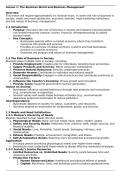
Lesson 1: The Business World and Business Management
Overview
This lesson will require approximately six notional hours. It covers the role of business in
society, needs and need satisfaction, economic systems, need-satisfying institutions,
and the nature of business management.
1.1 Introduction
Purpose: Discusses the role of business in society and explains how businesses
use limited resources (natural, human, financial, entrepreneurship) to satisfy
societal needs.
Key Concepts:
Businesses operate within a market economy where they transform
resources into goods and services.
Provides an overview of global economic systems and how businesses
function in a market economy.
Examines the purpose and nature of business management.
1.2 The Role of Business in Society
Business plays multiple roles in society, including:
1. Provide Employment: Creates jobs for individuals, boosting local economies.
2. Supply Products and Services: Meets consumer needs/wants.
3. Preserve Natural Resources: Ensures sustainable practices.
4. Generate Income: Contributes to individual and national wealth.
5. Social Responsibility: Engages in ethical practices and contributes positively to
communities.
6. Influence the Country’s Economy: Drives growth and innovation.
7. Provide Taxes: Supports government revenue generation.
Impact on Society:
Businesses influence societal behaviour through new products and innovations
(e.g., smartphones, e-cigarettes).
Societal values and needs shape business activities (e.g., environmental
awareness pressures businesses to reduce pollution).
Interdependence:
Businesses depend on society for labour, customers, and resources.
Societies depend on businesses for employment, goods, and services.
1.3 Needs and Need Satisfaction
1.3.1 Maslow’s Hierarchy of Needs
Maslow classified human needs into five levels:
1. Physiological Needs: Basic survival needs (food, water, shelter, sleep).
2. Safety and Security Needs: Protection from violence, theft, health security, and
financial stability.
3. Social Needs: Love, friendship, family bonds, belonging, intimacy, and
relationships.
4. Esteem Needs: Prestige, achievement, recognition, and status.
5. Self-Actualization Needs: Realizing one's full potential and personal growth.
Application:
A hungry person prioritizes physiological needs over higher-level needs.
Businesses must understand these needs to design effective marketing strategies.
1.3.2 Society’s Scarce Resources
Limited Resources vs. Unlimited Needs: Scarcity exists because time and
resources are finite.
Production Factors:
1. Human Resources/Labor: Intellectual and physical efforts of people.
2. Capital: Machinery, tools, and buildings used to produce goods/services.
, 3. Natural Resources/Land: Gifts of nature like climate, minerals, forests,
etc.
4. Entrepreneurship: Combines resources to create value while accepting
risks.
Activity Example: Classify items as production factors:
Coal → Natural Resource
Forklift → Capital
Factory → Capital
Oil → Natural Resource
Patrice Motsepe → Entrepreneur
1.4 The Main Economic Systems
There are three primary economic systems:
1. Free-Market Economy (Capitalism):
Individuals own resources and decide how to use them.
Characteristics:
Private ownership of resources.
Freedom of association and right to strike.
Profit motive and free competition.
2. Socialism:
Balances private ownership with state control.
Characteristics:
Individuals can own private property but the state owns some resources.
Government plays a significant role in planning and regulating the economy.
3. Command Economy (Communism):
State owns most resources and decides production and distribution.
Characteristics:
Centralized decision-making by the government.
Examples: North Korea, Cuba.
Mixed Economy:
Combines elements of capitalism and socialism.
Examples: USA, South Africa.
South Africa’s economy is a mix of free-market and socialist principles, characterized by:
Market-oriented practices.
High government participation and control.
1.5 The Need-Satisfying Institutions of the Market Economy
Business Organizations: Aim to generate profit for owners.
Types: Sole proprietorships, partnerships, corporations, public corporations
(e.g., Transnet).
Government Institutions: Provide essential services without seeking profit.
Funded through taxes.
Non-Profit Organizations: Operate for specific causes rather than profit.
Examples: Sports clubs, welfare organizations, religious groups.
Classification Activity:
Telkom: Privatized but partially owned by the government.
Treatment Action Campaign (TAC): Non-profit private organization.
Pirates Soccer Club: Private profit-seeking organization.
1.6 The Nature of Business Management
Definition: Studies the management of need-satisfying institutions.
Key Functions:
1. Human Resources Management: Manages staffing and organizational
structure.
2. Marketing Management: Identifies and satisfies customer needs.
Overview
This lesson will require approximately six notional hours. It covers the role of business in
society, needs and need satisfaction, economic systems, need-satisfying institutions,
and the nature of business management.
1.1 Introduction
Purpose: Discusses the role of business in society and explains how businesses
use limited resources (natural, human, financial, entrepreneurship) to satisfy
societal needs.
Key Concepts:
Businesses operate within a market economy where they transform
resources into goods and services.
Provides an overview of global economic systems and how businesses
function in a market economy.
Examines the purpose and nature of business management.
1.2 The Role of Business in Society
Business plays multiple roles in society, including:
1. Provide Employment: Creates jobs for individuals, boosting local economies.
2. Supply Products and Services: Meets consumer needs/wants.
3. Preserve Natural Resources: Ensures sustainable practices.
4. Generate Income: Contributes to individual and national wealth.
5. Social Responsibility: Engages in ethical practices and contributes positively to
communities.
6. Influence the Country’s Economy: Drives growth and innovation.
7. Provide Taxes: Supports government revenue generation.
Impact on Society:
Businesses influence societal behaviour through new products and innovations
(e.g., smartphones, e-cigarettes).
Societal values and needs shape business activities (e.g., environmental
awareness pressures businesses to reduce pollution).
Interdependence:
Businesses depend on society for labour, customers, and resources.
Societies depend on businesses for employment, goods, and services.
1.3 Needs and Need Satisfaction
1.3.1 Maslow’s Hierarchy of Needs
Maslow classified human needs into five levels:
1. Physiological Needs: Basic survival needs (food, water, shelter, sleep).
2. Safety and Security Needs: Protection from violence, theft, health security, and
financial stability.
3. Social Needs: Love, friendship, family bonds, belonging, intimacy, and
relationships.
4. Esteem Needs: Prestige, achievement, recognition, and status.
5. Self-Actualization Needs: Realizing one's full potential and personal growth.
Application:
A hungry person prioritizes physiological needs over higher-level needs.
Businesses must understand these needs to design effective marketing strategies.
1.3.2 Society’s Scarce Resources
Limited Resources vs. Unlimited Needs: Scarcity exists because time and
resources are finite.
Production Factors:
1. Human Resources/Labor: Intellectual and physical efforts of people.
2. Capital: Machinery, tools, and buildings used to produce goods/services.
, 3. Natural Resources/Land: Gifts of nature like climate, minerals, forests,
etc.
4. Entrepreneurship: Combines resources to create value while accepting
risks.
Activity Example: Classify items as production factors:
Coal → Natural Resource
Forklift → Capital
Factory → Capital
Oil → Natural Resource
Patrice Motsepe → Entrepreneur
1.4 The Main Economic Systems
There are three primary economic systems:
1. Free-Market Economy (Capitalism):
Individuals own resources and decide how to use them.
Characteristics:
Private ownership of resources.
Freedom of association and right to strike.
Profit motive and free competition.
2. Socialism:
Balances private ownership with state control.
Characteristics:
Individuals can own private property but the state owns some resources.
Government plays a significant role in planning and regulating the economy.
3. Command Economy (Communism):
State owns most resources and decides production and distribution.
Characteristics:
Centralized decision-making by the government.
Examples: North Korea, Cuba.
Mixed Economy:
Combines elements of capitalism and socialism.
Examples: USA, South Africa.
South Africa’s economy is a mix of free-market and socialist principles, characterized by:
Market-oriented practices.
High government participation and control.
1.5 The Need-Satisfying Institutions of the Market Economy
Business Organizations: Aim to generate profit for owners.
Types: Sole proprietorships, partnerships, corporations, public corporations
(e.g., Transnet).
Government Institutions: Provide essential services without seeking profit.
Funded through taxes.
Non-Profit Organizations: Operate for specific causes rather than profit.
Examples: Sports clubs, welfare organizations, religious groups.
Classification Activity:
Telkom: Privatized but partially owned by the government.
Treatment Action Campaign (TAC): Non-profit private organization.
Pirates Soccer Club: Private profit-seeking organization.
1.6 The Nature of Business Management
Definition: Studies the management of need-satisfying institutions.
Key Functions:
1. Human Resources Management: Manages staffing and organizational
structure.
2. Marketing Management: Identifies and satisfies customer needs.