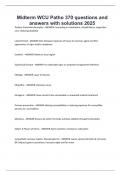
Midterm WCU Patho 370 questions and
answers with solutions 2025
Tertiary Prevention Examples - ANSWER Counseling on medication; rehabilitation; supportive
care; reducing disability
Latent Period - ANSWER time between exposure of tissue to injurious agent and first
appearance of signs and/or symptoms
Endemic - ANSWER Native to local region
Subclinical Disease - ANSWER no noticeable signs or symptoms (inapparent infection)
Etiology - ANSWER cause of disease
Idiopathic - ANSWER unknown cause
latrogenic - ANSWER Cause results from unintended or unwanted medical treatment
Primary prevention - ANSWER altering susceptibility or reducing exposure for susceptible
persons ex: vaccinations
Allostasis - ANSWER process by which the body achieves stability through homeostatis
Selye's 3 Phases of Stress - ANSWER Alarm reaction; resistance; exhaustian
sympathetic nervous system: Norepinephrine - ANSWER causes vasoconstriction & increases
BP; Reduces gastric secretions; increases night and far vision
,sympathetic nervous system: epinephrine - ANSWER enhances myocardial contractility;
increases HR & CO; causes bronchiodilation; increases glucose release from liver
Hormones released during the stress response - ANSWER Cortisol
Antidiuretic Hormone (ADH)
Norepinephrine
Epinephrine
Endorphines
Oxytocin
RAA pathway (renin-angiotensin-aldosterone)
Types of intracellular accumulation - ANSWER -Excessive amounts of normal intracellular
substance
-Abnormal substances from faulty matabolism synthesis
-particles that the cell is unable to degrade
Cellular adaptation types - ANSWER -Atrophy: Decrease cell size
-Hypertrophy: increase cell size
-Hyperplasia: increase cell number
-Metaplasia: conversion of one cell type to another
-Dysplasia: disorderly growth
Coagulative necrosis - ANSWER this process begins with ischemia, ends with degradation of
plasma membrane (heart)
, Liquefactive necrosis - ANSWER liquification of lysosomal enzymes, formation of abscess or cyst
from dissolved dead tissue (brain)
Fat necrosis - ANSWER death of adipose tissue, appears as chalk white area ,usually due to
trauma or pancreatitis (pancreas)
Caseous Necrosis - ANSWER characteristic of lung damage secondary to tuberculosis (bacterial
infection; resembles clumpy cheese (lung)
Apoptosis - ANSWER programmed cell death
Side effects of chemotherapy - ANSWER anemia
nausea
bleeding
infections
-oma - ANSWER tumor
carcinoma - ANSWER cancerous tumor (begins in kin or tissue that lines or covers body organs)
sarcoma - ANSWER malignant tumor (begins in bone or in soft tissue of the body)
staging - ANSWER the process of classifying tumors with respect to how far the disease has
progressed, the potential for its responding to therapy, and the patient's prognosis (stage 0 to 4)
grading - ANSWER a way to classify cancer cells & is done by a pathologist
answers with solutions 2025
Tertiary Prevention Examples - ANSWER Counseling on medication; rehabilitation; supportive
care; reducing disability
Latent Period - ANSWER time between exposure of tissue to injurious agent and first
appearance of signs and/or symptoms
Endemic - ANSWER Native to local region
Subclinical Disease - ANSWER no noticeable signs or symptoms (inapparent infection)
Etiology - ANSWER cause of disease
Idiopathic - ANSWER unknown cause
latrogenic - ANSWER Cause results from unintended or unwanted medical treatment
Primary prevention - ANSWER altering susceptibility or reducing exposure for susceptible
persons ex: vaccinations
Allostasis - ANSWER process by which the body achieves stability through homeostatis
Selye's 3 Phases of Stress - ANSWER Alarm reaction; resistance; exhaustian
sympathetic nervous system: Norepinephrine - ANSWER causes vasoconstriction & increases
BP; Reduces gastric secretions; increases night and far vision
,sympathetic nervous system: epinephrine - ANSWER enhances myocardial contractility;
increases HR & CO; causes bronchiodilation; increases glucose release from liver
Hormones released during the stress response - ANSWER Cortisol
Antidiuretic Hormone (ADH)
Norepinephrine
Epinephrine
Endorphines
Oxytocin
RAA pathway (renin-angiotensin-aldosterone)
Types of intracellular accumulation - ANSWER -Excessive amounts of normal intracellular
substance
-Abnormal substances from faulty matabolism synthesis
-particles that the cell is unable to degrade
Cellular adaptation types - ANSWER -Atrophy: Decrease cell size
-Hypertrophy: increase cell size
-Hyperplasia: increase cell number
-Metaplasia: conversion of one cell type to another
-Dysplasia: disorderly growth
Coagulative necrosis - ANSWER this process begins with ischemia, ends with degradation of
plasma membrane (heart)
, Liquefactive necrosis - ANSWER liquification of lysosomal enzymes, formation of abscess or cyst
from dissolved dead tissue (brain)
Fat necrosis - ANSWER death of adipose tissue, appears as chalk white area ,usually due to
trauma or pancreatitis (pancreas)
Caseous Necrosis - ANSWER characteristic of lung damage secondary to tuberculosis (bacterial
infection; resembles clumpy cheese (lung)
Apoptosis - ANSWER programmed cell death
Side effects of chemotherapy - ANSWER anemia
nausea
bleeding
infections
-oma - ANSWER tumor
carcinoma - ANSWER cancerous tumor (begins in kin or tissue that lines or covers body organs)
sarcoma - ANSWER malignant tumor (begins in bone or in soft tissue of the body)
staging - ANSWER the process of classifying tumors with respect to how far the disease has
progressed, the potential for its responding to therapy, and the patient's prognosis (stage 0 to 4)
grading - ANSWER a way to classify cancer cells & is done by a pathologist