Summary #1 learning & memory
Cognitive views of learning
Information processing model/theory
= a dominant theory of learning and memory since the 1970’s. about processing,
storage, retrieval of knowledge.
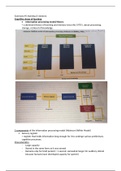
3 components of the information processing model (Atkinson-Shiffrin Model)
1. Sensory register
= register that holds information long enough for it to undergo various preliminary
cognitive processes.
Characteristics
- Large capacity
- Stored in the same form as it was sensed
- Remains only for brief period (< 1 second, somewhat longer for auditory stimuli
because humans have developed capacity for speech)
, IMPORTANT
perception is not the same as reception
is the interpretation of stimuli/assigning meaning to a stimulus.
Data driven (BOTTUM UP)
= features are extracted/analyzed and organized into patterns (aka gestalt)
Conceptually driven (TOP DOWN)
= features detected are combined in light of context and prior knowledge
Role of attention to transfer information to working memory (WM)
= focused cognitive processing of particular aspects of the environment.
we must pay attention to information from the sensory register in order to get it into WM
Factors influencing attention
- Motion
- Size
- Intensity
- Novelty
- Incongruity
- Social cues
- Emotion
- Personal significance
attention is a limited source, give up attending to other stimuli
Educational implication
Pay attention to information for it to be retained
Takes time to bring information into consciousness
2. Working memory
= storage mechanism that holds information for a brief time after it’s attended to (=
short term memory) + some cognitive processing takes place here.
Characteristics
- Limited capacity (magical number 7±2) chunking* as strategy to cram in more
- Much information is stored in auditory form (when info is language based)
- Short duration (< 30 seconds and in many cases even shorter)
Alan baddely: elements of WM
1. Central executive : controls attention & resources; head of the head
2. Phonological loop : holds verbal and acoustical information STM
3. Visuospatial sketchpad : for visual/spatial information
Cognitive views of learning
Information processing model/theory
= a dominant theory of learning and memory since the 1970’s. about processing,
storage, retrieval of knowledge.
3 components of the information processing model (Atkinson-Shiffrin Model)
1. Sensory register
= register that holds information long enough for it to undergo various preliminary
cognitive processes.
Characteristics
- Large capacity
- Stored in the same form as it was sensed
- Remains only for brief period (< 1 second, somewhat longer for auditory stimuli
because humans have developed capacity for speech)
, IMPORTANT
perception is not the same as reception
is the interpretation of stimuli/assigning meaning to a stimulus.
Data driven (BOTTUM UP)
= features are extracted/analyzed and organized into patterns (aka gestalt)
Conceptually driven (TOP DOWN)
= features detected are combined in light of context and prior knowledge
Role of attention to transfer information to working memory (WM)
= focused cognitive processing of particular aspects of the environment.
we must pay attention to information from the sensory register in order to get it into WM
Factors influencing attention
- Motion
- Size
- Intensity
- Novelty
- Incongruity
- Social cues
- Emotion
- Personal significance
attention is a limited source, give up attending to other stimuli
Educational implication
Pay attention to information for it to be retained
Takes time to bring information into consciousness
2. Working memory
= storage mechanism that holds information for a brief time after it’s attended to (=
short term memory) + some cognitive processing takes place here.
Characteristics
- Limited capacity (magical number 7±2) chunking* as strategy to cram in more
- Much information is stored in auditory form (when info is language based)
- Short duration (< 30 seconds and in many cases even shorter)
Alan baddely: elements of WM
1. Central executive : controls attention & resources; head of the head
2. Phonological loop : holds verbal and acoustical information STM
3. Visuospatial sketchpad : for visual/spatial information