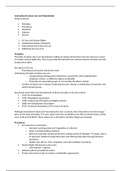
International Labour Law and Globalisation
Wrap up lecture
Principles
Procedures
Standards
Subjects
Sources
1. ILO Law and Human Rights
2. Fundamental Labour Standards
3. International Social Security Law
4. Additional Sources of ILL
Principles
Principles of labour law in an international setting are mainly derived from ILO, but also have a basis
in broader Human Rights law. They’re generally also derived from national systems of labour law and
fundamental rights.
Key rights of ILO are:
- Promoting social justice and decent work
Underlying principles of Labour law are:
o Compensating existing power-imbalances caused inter alia by globalization
(employer-worker, or different regions worldwide)
o Protection of vulnerable groups in- and outside the labour market
- Creation of labour law is always a balancing exercise: Always a combination of economic and
social interests/issues
Documents that reflect the development of these principles in the ILO context:
1919: ILO Constitution
1944: Philadelphia Declaration
1998: Fundamental Principles and Rights at Work
2008: Fair Globalization Declaration
2019: Centenary Declaration of The Future of Work
Although international labour law has existed for over a century, there have been very few changes
done on the basic principles. The core values from the constitutions are still as relevant today as they
were at the end of WW2. These values are re-iterated in all other things we reviewed.
Procedures
ILO supervisory mechanism
o Has been working pretty well (regardless of criticism)
o Doesn’t include binding sanctions
o Based on triparteid consensual decision making and social dialogue unique, idea is
to approach solution through discussion and offering help often through technical
assistance.
o CEACR, CAS, GB, ILC, CFA, complaints and representation procedures
Human Rights Mechanisms and courts
o International / regional
National judicial and political system
Private instruments (code of conduct, stakeholder agreements)
Wrap up lecture
Principles
Procedures
Standards
Subjects
Sources
1. ILO Law and Human Rights
2. Fundamental Labour Standards
3. International Social Security Law
4. Additional Sources of ILL
Principles
Principles of labour law in an international setting are mainly derived from ILO, but also have a basis
in broader Human Rights law. They’re generally also derived from national systems of labour law and
fundamental rights.
Key rights of ILO are:
- Promoting social justice and decent work
Underlying principles of Labour law are:
o Compensating existing power-imbalances caused inter alia by globalization
(employer-worker, or different regions worldwide)
o Protection of vulnerable groups in- and outside the labour market
- Creation of labour law is always a balancing exercise: Always a combination of economic and
social interests/issues
Documents that reflect the development of these principles in the ILO context:
1919: ILO Constitution
1944: Philadelphia Declaration
1998: Fundamental Principles and Rights at Work
2008: Fair Globalization Declaration
2019: Centenary Declaration of The Future of Work
Although international labour law has existed for over a century, there have been very few changes
done on the basic principles. The core values from the constitutions are still as relevant today as they
were at the end of WW2. These values are re-iterated in all other things we reviewed.
Procedures
ILO supervisory mechanism
o Has been working pretty well (regardless of criticism)
o Doesn’t include binding sanctions
o Based on triparteid consensual decision making and social dialogue unique, idea is
to approach solution through discussion and offering help often through technical
assistance.
o CEACR, CAS, GB, ILC, CFA, complaints and representation procedures
Human Rights Mechanisms and courts
o International / regional
National judicial and political system
Private instruments (code of conduct, stakeholder agreements)