Data Processing in Geography: Full Summary
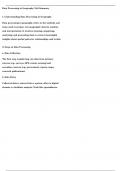
1. Understanding Data Processing in Geography
Data processing in geography refers to the methods and
steps used to prepare raw geographic data for analysis
and interpretation. It involves cleaning, organizing,
analyzing, and presenting data to extract meaningful
insights about spatial patterns, relationships, and trends.
2. Steps in Data Processing
a. Data Collection
The first step is gathering raw data from primary
sources (e.g., surveys, GPS, remote sensing) and
secondary sources (e.g., government reports, maps,
research publications).
b. Data Entry
Collected data is entered into a system, often in digital
formats, to facilitate analysis. Tools like spreadsheets,
, databases, and Geographic Information Systems (GIS) are
commonly used.
c. Data Cleaning
Removing duplicates or redundant entries.
Correcting errors in measurements or categorizations.
Handling missing or incomplete data by interpolation or
estimation.
d. Data Transformation
Converting data into a consistent format (e.g., converting
raw numbers to percentages or standardizing units like
kilometers or meters).
Aggregating data (e.g., combining data from different
sources for analysis).
Georeferencing: Associating geographic coordinates with
data points to ensure spatial accuracy.
e. Data Classification
Grouping data into categories to identify patterns. For
example:
1. Understanding Data Processing in Geography
Data processing in geography refers to the methods and
steps used to prepare raw geographic data for analysis
and interpretation. It involves cleaning, organizing,
analyzing, and presenting data to extract meaningful
insights about spatial patterns, relationships, and trends.
2. Steps in Data Processing
a. Data Collection
The first step is gathering raw data from primary
sources (e.g., surveys, GPS, remote sensing) and
secondary sources (e.g., government reports, maps,
research publications).
b. Data Entry
Collected data is entered into a system, often in digital
formats, to facilitate analysis. Tools like spreadsheets,
, databases, and Geographic Information Systems (GIS) are
commonly used.
c. Data Cleaning
Removing duplicates or redundant entries.
Correcting errors in measurements or categorizations.
Handling missing or incomplete data by interpolation or
estimation.
d. Data Transformation
Converting data into a consistent format (e.g., converting
raw numbers to percentages or standardizing units like
kilometers or meters).
Aggregating data (e.g., combining data from different
sources for analysis).
Georeferencing: Associating geographic coordinates with
data points to ensure spatial accuracy.
e. Data Classification
Grouping data into categories to identify patterns. For
example: