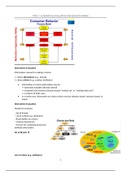
TOPIC 7: ALTERNATIVES EVALUATION AND DECISION MAKING
Alternatives Evaluation
Information relevant to making a choice:
➢ choice alternatives (e.g., brands)
➢ choice criteria (e.g., product attributes)
information on choice alternatives may be
➢ externally available (stimulus-based)
➢ retrieved from memory (memory-based “evoked set” or “consideration set”)
➢ a mixture of both cases
in a similar way, information on choice criteria may be stimulus-based, memory-based, or
mixed
Alternatives Evaluation
Needed to evaluate:
– Set of brands
– List of criteria (e.g. attributes)
– Brand beliefs on criteria
– Criteria importances
– Process for combining brand and
attribute information
Set of Brands
List of criteria (e.g. attributes)
1
,List of criteria (e.g. attributes)
The various features a consumer looks for in response to a particular type of problem
Type of evaluative criteria:
1) Core function (technical)
2) Financial & behavioral costs (economic)
3) Commanded & obliged (legalistic)
4) Esteem and self-esteem (integrative)
5) Risk reduction (adaptive)
6) Liking (intrinsic)
7) Moral
Process for combining brand and attribute information
2
,Choice Disjunctive Rule
Establishes a minimum required performance for each
important attribute (often a high level).
All brands that meet or exceed the performance level for any
key attribute are acceptable.
If minimum performance was:
Choice Compensatory Rule
The compensatory decision rule states that the brand that rates highest on the sum of the
consumer’s judgments of the relevant evaluative criteria will be chosen.
3
, High involvement choice … is often a staged process
Stage 1: Narrow the set of all alternatives (dozens of brands) to a smaller consideration (also
called evoked) set
- often done on basis of meeting the threshold on one or a few attributes
(= noncompensatory)
Stage 2: Choose the best alternative from the consideration set
- often done comparing some “weighted average scores” across cars (= compensatory)
Decision Making
Consumer Choice Processes
Attribute-based choices
– Have pre-determined evaluative criteria
– May require both external and internal search
– Complicated decision rules may be used
Affective choices
– More holistic; an overall evaluation
– Based on how one feels about a purchase
Affective choices
With affective decision making, consumers make a decision because the choice feels right
rather than because they have made a detailed, systematic evaluation of offerings
Appraisal theory examines how our emotions are determined by the way that we think about
or “appraise” the situation. This theory also explains how and why certain emotions can
affect future judgments and choices. People who are fearful tend to see more risk in new
situations than do people who are angry.
Affective forecasts and choices
Consumers’ predictions of what they will feel in the future affective forecasting—can
influence the choices they make today
Affective forecasting occurs when consumers try to predict how they will feel in a future
consumption situation. Specifically, they try to predict what feelings they will have, how
strongly these feelings will be, and how long the feelings will last
Imagery
Imagery plays a key role in emotional decision making. Consumers can attempt to imagine
themselves consuming the product or service and can use any emotions they experience as
input for the decision
Adding information actually makes imagery processing easier because more information
makes it easier for consumers to form an accurate image (whereas it may lead to information
overload under cognitive processing)
4
Alternatives Evaluation
Information relevant to making a choice:
➢ choice alternatives (e.g., brands)
➢ choice criteria (e.g., product attributes)
information on choice alternatives may be
➢ externally available (stimulus-based)
➢ retrieved from memory (memory-based “evoked set” or “consideration set”)
➢ a mixture of both cases
in a similar way, information on choice criteria may be stimulus-based, memory-based, or
mixed
Alternatives Evaluation
Needed to evaluate:
– Set of brands
– List of criteria (e.g. attributes)
– Brand beliefs on criteria
– Criteria importances
– Process for combining brand and
attribute information
Set of Brands
List of criteria (e.g. attributes)
1
,List of criteria (e.g. attributes)
The various features a consumer looks for in response to a particular type of problem
Type of evaluative criteria:
1) Core function (technical)
2) Financial & behavioral costs (economic)
3) Commanded & obliged (legalistic)
4) Esteem and self-esteem (integrative)
5) Risk reduction (adaptive)
6) Liking (intrinsic)
7) Moral
Process for combining brand and attribute information
2
,Choice Disjunctive Rule
Establishes a minimum required performance for each
important attribute (often a high level).
All brands that meet or exceed the performance level for any
key attribute are acceptable.
If minimum performance was:
Choice Compensatory Rule
The compensatory decision rule states that the brand that rates highest on the sum of the
consumer’s judgments of the relevant evaluative criteria will be chosen.
3
, High involvement choice … is often a staged process
Stage 1: Narrow the set of all alternatives (dozens of brands) to a smaller consideration (also
called evoked) set
- often done on basis of meeting the threshold on one or a few attributes
(= noncompensatory)
Stage 2: Choose the best alternative from the consideration set
- often done comparing some “weighted average scores” across cars (= compensatory)
Decision Making
Consumer Choice Processes
Attribute-based choices
– Have pre-determined evaluative criteria
– May require both external and internal search
– Complicated decision rules may be used
Affective choices
– More holistic; an overall evaluation
– Based on how one feels about a purchase
Affective choices
With affective decision making, consumers make a decision because the choice feels right
rather than because they have made a detailed, systematic evaluation of offerings
Appraisal theory examines how our emotions are determined by the way that we think about
or “appraise” the situation. This theory also explains how and why certain emotions can
affect future judgments and choices. People who are fearful tend to see more risk in new
situations than do people who are angry.
Affective forecasts and choices
Consumers’ predictions of what they will feel in the future affective forecasting—can
influence the choices they make today
Affective forecasting occurs when consumers try to predict how they will feel in a future
consumption situation. Specifically, they try to predict what feelings they will have, how
strongly these feelings will be, and how long the feelings will last
Imagery
Imagery plays a key role in emotional decision making. Consumers can attempt to imagine
themselves consuming the product or service and can use any emotions they experience as
input for the decision
Adding information actually makes imagery processing easier because more information
makes it easier for consumers to form an accurate image (whereas it may lead to information
overload under cognitive processing)
4