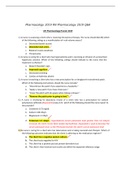
ATI TEAS 7 Practice Questions and Answers
Chemical bonding - a. Uses electrons that are closest to the nucleus of the atoms bonding b. Always uses electrons from only of the atoms involved c. Uses all the electrons in all atoms involved d. Uses the valence electrons of all the atoms involved D. Uses the valence electrons of all the atoms involved Which of the following would have the most dramatic effect in changing the reaction rate? a. Decreasing the temperature by two-fold b. Increasing the pressure by two-fold c. Decreasing the activation energy by three-fold d. Decreasing the concentration of reactants by two-fold C. Decreasing the activation energy by three-fold Group one in the periodic table has ____ valence electrons and is ___ reactive than Group two. a. Zero; more b. Zero; less c. One; less d. One; more C. One; less Enzymes are created from amino acid chains. As such, what might prevent the action of an enzyme? a. A pH close to 7 b. A high temperature c. The lack of hydrogen ions in solution d. A lack of ATP in the cell B. A high temperature If a scientists want to determine the rate at which an enzyme works, what could he or she measure? a. The rate at which the enzyme is degraded b. The rate at which the product disappears c. The rate at which the reactants disappear d. The rate at which the products appears D. The rate at which the products appears The rate of a chemical reaction depends on all of the following except a. Surface area b. Temperature c. Presence of catalysts d. Amount of mass lost d. Amount of mass lost Which of the answer choices provided best defines the following statement? For a given mass and constant temperature, an inverse relationship exists between the volume and pressure of a gas? a. Boyle's Law b. Ideal Gas Law c. Charles' Law d. Stefan-Boltzmann Law A. Boyle's law Prokaryotic and eukaryotic cells are similar in having which of the following? a. Integral membrane proteins in the plasma membrane b. Presence of a nucleus c. Membrane-bound organelles d. Protein-studded DNA A. Integral membrane proteins in the plasma membrane Blood cells that are responsible for transportation of oxygen are called a. Leukocytes b. Thrombocytes c. Erythrocytes d. Plasma cells C. Erythrocytes What is another name for the Adam's Apple? a. Vocal box b. Thyroid cartilage c. Cricoid cartilage d. Hyoid bone B. Thyroid cartilage When exhaling, the diaphragm a. Relaxes b. Contracts c. Moves down and in d. Stays in the same position A. Relaxes Which of the following correctly lists the cellular hierarchy from the simplest to most complex structure? a. Tissue, cell, organ, organ system, organism b. Organism, organ system, organ, tissue, cell c. Organ system, organism, organ, tissue, cell d. Cell, tissue, organ, organ system, organism D. Cell, tissue, organ, organ system, organism If a cell is placed in a hypertonic solution, what will happen to the cell? a. It does not affect the cell b. It will swill c. It will stay the same d. It will shrink D. It will shrink What is the longest phase of the cell cycle? a. Cytokinesis b. Interphase c. Metaphase d. Mitosis B. Interphase B = alleles for brown eyes; g = alleles for green eyes B g B Bg Bg g Bg gg What word describes the allele for green eyes? a. Heterozygous b. Dominant c. Recessive d. Homozygous C. Recessive What is the possibility that the offspring produces will have brown eyes? a. 100% b. 25% c. 75% d. 50% C. 75% What are groups of cells that perform the same function? a. Molecules b. Organs c. Plastids d. Tissues D. Tissues When does the nuclear division of somatic cells take place during cellular respiration? a. Mitosis b. Interphase c. Meiosis d. Cytokinesis A. mitosis Which group of major parts and organs make up the immune system? a. Lymphatic system, spleen, tonsils, thymus, and bone marrow b. Nose, trachea, bronchial tubes, lungs, alveolus, and diaphragm c. Brain, spinal cord, and nerve cells d. Heart, veins, arteries, and capillaries A.lymphatic system, spleen, tonsils, thymus, and bone marrow What is the role of ribosomes? a. Waste removal b. Make proteins c. Storage d. Transport B. Make proteins Which of the following is an example of a tissue? a. Mammal b. Xylem c. Liver d. Hamstring B. Xylem The adrenal glands are part of the a. Emphatic system b. Respiratory system c. Endocrine system d. Immune system C. Endocrine system Which of the following is exchanged between two or more atoms that undergo ionic bonding? a. Transitory electrons b. Electrical charges c. Neutrons d. Valence electrons D. Valence electrons Blood is prevented from changing direction in the veins by a. Pressure generated from the heart b. Valves c. Vacuum generated from the heart d. Squeezing at the vein by nearby skeletal muscle B. Valves The liquid part of the blood is called a. Plasma b. Blood fluid c. Serous fluid d. Serum A. Plasma Which of the following is true regarding the periodic table? a. Groups have the same number of valence electrons and similar chemical properties b. Periods are vertical columns c. Atomic radius increases as you go from left to right d. Alkali metals are frequently found by themselves in nature A. Groups have the same number of valence electrons and similar chemical properties A double bond between two atoms, for example the double bond between oxygen in O2 has how many electrons? a. 2 b. 4 c. 6 d. 8 B. 4 What is the anterior bone of the lower leg? a. Ulna b. Fibula c. Tibia d. Radius C. Tibia Assuming every variable unmentioned in the Ideal Gas Law remains constant, which is true? a. As the temperature increases, the pressure of a gas must decrease b. As the number of molecules in a gas increases, the temperature must increase c. As volume increases, the number of molecules must increase d. As pressure increases, volume must increase C. As volume increases, the number of molecules must increase The humerus and ulna form the a. Shoulder joint b. Elbow joint c. Wrist joint d. Knee joint B. Elbow joint The patella is also called the a. Breastbone b. Kneecap c. Finger bone d. Funny bone B. Kneecap The bone that is stationary during movement is called the a. Insertion b. Agonist c. Origin d. Antagonist C. Origin Which of the following is the process that produces a liquid fro a gas? a. Vaporization b. Condensation c. Sublimation d. Denitrification B. Condensation What is the primary function of the quadriceps muscle? a. Extend the knee joint b. Flex the knee joint c. Extend the hip joint d. Flew the hip joint A. Extend the knee joint Which part of the brain is responsible for higher brain functions? a. The pons b. The cerebral cortex c. The cerebellar cortex d. Medulla B. The cerebral cortex How many thoracic spinal nerves are there in the human body? a. 8 b. 9 c. 12 d. 14 B. 9 Which of the following is not a specialized sense? a. Touch b. Balance c. Sight d. Hearing A. Touch In which region of the small intestine are most of the nutrients absorbed? a. The jejunum b. The ileum c. The duodenum d. The colon A. Jejunum Which type of nutrient is broken down by trypsin? a. Protein b. Fat c. Sugar d. Carbohydrates A. Protein What is true of elements found in the same group (column) in the Periodic Table? a. They have the same atomic mass b. They have the same level of reactivity c. They have the same number of protons d. They have the same number of valence electrons D. They have the same number of valence electrons Compounds that are acidic will be able to lower the pH of a solution by doing which of the following? a. Accepting H+ ions b. Releasing H+ ions c. Binding with acidic species in solution d. Reducing oxidation species in solution B. Releasing H+ ions Which of the following elements is the most electronegative? a. Chlorine b. Iron c. Magnesium d. Silicon A. Chlorine Upon touching a chair cushion and then a metal plate, John notices that the metal plate feels much colder than the cushion, although the surrounding air temperature is the same. What is an explanation for this? a. The chair cushion has a higher heat capacity than the metal plate b. The metal plate has a higher heat transfer rate than the chair cushion c. The metal plate is able to absorb more heat from the air than the cushion d. The chair cushion produces some internal heat B. The metal plate has a higher heat transfer rate than the chair cushion If a pitcher throws a baseball into the air, and notices that it takes 5 seconds to reach its peak, how long will the baseball need to fall back to the ground? Neglect air resistance. a. 2.5 seconds b. 9.8 seconds c. 5.0 seconds d. 10.0 seconds C. 5 seconds Which of the following is true regarding DNA in the human body? a. DNA is used as an energy source b. DNA is used as a template for creation of proteins c. Each sperm has forty-six chromosomes d. DNA is made of amino acids B. DNA is used as a template for creation of proteins How many kingdoms of life are there? a. 3 b. 5 c. 7 d. 9 B. 5 Alleles for brown eyes (B) are dominant over alleles for blue eyes (b). Assume both parent have brown eyes, but have one allele each of both B and b. What is the percent chance that their offspring have brown eyes? a. 100 b. 75 c. 66 d. 50 B. 75 Plants absorb carbon dioxide (CO2) to create sugar for energy. What is the primary byproduct of this process? a. Oxygen b. Nitrogen c. Carbon monoxide d. Carbon A. Oxygen What prevents ultraviolet radiation produced by the sun from damaging life on earth? a. Ozone layer b. Greenhouse gases c. The vacuum between earth and sun d. The water layer A. Ozone layer Which of the following is not present in an animal cell? a. Nucleus b. Mitochondria c. Cytoplasm d. Cell wall D. Cell wall Mitosis is the process of cell division to create new cells. What is the process of cell division required to create new sex cells, or gametes? a. Telosis b. Meiosis c. Kinesis d. Phoresis B. Meiosis What are the two main parts of the human body's central nervous system? a. The heart and spinal cord b. The brain and spinal cord c. The peripheral nerves and the brain d. The spinal cord and the peripheral nerves B. The brain and spinal cord Which of the following is not an organ system in humans? a. Endocrine system b. Respiratory system c. Vascular system d. Muscular system C. Vascular system Humans can turn glucose into ATP, the basic energy molecule in the body. What is a byproduct of this process? a. Carbon dioxide b. Oxygen c. Nitrogen d. Phosphorus A. Carbon dioxide Which of the following does NOT correctly match the part of the cell and its primary function? a. Mitochondria: production of ATP through oxidative phosphorylation b. Nucleus: DNA replication and transcription c. Smooth endoplasmic reticulum: translation of mRNA into proteins d. Golgi apparatus: packaging and transportation of proteins within and in/out of cells C. Smooth endoplasmic reticulum: translation of mRNA into proteins What is the primary difference between a cell membrane and a cell wall? a. A cell membrane is flexible and a cell wall is rigid b. A cell membrane is not found in plants whereas a cell wall is c. A cell membrane is not found in animals, whereas a cell wall is d. A cell membrane is composed of protein, whereas a cell wall is composed of sugar A. A cell membrane is flexible and a cell wall is rigid What skill is a scientist using when he or she observes the ways in which different mammals climb trees? a. Drawing conclusions b. Interpreting data c. Making observations d. Making a hypothesis C. Making observations When conducting an experiment, the factor that is being measured is called what? a. Independent variable b. Dependent variable c. Conclusion d. Controlled variable B. Dependent variable Which of the following questions is the best high-level scientific question? a. Who is credited with inventing the electromagnet? b. How many penguins live in Antarctica? c. Is the boiling or freezing point of water affected by how much salt is in it? d. When did dinosaurs become extinct? C. Is the boiling or freezing point of water affected by how much salt is in it? What is the correct order of the steps in the scientific method? a. Ask a question, analyze results, make a hypothesis, test the hypothesis, draw conclusions, communicate results b. Make a hypothesis, test the hypothesis, analyze results, ask a question, draw conclusions, communicate results c. Ask a question, make a hypothesis, test the hypothesis, analyze results, draw conclusions, communicate results d. Ask a question, make a hypothesis, test the hypothesis, draw conclusions, analyze results, communicate results C. Ask a question, make a hypothesis, test the hypothesis, analyze results, draw conclusions, communicate results When determining the mass of an ant, you should use - a. Meters b. Grams c. Liters d. Kilograms B. Grams Which of the following cellular processes does not use ATP? a. Facilitated diffusion b. DNA replication c. Active transport through the cell membrane d. Movement of the mot complex in a flagellum A. Facilitated diffusion ) Hemophilia is a hereditary genetic disorder that prevents blood from clotting correctly. The allele for hemophilia is recessive and carried on the X chromosome. A couple has two sons, one who has hemophilia and one who does not. What can be said about the genotype of the couple? a. The mother is an asymptomatic carrier of the disorder b. The father is an asymptomatic carrier of the disorder c. The mother does not carry the gene for the disorder d. The father does not carry the gene for the disorder A. The mother is an asymptomatic carrier of the disorder Which of the following would most likely decrease the efficiency of the C3 pathway but not of the C4 pathway? a. An increase in available sunlight b. An increase in atmospheric oxygen c. An increase in temperature d. An increase in available water C. An increase in temperature Over a period of several hundred years, a glacier melts and is transformed into a lake populated by many species of birds, algae, and other aquatic organisms. Later, the lake slowly dries up and becomes a valley, where grasses and shrubs predominantly grow. This passage describes which of the following ecological processes? a. Convergence b. Succession c. Adaption d. Evolution B. Succession A scientist discovers a new species of snail that lives in the ocean. He tested the ability of this species to handle heat by measuring its growth rate as he increased the temperature of the water. He also tested two different concentrations of salt to determine which type of marine environment the snail would be best suited for. In the experiment described above, what is the dependent variable? a. Salt concentration b. Temperature c. Growth rate d. Number of snails C. Growth rate When measuring blood pressure, the numbers represent: a. The systolic and diastolic pressures, respectively b. The diastolic and systolic pressures, respectively c. The pressure in the arteries and the veins, respectively d. The pressure in the veins and arteries respectively A. The systolic and diastolic pressures, respectively

Geschreven voor
- Instelling
- Walden University
- Vak
- ATI TEAS 7
Documentinformatie
- Geüpload op
- 6 februari 2025
- Aantal pagina's
- 30
- Geschreven in
- 2024/2025
- Type
- Tentamen (uitwerkingen)
- Bevat
- Vragen en antwoorden
Onderwerpen
-
ati teas
-
ati teas 7
-
ati teas 7 practice questions and answers