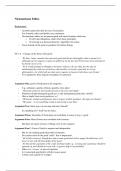
Chapter 1. The Living world
1.1 What is living
Organisms that show growth, reproduction, metabolism, cellular organization, and
consciousness are classified as living.
# Key Characteristics of Living Organisms:
Growth:
Increase in mass and number of cells.
In living organisms: Growth is intrinsic (from within).
In non-living objects (e.g., mountains): Growth is extrinsic (external addition).
Reproduction:
Ability to produce offspring.
Exceptions: Mules, sterile workers (bees), and infertile humans do not reproduce.
Metabolism:
Sum of all chemical reactions in the body (anabolism + catabolism).
No non-living entity shows metabolism.
Cellular Organization:
All living organisms are made up of cells, which are the structural and functional units of
life.
,Consciousness:
Ability to sense and respond to stimuli (internal and external).
Plants also respond (e.g., phototropism).
Consciousness is the defining property of life.
# Diversity of Life:
Approx. 1.7–1.8 million species are identified.
# Defining Feature of Living:
Metabolism and Cellular Organization are common to all living organisms.
Consciousness is unique to higher organisms.
1.2. Diversity in the Living World
# Biodiversity:
Definition: Refers to the variety of living organisms found on Earth.
Approx. 1.7–1.8 million species identified so far.
Includes plants, animals, microorganisms, etc.
# Need for Classification:
To organize and study the vast variety of organisms systematically.
,Helps in identifying similarities and differences among organisms.
# Nomenclature
Scientific names are based on standard principles and criteria.
Binomial Nomenclature:
Developed by Carolus Linnaeus.
Each name has two components: Genus and Species.
Written in italics (or underlined when handwritten).
Example: Homo sapiens (Human).
# Taxonomy:
Definition: Science of classification of organisms.
Includes identification, naming, and placing organisms into groups.
Systematics: Study of the diversity of organisms and their evolutionary relationships.
# Taxonomic Categories:
Organisms are classified into a hierarchy of groups based on similarities and
differences:
Domain → Kingdom → Phylum → Class → Order → Family → Genus → Species.
Mnemonic for Hierarchy:
"Dear King Philip Came Over For Good Soup."
# Taxonomical Aids:
, Herbarium: Collection of preserved plant specimens.
Botanical Gardens: Institutions with collections of living plants.
Museums: Collections of preserved animals and other specimens.
Zoological Parks: Places where wild animals are kept in natural habitats.
Key: Used for identification of organisms.
1.3 Taxonomic Categories
# Definition of Taxonomic Categories:
Taxonomic categories are levels or ranks in the classification system used to group
organisms based on shared characteristics.
Organisms are classified in a hierarchical arrangement.
Example: Homo sapiens → Domain: Eukarya → Kingdom: Animalia → ... → Species:
sapiens.
# Hierarchy of Categories:
There are seven obligate categories in the taxonomic hierarchy:
Domain → Kingdom → Phylum/Division → Class → Order → Family → Genus → Species.
# Description of Categories:
Species:
1.1 What is living
Organisms that show growth, reproduction, metabolism, cellular organization, and
consciousness are classified as living.
# Key Characteristics of Living Organisms:
Growth:
Increase in mass and number of cells.
In living organisms: Growth is intrinsic (from within).
In non-living objects (e.g., mountains): Growth is extrinsic (external addition).
Reproduction:
Ability to produce offspring.
Exceptions: Mules, sterile workers (bees), and infertile humans do not reproduce.
Metabolism:
Sum of all chemical reactions in the body (anabolism + catabolism).
No non-living entity shows metabolism.
Cellular Organization:
All living organisms are made up of cells, which are the structural and functional units of
life.
,Consciousness:
Ability to sense and respond to stimuli (internal and external).
Plants also respond (e.g., phototropism).
Consciousness is the defining property of life.
# Diversity of Life:
Approx. 1.7–1.8 million species are identified.
# Defining Feature of Living:
Metabolism and Cellular Organization are common to all living organisms.
Consciousness is unique to higher organisms.
1.2. Diversity in the Living World
# Biodiversity:
Definition: Refers to the variety of living organisms found on Earth.
Approx. 1.7–1.8 million species identified so far.
Includes plants, animals, microorganisms, etc.
# Need for Classification:
To organize and study the vast variety of organisms systematically.
,Helps in identifying similarities and differences among organisms.
# Nomenclature
Scientific names are based on standard principles and criteria.
Binomial Nomenclature:
Developed by Carolus Linnaeus.
Each name has two components: Genus and Species.
Written in italics (or underlined when handwritten).
Example: Homo sapiens (Human).
# Taxonomy:
Definition: Science of classification of organisms.
Includes identification, naming, and placing organisms into groups.
Systematics: Study of the diversity of organisms and their evolutionary relationships.
# Taxonomic Categories:
Organisms are classified into a hierarchy of groups based on similarities and
differences:
Domain → Kingdom → Phylum → Class → Order → Family → Genus → Species.
Mnemonic for Hierarchy:
"Dear King Philip Came Over For Good Soup."
# Taxonomical Aids:
, Herbarium: Collection of preserved plant specimens.
Botanical Gardens: Institutions with collections of living plants.
Museums: Collections of preserved animals and other specimens.
Zoological Parks: Places where wild animals are kept in natural habitats.
Key: Used for identification of organisms.
1.3 Taxonomic Categories
# Definition of Taxonomic Categories:
Taxonomic categories are levels or ranks in the classification system used to group
organisms based on shared characteristics.
Organisms are classified in a hierarchical arrangement.
Example: Homo sapiens → Domain: Eukarya → Kingdom: Animalia → ... → Species:
sapiens.
# Hierarchy of Categories:
There are seven obligate categories in the taxonomic hierarchy:
Domain → Kingdom → Phylum/Division → Class → Order → Family → Genus → Species.
# Description of Categories:
Species: