| OnlineExams | TestPrep | StudyResources | AcademicSuccess | ExamPreparation | QuizTime | LearningTools | Education | StudentSupport
In today's fast-paced educational landscape, students need reliable resources to excel in their studies.
5.0
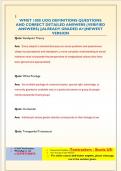
WMST 1000 Questions with Detailed Verified
Answers (100% Correct Answers) /Already Graded
A+
Q: What is Women's Studies? What is the importance of Women's
Studies both inside and outside of the academy?
Ans: "Women's studies is an important and exciting experience that
introduces new ways of seeing both of the world and oneself. Women's
studies courses investigate women's experiences, perspectives, and
contributions, placing women at the center of inquiry." - Kelly et al, p. 8
Women's studies scholars are able to ask new questions, and uncover the
ways in which the experiences/perspectives/contributions and voices
of women and other marginalized identities have been over-looked,
under-appreciated, or even silenced into raditional academic fields of
study
An interdisciplinary field of study - borrows theories, concepts, and
methodologies from sociology, philosophy, psychology, history,
political science, and critical race theory in the study of a wide range
of issues affecting the lives of women and other marginalized groups
Q: Why have educational systems traditionally been limiting rather than
empowering places for women?
Ans: Push to "female" careers
Women have been encouraged to pursue occupations that have
traditionally been associated with women rather than those that have
traditionally been associated with men
,Women have not been encouraged to pursue careers in technology,
engineering, math
Expectations about where men and women's natural abilities lie
Women usually encounter male professors in university/college
Women often constructed as passive and emotional
Teachers, parents, media, and others in positions of authority, reinforce
stereotypes that women are by nature passive and emotional rather
than inquisitive and assertive
Men tend to occupy positions of authority
Men tend to occupy higher-level administrative roles
They have had the authority to define what counts as "valid areas of inquiry"
and "legitimate methods for knowledge seeking"
Because of the gender imbalance that we find when it comes to those who
have the most power when it comes to structuring the education
system, women, women's experiences, and work by those working in
women's studies have not been adequately brought into the
mainstream education system and curricula
"The dominant message is that human experience equals male experience.
Sometimes this message is overt, but it is sometimes so subtle and
deeply embedded in the educational experience that we are not
aware of it - Kelly et al, p. 9
Q: What does feminism mean today? What are some of the reasons
that women do not want to be associated with feminism?
Ans: "The term feminism refers to the belief that women have been
historically subordinate to men as well as to the commitment to
working for freedom for women in all aspects of social life." - Kelly, et
al., p. 11
Feminism is not about having women dominate men. It's also not about
hating men. Feminism is about equality.
Examstudy - Stuvia US
, Women don't want to be associated with feminism because:
Range of stereotypes and negative cultural representations associated with
feminists
Man hating
Perpetuating the view that all men are evil
Working to have women dominate men
Most of the reasons people distance themselves from the term feminist are
inconsistent with the definition and foals of feminism and the feminist
movement
Q: What are the key issues that characterized each of the three feminist
movements?
Ans: 1st Wave Feminism - Better education for women, political
representation for women.
2nd Wave Feminism:
Advancing social and legal status of women
Further political representation
Change in existing patriarchal laws (divorce, domestic violence, abortion)
Sociocultural purposes: improve representation of women in media,
advance women's status in workplace, question the assumption that
women should prize marriage and raising children over their education
and careers
Q: Do you agree with conservative feminist writer Christina Hoff
Sommers "that you can't have everything" with regards to women
having both a career and a family? If so, why? If not, why not?
Ans:
Examstudy - Stuvia US
In today's fast-paced educational landscape, students need reliable resources to excel in their studies.
5.0
WMST 1000 Questions with Detailed Verified
Answers (100% Correct Answers) /Already Graded
A+
Q: What is Women's Studies? What is the importance of Women's
Studies both inside and outside of the academy?
Ans: "Women's studies is an important and exciting experience that
introduces new ways of seeing both of the world and oneself. Women's
studies courses investigate women's experiences, perspectives, and
contributions, placing women at the center of inquiry." - Kelly et al, p. 8
Women's studies scholars are able to ask new questions, and uncover the
ways in which the experiences/perspectives/contributions and voices
of women and other marginalized identities have been over-looked,
under-appreciated, or even silenced into raditional academic fields of
study
An interdisciplinary field of study - borrows theories, concepts, and
methodologies from sociology, philosophy, psychology, history,
political science, and critical race theory in the study of a wide range
of issues affecting the lives of women and other marginalized groups
Q: Why have educational systems traditionally been limiting rather than
empowering places for women?
Ans: Push to "female" careers
Women have been encouraged to pursue occupations that have
traditionally been associated with women rather than those that have
traditionally been associated with men
,Women have not been encouraged to pursue careers in technology,
engineering, math
Expectations about where men and women's natural abilities lie
Women usually encounter male professors in university/college
Women often constructed as passive and emotional
Teachers, parents, media, and others in positions of authority, reinforce
stereotypes that women are by nature passive and emotional rather
than inquisitive and assertive
Men tend to occupy positions of authority
Men tend to occupy higher-level administrative roles
They have had the authority to define what counts as "valid areas of inquiry"
and "legitimate methods for knowledge seeking"
Because of the gender imbalance that we find when it comes to those who
have the most power when it comes to structuring the education
system, women, women's experiences, and work by those working in
women's studies have not been adequately brought into the
mainstream education system and curricula
"The dominant message is that human experience equals male experience.
Sometimes this message is overt, but it is sometimes so subtle and
deeply embedded in the educational experience that we are not
aware of it - Kelly et al, p. 9
Q: What does feminism mean today? What are some of the reasons
that women do not want to be associated with feminism?
Ans: "The term feminism refers to the belief that women have been
historically subordinate to men as well as to the commitment to
working for freedom for women in all aspects of social life." - Kelly, et
al., p. 11
Feminism is not about having women dominate men. It's also not about
hating men. Feminism is about equality.
Examstudy - Stuvia US
, Women don't want to be associated with feminism because:
Range of stereotypes and negative cultural representations associated with
feminists
Man hating
Perpetuating the view that all men are evil
Working to have women dominate men
Most of the reasons people distance themselves from the term feminist are
inconsistent with the definition and foals of feminism and the feminist
movement
Q: What are the key issues that characterized each of the three feminist
movements?
Ans: 1st Wave Feminism - Better education for women, political
representation for women.
2nd Wave Feminism:
Advancing social and legal status of women
Further political representation
Change in existing patriarchal laws (divorce, domestic violence, abortion)
Sociocultural purposes: improve representation of women in media,
advance women's status in workplace, question the assumption that
women should prize marriage and raising children over their education
and careers
Q: Do you agree with conservative feminist writer Christina Hoff
Sommers "that you can't have everything" with regards to women
having both a career and a family? If so, why? If not, why not?
Ans:
Examstudy - Stuvia US