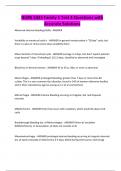
NURS 5333 Family 1 Test 4 Questions with
Accurate Solutions
Abnormal Uterine bleeding (AUB) - ANSWER
Variability in menstrual cycle's - ANSWER In general menstruation is "28 day" cycle, but
there is a plus or minus seven days variability there
Mean duration of menstrual cycle - ANSWER average is 4 days, but don't expect patients
to go beyond 7 days. If bleeding 8, 10,11 days, classified as abnormal and investigate
Blood loss in Normal menses - ANSWER 35 to 50 cc. 80cc or more is abnormal
Menorrhagia - ANSWER prolonged bleeding, greater than 7 days or more than 80
cc/day. This is a very common Gyn disorder, found in 14% of women otherwise healthy
and in their reproductive age (as young as 11-12 yo sometimes)
Metrorrhagia - ANSWER Uterine bleeding occuring at Irregular, but real frequent
intervals
Mittelschmerz - ANSWER Pain that occurs with ovulation, which would be about mid
cycle
Breakthrough bleeding (ex. of Metrorrhagia) - ANSWER Either w/ ovulation
(Mittelschmerz), or Anovulation, pt does not ovulate at all
Menometrorrhagia - ANSWER prolonged uterine bleeding occurring at irregular intervals
(ex. pt spots everyday or bleed every 3-4 days, bleed during intercourse, exercising)
, anovulation - ANSWER pts who do not ovulate, will have uterine bleeding occurring in
irregular intervals for a long time, which is why they are NOT having regular cycles
Oligomenorrhea - ANSWER Reduction in frequency of menses. Not menstruating every
month in a predictable pattern.
Amenorrhea - ANSWER No menses for at least 3-6 months. Part two is that they need to
have had a regular cycle prior to this.
Primary amenorrhea - ANSWER patient has never had a any bleeding (menses) Ever. No
prior first period. If they are 15 or 16, need to think about structural problems, missing
ovaries, etc.)
Secondary Amenorrhea - ANSWER no menses for 3-6 months after the regular cycle has
been established. Cannot be classified as Secondary amenorrhea in the first 2years of
starting menarche.
Hypomenorrhea - ANSWER reduction on number of days. Most of the time a side effect
of medications (birth control pills, birth control patches). Important to get a good
history of what they are taking.
Menopause - ANSWER Absence of cycles for 12 months, average age 51 yo
Menstrual bleeding stops if certain things happen - ANSWER NSAIDS (block
prostaglandins, which cause contractions and expulsion bleeding) and increasing
Estrogen (Cessation of blood with higher estrogen levels)
Accurate Solutions
Abnormal Uterine bleeding (AUB) - ANSWER
Variability in menstrual cycle's - ANSWER In general menstruation is "28 day" cycle, but
there is a plus or minus seven days variability there
Mean duration of menstrual cycle - ANSWER average is 4 days, but don't expect patients
to go beyond 7 days. If bleeding 8, 10,11 days, classified as abnormal and investigate
Blood loss in Normal menses - ANSWER 35 to 50 cc. 80cc or more is abnormal
Menorrhagia - ANSWER prolonged bleeding, greater than 7 days or more than 80
cc/day. This is a very common Gyn disorder, found in 14% of women otherwise healthy
and in their reproductive age (as young as 11-12 yo sometimes)
Metrorrhagia - ANSWER Uterine bleeding occuring at Irregular, but real frequent
intervals
Mittelschmerz - ANSWER Pain that occurs with ovulation, which would be about mid
cycle
Breakthrough bleeding (ex. of Metrorrhagia) - ANSWER Either w/ ovulation
(Mittelschmerz), or Anovulation, pt does not ovulate at all
Menometrorrhagia - ANSWER prolonged uterine bleeding occurring at irregular intervals
(ex. pt spots everyday or bleed every 3-4 days, bleed during intercourse, exercising)
, anovulation - ANSWER pts who do not ovulate, will have uterine bleeding occurring in
irregular intervals for a long time, which is why they are NOT having regular cycles
Oligomenorrhea - ANSWER Reduction in frequency of menses. Not menstruating every
month in a predictable pattern.
Amenorrhea - ANSWER No menses for at least 3-6 months. Part two is that they need to
have had a regular cycle prior to this.
Primary amenorrhea - ANSWER patient has never had a any bleeding (menses) Ever. No
prior first period. If they are 15 or 16, need to think about structural problems, missing
ovaries, etc.)
Secondary Amenorrhea - ANSWER no menses for 3-6 months after the regular cycle has
been established. Cannot be classified as Secondary amenorrhea in the first 2years of
starting menarche.
Hypomenorrhea - ANSWER reduction on number of days. Most of the time a side effect
of medications (birth control pills, birth control patches). Important to get a good
history of what they are taking.
Menopause - ANSWER Absence of cycles for 12 months, average age 51 yo
Menstrual bleeding stops if certain things happen - ANSWER NSAIDS (block
prostaglandins, which cause contractions and expulsion bleeding) and increasing
Estrogen (Cessation of blood with higher estrogen levels)