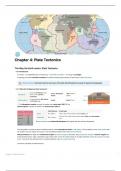
Eurasian Plate
North American
Plate
Juan de Fuca
Arabian Philippine
Caribbean
African Plate Indian
Cocos Plate
Pacific Plate Pacific Plate
South American Somali
Plate Plate
Nazca
Plate
Australian Plate
🌐
Chapter 4: Plate Tectonics
Scotia
Antarctic Plate
The Way the Earth works: Plate Tectonics
4.1 Introduction
Paradigm = an established line of reasoning → Scientific revolution = a change in paradigm
In geology, the latest scientific revolution took place following the proposal of the theory of plate tectonics.
Plate tectonics = the theory that the outer layer of the Earth (the lithosphere) consists of separate moving plates.
4.2 What Do We Mean by Plate Tectonics?
the outer 100-150 km of the
crust + lithospheric rigid: bends or
Lithosphere Earth: can be oceanic or
mantle breaks
continental
the layer between 100-150 km
Asthenosphere mantle plastic: flows
and 350 km deep
→ The lithospheric mantle consists of mantle rock cooler than 1280 °C, the
asthenosphere consists of mantle rock warmer than 1280 °C.
Total thickness Crustal layer
Ocean 10 to 100 km 7 km to 10 km and consists of dense mafic rock
25 km to 70 km and consists of less dense felsic and intermediate
Continental 150 to 200 km
rock
Due to isostacy the continental lithosphere sits higher than the oceanic lithosphere.
The lithosphere consists of about 20 different pieces called lithospheric plates or just plates. The big plates are the major plates and
the smaller ones are called microplates. The boundaries between them are plate boundaries.
Plate boundaries that align with continental margins are active margins, otherwise, they are passive margins. Passive margins are
characterised by thin, older continental crust buried under a 10 to 15 km thick layer of younger sediment, known as a passive-margin
basin. The top of this sediment forms a shallow seafloor area, the continental shelf.
The basic principles of plate tectonics:
Chapter 4: Plate Tectonics 1
North American
Plate
Juan de Fuca
Arabian Philippine
Caribbean
African Plate Indian
Cocos Plate
Pacific Plate Pacific Plate
South American Somali
Plate Plate
Nazca
Plate
Australian Plate
🌐
Chapter 4: Plate Tectonics
Scotia
Antarctic Plate
The Way the Earth works: Plate Tectonics
4.1 Introduction
Paradigm = an established line of reasoning → Scientific revolution = a change in paradigm
In geology, the latest scientific revolution took place following the proposal of the theory of plate tectonics.
Plate tectonics = the theory that the outer layer of the Earth (the lithosphere) consists of separate moving plates.
4.2 What Do We Mean by Plate Tectonics?
the outer 100-150 km of the
crust + lithospheric rigid: bends or
Lithosphere Earth: can be oceanic or
mantle breaks
continental
the layer between 100-150 km
Asthenosphere mantle plastic: flows
and 350 km deep
→ The lithospheric mantle consists of mantle rock cooler than 1280 °C, the
asthenosphere consists of mantle rock warmer than 1280 °C.
Total thickness Crustal layer
Ocean 10 to 100 km 7 km to 10 km and consists of dense mafic rock
25 km to 70 km and consists of less dense felsic and intermediate
Continental 150 to 200 km
rock
Due to isostacy the continental lithosphere sits higher than the oceanic lithosphere.
The lithosphere consists of about 20 different pieces called lithospheric plates or just plates. The big plates are the major plates and
the smaller ones are called microplates. The boundaries between them are plate boundaries.
Plate boundaries that align with continental margins are active margins, otherwise, they are passive margins. Passive margins are
characterised by thin, older continental crust buried under a 10 to 15 km thick layer of younger sediment, known as a passive-margin
basin. The top of this sediment forms a shallow seafloor area, the continental shelf.
The basic principles of plate tectonics:
Chapter 4: Plate Tectonics 1