💨
Chapter 3: Continental Drift
Drifting Continents and Spreading Seas
3.1 Introduction
Alfred Wegener, a German geologist, is the writer of The Origin of the Continents and Oceans (1929). In this book, he proposes the
idea that all continents were once part of one supercontinent called Pangaea.
💢 Continental drift (1929) = the gradual movement of continents across the Earth’s surface.
→ Continental drift was initially rejected by the geology community because Wegener didn’t provide an explanation for what force
could move the immense mass of a continent.
🌊 Seafloor spreading (1960) = as continents move apart, new ocean floor forms between them.
→ This concept was first proposed by Harry Hess, an American geologist and named by his contemporary; Robert Dietz.
💢 Plate tectonics = the theory that the outer layer of the Earth (the lithosphere) consists of separate plates.
3.2 Wegener’s Evidence for Continental Drift
💨 Evidence for continental drift:
1. The fit of the continents: Wegener noticed that all continents could be stuck together with
remarkably few overlaps or gaps. He concluded that it fit so well, it couldn’t be a coincidence.
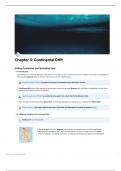
→ On the image you can see the Bullard fit: a computer generated map made by Edward Bullard.
Chapter 3: Continental Drift 1
Chapter 3: Continental Drift
Drifting Continents and Spreading Seas
3.1 Introduction
Alfred Wegener, a German geologist, is the writer of The Origin of the Continents and Oceans (1929). In this book, he proposes the
idea that all continents were once part of one supercontinent called Pangaea.
💢 Continental drift (1929) = the gradual movement of continents across the Earth’s surface.
→ Continental drift was initially rejected by the geology community because Wegener didn’t provide an explanation for what force
could move the immense mass of a continent.
🌊 Seafloor spreading (1960) = as continents move apart, new ocean floor forms between them.
→ This concept was first proposed by Harry Hess, an American geologist and named by his contemporary; Robert Dietz.
💢 Plate tectonics = the theory that the outer layer of the Earth (the lithosphere) consists of separate plates.
3.2 Wegener’s Evidence for Continental Drift
💨 Evidence for continental drift:
1. The fit of the continents: Wegener noticed that all continents could be stuck together with
remarkably few overlaps or gaps. He concluded that it fit so well, it couldn’t be a coincidence.
→ On the image you can see the Bullard fit: a computer generated map made by Edward Bullard.
Chapter 3: Continental Drift 1