Hoorcollege 1: What is Classical?
General use:
● Ageless
● Model for later generations (time-tested)
● Refined
History:
● Generally: “Classical Antiquity”
● Specifically: “The Classical period in Greece” (480-323 BC)
Art History:
● Naturalism
● Controlled and superior (“Olympian”)
● Emotionally balanced (negative: devoid of emotion)
Classis (Latin)
● The census class division of Roman citizens (also: highest of these classes)
‘Classical’
● Term appears in mid-18th c.
● Circulated widely by J.W. von Goethe and his contemporaries ca. 1800 to speak of
“classical antiquity” and the classical age in Athens in particular.
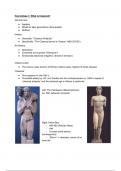
Left: The Calf-bearer (Moschophoros)
Ca. 560, Athenian Acropolis
Right: Kritios Boy
- 490-480 (Persian Wars)
- Hair
- Counter poise stance
(contrapposto)
- “Ethos”--> character, sense of an
inner life
,Classical Period
● Ca. 490-480 BCE (Persian Wars) to ca. 323 BCE (death of Alexander the Great)
● (Emotionally) balance The Spear-bearer (Doryphoros)
● Rhythm
● Order
● Controlled and superior (“Olympian”)
● Naturalism
The first humanist:
Protagoras from Abdera
”In each case there are two
opposite views”
ca. 490-420 BC
Minoans
-middle bronze age→ marine style
-2100-1600 BCE
-Palaces in Crete→ they were powerhubs, centers of redistribution. Linear A
-Pithos: large storage container
-Crete: many references to Bulls (fresco, rhyton)
-Lost influence about 1600: buildings collapsed because of earthquakes and mainland
invaders.
Mycenaeans:
- take over aspects from Minoans
, - 1600-1050
- conquest of Minoan Crete in 1450 BCE
- palaces on the mainland
- linear B
- burial culture: burial mounts and tholos (beehive) after 1450.
- king was the ruler of the religion
- figurines were found
- pottery: at first like Minoan sea creatures, then more geometric, more abstract, but
warrior scenes as well.
The end of the Bronze Age
● Mass migration. Most of these kingdoms collapsed
● Hittites in Anatolia--> Ugarit harbor town. Destroyed by the Sea people.
● Migration of the Sea Peoples--> 1210 Mycenae and then clockwise until 1177 in the Nile
delta.
● New type of small ship causes the migration.
, Hoorcollege 2a: the Early Iron Age Period and Style
Early Iron Age
● Disappearance of palatial culture
● Warlords
● Limited architectural remains
● Limited utensils
● “Fluchtburgen” -> people move away from the coast
and live on relatively easily defendable hilltops
● Peak sanctuaries
● Burials → cremation
● Introduction of iron
○ From Anatolia, via Cyprus
● Colonization of Asia Minor and Cyprus
Sub-Mycenaean
Ca. 1070-1025 BCE
Pottery: Minoan and Mycenaean
● Mycenaean Buttery employs shapes native to the mainlands, such as the stirrup jar,
the two handled drinking cup, and tall kylix (cup) , but was clearly influenced by
Minoan painted motives after the conquest of Knossos in 1450. Motives have
travelled but have also been adapted to differing tastes.
● Abstract ornament and horizontal bands, as well as highly stylized warriors, hunters,
and chariot scenes, are common on Mycenaean pottery.
General use:
● Ageless
● Model for later generations (time-tested)
● Refined
History:
● Generally: “Classical Antiquity”
● Specifically: “The Classical period in Greece” (480-323 BC)
Art History:
● Naturalism
● Controlled and superior (“Olympian”)
● Emotionally balanced (negative: devoid of emotion)
Classis (Latin)
● The census class division of Roman citizens (also: highest of these classes)
‘Classical’
● Term appears in mid-18th c.
● Circulated widely by J.W. von Goethe and his contemporaries ca. 1800 to speak of
“classical antiquity” and the classical age in Athens in particular.
Left: The Calf-bearer (Moschophoros)
Ca. 560, Athenian Acropolis
Right: Kritios Boy
- 490-480 (Persian Wars)
- Hair
- Counter poise stance
(contrapposto)
- “Ethos”--> character, sense of an
inner life
,Classical Period
● Ca. 490-480 BCE (Persian Wars) to ca. 323 BCE (death of Alexander the Great)
● (Emotionally) balance The Spear-bearer (Doryphoros)
● Rhythm
● Order
● Controlled and superior (“Olympian”)
● Naturalism
The first humanist:
Protagoras from Abdera
”In each case there are two
opposite views”
ca. 490-420 BC
Minoans
-middle bronze age→ marine style
-2100-1600 BCE
-Palaces in Crete→ they were powerhubs, centers of redistribution. Linear A
-Pithos: large storage container
-Crete: many references to Bulls (fresco, rhyton)
-Lost influence about 1600: buildings collapsed because of earthquakes and mainland
invaders.
Mycenaeans:
- take over aspects from Minoans
, - 1600-1050
- conquest of Minoan Crete in 1450 BCE
- palaces on the mainland
- linear B
- burial culture: burial mounts and tholos (beehive) after 1450.
- king was the ruler of the religion
- figurines were found
- pottery: at first like Minoan sea creatures, then more geometric, more abstract, but
warrior scenes as well.
The end of the Bronze Age
● Mass migration. Most of these kingdoms collapsed
● Hittites in Anatolia--> Ugarit harbor town. Destroyed by the Sea people.
● Migration of the Sea Peoples--> 1210 Mycenae and then clockwise until 1177 in the Nile
delta.
● New type of small ship causes the migration.
, Hoorcollege 2a: the Early Iron Age Period and Style
Early Iron Age
● Disappearance of palatial culture
● Warlords
● Limited architectural remains
● Limited utensils
● “Fluchtburgen” -> people move away from the coast
and live on relatively easily defendable hilltops
● Peak sanctuaries
● Burials → cremation
● Introduction of iron
○ From Anatolia, via Cyprus
● Colonization of Asia Minor and Cyprus
Sub-Mycenaean
Ca. 1070-1025 BCE
Pottery: Minoan and Mycenaean
● Mycenaean Buttery employs shapes native to the mainlands, such as the stirrup jar,
the two handled drinking cup, and tall kylix (cup) , but was clearly influenced by
Minoan painted motives after the conquest of Knossos in 1450. Motives have
travelled but have also been adapted to differing tastes.
● Abstract ornament and horizontal bands, as well as highly stylized warriors, hunters,
and chariot scenes, are common on Mycenaean pottery.