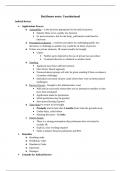
Backbones notes: Constitutional
Judicial Review
Applications Process
o Amenability – is the decision appropriate for the judicial process
Datafin: Must serve a public law function
Ex parte insurance: but for the body,, parliament would need to
intervene
o Procedural exclusivity – exclusive procedure for challenging public law
decisions, to challenge in another way would be an abuse of process.
o If there are private elements, JR cannot usually be brought
Unless
Neither party objected to the use of private law procedure
Contested decision is collateral to another claim
o Standing
Applicant must have sufficient interest
Fleet Street: liberal approach
Pressure/interest groups will only be given standing if there an absence
of another challenger.
Individual concerned citizens could where there were no better placed
challengers
o Review Process – brought to the administrative court
Will only be successful where there are no alternative remedies or they
have been exhausted
Application made for permission
Initial permission may be granted
Inter-partes hearing if grated
o Time-limit for review to be brought
Promptly and no later than 3 months from when the grounds arose
Undue delay, could refuse
Planning decisions – 6 weeks
o Ouster clauses
There is a strong presumption that parliament does not intend to
exclude JR.
Explicit, clear wording required
Strike a balance between parliament and ROL
Remedies
o Quashing order
o Prohibitory order
o Mandatory Order
o Injunction
o Damages
Grounds for Judicial Review
, o Illegality
Simple illegality – went beyond the boundaries of the power afforded
to that body.
Errors of law – decision made a mistake when interpreting the law
Errors of fact – no evidence of fact, mistake as to fact or finding of a
fact.
Irrelevant considerations
Improper purpose – discretion used for the wrong purpose
Fettering Discretion – hampered its own exercise of power
Unlawful delegation – public body not normally allowed to delegate
discretion unless government ministers delegate to sufficiently senior
official in own departments.
o Unreasonableness
Wednesbury test – so unreasonable that no reasonable authority could
have ever come to it. A relatively high bar.
Classes of unreasonableness
Material defects in the decision-making process
o Weighing up the wrong factors
o Failure to provide a comprehensive chain of reasoning
Oppressive decisions
o Imposes excessive hardship or infringement of rights
Violates constitutional principles – the law should be consistent
and sufficiently certain.
Intensity of review
Decisions affecting fundamental/human rights – higher
intensity
Decisions concerning broader policy – lower intensity
o Procedural Impropriety – failed to follow the correct procedure
Failure to observe statutory rules – would parliament have ntended that
the outcome of the non-compliance would be the invalidity of the
decision.
Duty to act fairly
Right to be heard
o Duty arisen?
o Level of duty owed – depends on character of body and
stake of decision
Licensing – usually no right to oral hearing
Generally should be given a ‘gist’ of reasoning
o Duty breached?
Case against the person – were not given
evidence against them.
Representations – no automatic duty
Witnesses – no automatic duty
Judicial Review
Applications Process
o Amenability – is the decision appropriate for the judicial process
Datafin: Must serve a public law function
Ex parte insurance: but for the body,, parliament would need to
intervene
o Procedural exclusivity – exclusive procedure for challenging public law
decisions, to challenge in another way would be an abuse of process.
o If there are private elements, JR cannot usually be brought
Unless
Neither party objected to the use of private law procedure
Contested decision is collateral to another claim
o Standing
Applicant must have sufficient interest
Fleet Street: liberal approach
Pressure/interest groups will only be given standing if there an absence
of another challenger.
Individual concerned citizens could where there were no better placed
challengers
o Review Process – brought to the administrative court
Will only be successful where there are no alternative remedies or they
have been exhausted
Application made for permission
Initial permission may be granted
Inter-partes hearing if grated
o Time-limit for review to be brought
Promptly and no later than 3 months from when the grounds arose
Undue delay, could refuse
Planning decisions – 6 weeks
o Ouster clauses
There is a strong presumption that parliament does not intend to
exclude JR.
Explicit, clear wording required
Strike a balance between parliament and ROL
Remedies
o Quashing order
o Prohibitory order
o Mandatory Order
o Injunction
o Damages
Grounds for Judicial Review
, o Illegality
Simple illegality – went beyond the boundaries of the power afforded
to that body.
Errors of law – decision made a mistake when interpreting the law
Errors of fact – no evidence of fact, mistake as to fact or finding of a
fact.
Irrelevant considerations
Improper purpose – discretion used for the wrong purpose
Fettering Discretion – hampered its own exercise of power
Unlawful delegation – public body not normally allowed to delegate
discretion unless government ministers delegate to sufficiently senior
official in own departments.
o Unreasonableness
Wednesbury test – so unreasonable that no reasonable authority could
have ever come to it. A relatively high bar.
Classes of unreasonableness
Material defects in the decision-making process
o Weighing up the wrong factors
o Failure to provide a comprehensive chain of reasoning
Oppressive decisions
o Imposes excessive hardship or infringement of rights
Violates constitutional principles – the law should be consistent
and sufficiently certain.
Intensity of review
Decisions affecting fundamental/human rights – higher
intensity
Decisions concerning broader policy – lower intensity
o Procedural Impropriety – failed to follow the correct procedure
Failure to observe statutory rules – would parliament have ntended that
the outcome of the non-compliance would be the invalidity of the
decision.
Duty to act fairly
Right to be heard
o Duty arisen?
o Level of duty owed – depends on character of body and
stake of decision
Licensing – usually no right to oral hearing
Generally should be given a ‘gist’ of reasoning
o Duty breached?
Case against the person – were not given
evidence against them.
Representations – no automatic duty
Witnesses – no automatic duty