NHA Module 2: Diseases and Conditions Exam Questions and Answers
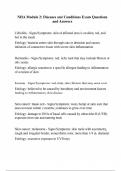
Cellulitis - Signs/Symptoms: skin of affected area is swollen, red, and hot to the touch Etiology: bacteria enters skin through cuts or abrasion and causes infection of connective tissue with severe skin inflammation Dermatitis - Signs/Symptoms: red, itchy rash that may include blisters or oily scales Etiology: allergic reaction to a specific allergen leading to inflammation of a region of skin Eczema - Signs/Symptoms: red, itchy skin; blisters that may crust over Etiology: believed to be caused by hereditary and environment factors leading to inflammatory skin disease Skin cancer: Basal cell - Signs/Symptoms: waxy bump or skin sore that does not heal within 2 months; continues to grow over time Etiology: damage to DNA of basal cells caused by ultraviolet B (UVB) exposure from sun and tanning beds Skin cancer: melanoma - Signs/Symptoms: skin mole with asymmetry, rough and irregular border, nonuniform color, more than 1/4 in. diameter Etiology: excessive exposure to UVB rays Sprain - Signs/Symptoms: painful swelling or bruising of joint area with decreased mobility Etiology: joint being pushed outside of normal range of motion, leading to joint and ligament damage Osteoporosis - Signs/Symptoms: typically no symptoms but severe disease can lead to increased fractures and back pain Etiology: malnutrition, inadequate calcium intake, endocrine disorders, immobilization and lack of exercise, and aging Osteoarthritis - Signs/Symptoms: pain with movement in a specific joint; stiffness; lack of flexibility Etiology: degeneration of articular cartilage and changes in the synovial membrane rheumatoid arthritis - Signs/Symptoms: systemic joint disorder; pain and decreased mobility in joints Etiology: autoimmune disorder leading to changes in connective tissues of the body, especially joints Gout - Signs/Symptoms: red, hot, swollen joint; most common in big toe Etiology: excessive accumulation of uric acid in a joint, forming needlelike crystals in the joint Muscular dystrophy - Signs/Symptoms: chronic and progressive muscle weakness leading to eventual paralysis of muscle groups Etiology: inherited or spontaneous genetic mutation in one of genes involved with protecting muscle fibers from damage Myopathy - Signs/Symptoms: muscle weakness, cramps, stiffness, spasms, tetany Etiology: can result from many different disease processes Myalgia - Signs/Symptoms: muscle pain (broad term) Etiology: traumatic injury, viral infection, overuse or stretching of muscle group, and/or meds and vaccines Repetitive stress disorder (RSD) - Signs/Symptoms: pain, tingling, numbness, swelling; redness, loss of flexibility and muscle weakness Etiology: repetitive tasks, forceful exertions, vibrations, mechanical compression and sustained uncomfortable positions Shin splint - Signs/Symptoms: pain and swelling in the lower leg Etiology: repeated stress of the tibia and connective tissues Anemia - Signs/Symptoms: fatigue, dizziness, cold extremities, headache, irregular heartbeat Etiology: most common cause is blood loss; dysfunction in creation of hemoglobin; excessive destruction of RBCs Atherosclerosis - Signs/Symptoms: chest pain, transient ischemic attacks (TIAs), peripheral artery disease, and kidney dysfunction Etiology: hardening of arteries due to fatty deposits causing narrowing of vessels Congestive heart failure (CHF) - Signs/Symptoms: fatigue, peripheral edema, shortness of breath Etiology: decreased ability to pump adequately due to coronary artery disease, high blood pressure, cardiomyopathy, or heart defects Hemophilia - Signs/Symptoms: excessive bleeding, frequent bruising Etiology: absence of clotting factors in the blood due to genetic defect Hypertension - Signs/Symptoms: higher than normal bp, headaches, irregular heart rhythms, and vision changes, or chest pain Etiology: genetics, smoking, obesity, stress, too much salt intake Myocardial Infarction (MI or heart attack) - Signs/Symptoms: acute chest pain, nausea, vomiting, heartburn, and profuse sweating Etiology: cardiac muscle becomes ischemic and dies due to blockage of the cardiac muscle (atherosclerosis of coronary artery) Acute renal failure - Signs/Symptoms: decreased urine output, fluid retention, fatigue, shortness of breath, confusion, and nausea Etiology: direct damage to kidneys; kidneys can no longer filter blood effectively, leading to dangerous levels of toxic waste Chronic renal failure - Signs/Symptoms: early stages no symptoms; later stages- high bp, feeling ill and fatigued Etiology: chronic and progressive disease in which kidneys cannot adequately filter blood due to many potential factors (diabetes, high bp, and glomerulonephritis)

Geschreven voor
- Instelling
- NHA CCMA
- Vak
- NHA CCMA
Documentinformatie
- Geüpload op
- 20 januari 2025
- Aantal pagina's
- 11
- Geschreven in
- 2024/2025
- Type
- Tentamen (uitwerkingen)
- Bevat
- Vragen en antwoorden
Onderwerpen
-
ccma
-
nha ccma
-
nha module 2
-
nha
-
nha module 2 diseases and conditions exam

Ook beschikbaar in voordeelbundel