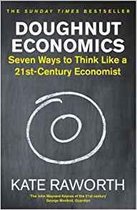
DOUGHNUT
ECONOMICS
English for business economics
Pauline Delphine Verhelst
VUB | 2019-2020
,Introduction
The twenty-first-century challenge
1. According to Raworth, what progress has been made globally in human well-being
over the past 60 years? Which challenges are we still facing? (pp4-6) C
Positive Negative
- Average life expectancy - 1/9 has not enough to eat
is 71 years (came from - In 2015, 6 milion children under the age of 5
48) died, more than half due to easy-cure
- Extreme poverty has conditions
fallen by more than half - 2 bilion people live on less than $3 a day
- Over 2 bilion people - Over 70 million young men en women are
have gained acces to unable to find work
safe drinking water en - World richest 1% owns more than the other
toilets for the first time 99% combined
- Global average temperature has risen by 0,8°C
- 40% of agricultural land is seriously degraded
- Over 50% of the world fisheries ar fully or over
exploited and by 2050 there will be more plastic
than fish in the sea
- Population will rise to 10 billion
The authority of economics
2. Write down the titles and authors of at least two textbooks used in courses on
economics you are taking/have taken at the VUB. What do you know about the
authors of these texts? If necessary, look online to find out about their professional
background. Remember to keep a note of the source of this information (e.g. which
webpage you found it on). Did you learn anything interesting or surprising about
the authors? (pp6-8) D
- N;Gregory Mankiw: 23th most influential economist in the world, Harvard
- Hal. R. Varian: chief at google
Walking away from economics – and back
3. Make sure you can sketch from memory the (simplified) doughnut diagram, as
represented on p11, and that you can explain in your own words what it shows.
(p11) C
- Cricital human deprivation = hunger & illiteracy
- Critical planetary degradation = climat change &
biodiversity loss
- The safe and just space for humanity = space in
which we can meet the needs of all within the
means of the planet
,Images in economics: a hidden history
4. Look at Samuelson’s 1948 Circular Flow diagram (p20). Are you already familiar
with this diagram? Explain in your own words what it shows. Which aspects of this
model are still in line with what is taught nowadays about the flow of income
around the economy? Which aspects are different? D
- Familiar: originally designed for engineer students
- Flow of goods, services en savings (p64)
5. Raworth also discusses other “core diagrams in economics” (p15). Can you
remember which diagram(s) you saw first when you started studying
Business/Economics. Which diagram(s) have you seen most frequently throughout
your studies in this field so far? Be prepared to sketch these on the blackboard and
to explain what they show. D
- Supply en demand curve (also most often)
A long struggle of escape
6. Which limitations of all (economic) models/diagrams are identified? (p22-23)
- Every model can only ever be a model, simplification of the world, but can never be
mistaken for the real thing. All models are wrong but some are usefull
Seven ways to think like a twenty-first-century economist
7.
a. List the “seven ways to think like a twenty-first century economist” which are
discussed in more detail throughout the book. For each of these, note:
i. what the traditional (twentieth century) approach of mainstream economics
has been to this aspect of economics?
ii. which new goal for the twenty-first century economy Raworth sets for this
aspect of economics. (p25-29) C
Way Traditional New goal
Change the goal GDP = gross domestic product Human rights
National output Dougnut
See the big picture Circular flow Enbedding society, nature
Energy = basics
Economy is part of society
Society is part of the earth
Nurture human nature Rational economic man Dependent upon the living
Self interest only world
Get savy with systems Supply and demand Feedback loops
Complex & dynamic system
Design to distribute Kuznets curve Other ways
It has to get worse before it gets More complex
better
Create to regenerate Clean environment = luxury good Ecological degradation =
result of degenerative
industrial design
Be agnostic about Long term of GDP growth Nothing in nature grows for
growth Endless growth ever
b. In how far does the picture of 20th century economics presented by Raworth
reflect what you have seen in your courses at the VUB so far? D
- A little, estimation
, c. Do you agree that the goals Raworth identifies for the 21st century economy
are the goals we should be aiming for? Are they achievable? In what timescale?
What would need to change in order for these goals to be met? D
- Yes, we need to adapt, people need to be open for change
8. What don’t the “seven ways to think like a twenty-first century economist” do,
according to Raworth? What does she say we can do now? Which task remains for
“economic thinkers in the decades ahead”? (p30) C
- They don’t lay out a specific policy prescription or institutional fix
- They promise no immediate answers
- Task = bring the 7 ways into practice & add many more
9. “If humanity’s twenty-first-century goal is to get into the Doughnut, what economic
mindset will give us the best chance of getting there?” (p10). In your own view,
which economic systems/measures/policies would help to increase social well-
being and reduce ecological pressures? How realistic do you think it is that these
will be implemented? D
- Stimulate each other to take care of the environment
- Progressive mindset
- Socialism
- Less focus on groth
- Focus on other effects
- Create to regenerate
ECONOMICS
English for business economics
Pauline Delphine Verhelst
VUB | 2019-2020
,Introduction
The twenty-first-century challenge
1. According to Raworth, what progress has been made globally in human well-being
over the past 60 years? Which challenges are we still facing? (pp4-6) C
Positive Negative
- Average life expectancy - 1/9 has not enough to eat
is 71 years (came from - In 2015, 6 milion children under the age of 5
48) died, more than half due to easy-cure
- Extreme poverty has conditions
fallen by more than half - 2 bilion people live on less than $3 a day
- Over 2 bilion people - Over 70 million young men en women are
have gained acces to unable to find work
safe drinking water en - World richest 1% owns more than the other
toilets for the first time 99% combined
- Global average temperature has risen by 0,8°C
- 40% of agricultural land is seriously degraded
- Over 50% of the world fisheries ar fully or over
exploited and by 2050 there will be more plastic
than fish in the sea
- Population will rise to 10 billion
The authority of economics
2. Write down the titles and authors of at least two textbooks used in courses on
economics you are taking/have taken at the VUB. What do you know about the
authors of these texts? If necessary, look online to find out about their professional
background. Remember to keep a note of the source of this information (e.g. which
webpage you found it on). Did you learn anything interesting or surprising about
the authors? (pp6-8) D
- N;Gregory Mankiw: 23th most influential economist in the world, Harvard
- Hal. R. Varian: chief at google
Walking away from economics – and back
3. Make sure you can sketch from memory the (simplified) doughnut diagram, as
represented on p11, and that you can explain in your own words what it shows.
(p11) C
- Cricital human deprivation = hunger & illiteracy
- Critical planetary degradation = climat change &
biodiversity loss
- The safe and just space for humanity = space in
which we can meet the needs of all within the
means of the planet
,Images in economics: a hidden history
4. Look at Samuelson’s 1948 Circular Flow diagram (p20). Are you already familiar
with this diagram? Explain in your own words what it shows. Which aspects of this
model are still in line with what is taught nowadays about the flow of income
around the economy? Which aspects are different? D
- Familiar: originally designed for engineer students
- Flow of goods, services en savings (p64)
5. Raworth also discusses other “core diagrams in economics” (p15). Can you
remember which diagram(s) you saw first when you started studying
Business/Economics. Which diagram(s) have you seen most frequently throughout
your studies in this field so far? Be prepared to sketch these on the blackboard and
to explain what they show. D
- Supply en demand curve (also most often)
A long struggle of escape
6. Which limitations of all (economic) models/diagrams are identified? (p22-23)
- Every model can only ever be a model, simplification of the world, but can never be
mistaken for the real thing. All models are wrong but some are usefull
Seven ways to think like a twenty-first-century economist
7.
a. List the “seven ways to think like a twenty-first century economist” which are
discussed in more detail throughout the book. For each of these, note:
i. what the traditional (twentieth century) approach of mainstream economics
has been to this aspect of economics?
ii. which new goal for the twenty-first century economy Raworth sets for this
aspect of economics. (p25-29) C
Way Traditional New goal
Change the goal GDP = gross domestic product Human rights
National output Dougnut
See the big picture Circular flow Enbedding society, nature
Energy = basics
Economy is part of society
Society is part of the earth
Nurture human nature Rational economic man Dependent upon the living
Self interest only world
Get savy with systems Supply and demand Feedback loops
Complex & dynamic system
Design to distribute Kuznets curve Other ways
It has to get worse before it gets More complex
better
Create to regenerate Clean environment = luxury good Ecological degradation =
result of degenerative
industrial design
Be agnostic about Long term of GDP growth Nothing in nature grows for
growth Endless growth ever
b. In how far does the picture of 20th century economics presented by Raworth
reflect what you have seen in your courses at the VUB so far? D
- A little, estimation
, c. Do you agree that the goals Raworth identifies for the 21st century economy
are the goals we should be aiming for? Are they achievable? In what timescale?
What would need to change in order for these goals to be met? D
- Yes, we need to adapt, people need to be open for change
8. What don’t the “seven ways to think like a twenty-first century economist” do,
according to Raworth? What does she say we can do now? Which task remains for
“economic thinkers in the decades ahead”? (p30) C
- They don’t lay out a specific policy prescription or institutional fix
- They promise no immediate answers
- Task = bring the 7 ways into practice & add many more
9. “If humanity’s twenty-first-century goal is to get into the Doughnut, what economic
mindset will give us the best chance of getting there?” (p10). In your own view,
which economic systems/measures/policies would help to increase social well-
being and reduce ecological pressures? How realistic do you think it is that these
will be implemented? D
- Stimulate each other to take care of the environment
- Progressive mindset
- Socialism
- Less focus on groth
- Focus on other effects
- Create to regenerate