Oncology 4
HC 3
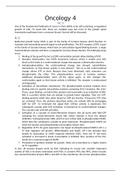
One of the fundamental hallmarks of cancer is their ability to be self-sustaining, unregulated
growth of cells. To reach this, there are multiple ways but most of the growth signal
transduction pathways have a common thread. Several will be discussed.
4.1
Epidermal growth factor (EGF) is part of the family of tyrosine kinases which function to
translate and extracellular growth signal to cell proliferation. The EGF receptor, EGFR, is part
of the family of tyrosine kinases which have an extracellular ligand-binding domain, a single
transmembrane domain and then a cytoplasmic tyrosine kinase domain. The following steps
occur:
1. Binding of the growth factor to EGFR: extracellular pockets allow binding of EGF.
2. Receptor dimerization: two EGFR monomers interact, which is enable once EGF
binds as this leads to a conformational change that exposes a dimerization domain.
3. Autophosphorylation: the conformational change also disrupts autoinhibitory
interactions, so that kinase activity is now allowed – this so as the conformational
change allows ATP to bind. Because they have dimerized, each monomer can
phosphorylate the other. This phosphorylation occurs at tyrosine residues.
Additional phosphorylation turns off the signal again, as this changes the
conformation again so that kinase activity is inhibited. The receptor is endocytosed
and degraded.
4. Activation of intracellular transducers: The phosphorylated tyrosine residues form
binding sites for specific intracellular proteins containing SH2/3 domains, like Grb2.
These, upon binding, can bind other proteins and eventually cause activation of RAS.
RAS is a protein family that are pivotal in growth factor signaling. They are GTP-
binding proteins which thus when bound to GDP are inactive. If bound to GTP, they
are activated. Thus, the proteins described earlier can activate RAS by exchanging
GDP for GTP. To terminate the signal RAS’ GTPase activity is expressed. The
subsequent cascade after RAS activation, is directed by its conformational changes.
The cascade ends with Raf activation.
5. Activation of a cascade of serine/threonine kinases: this all starts with RAS-GTP
activating the serine/threonine kinase Raf, which releases it from the default
inhibition. It phosphorylates MEK, which in turn is then able to phosphorylate MAPK,
which links the cytoplasmic cascade to gene expression. Phosphorylated MAPK can
enter the nucleus and phosphorylate transcription factors here.
6. Regulation of TFs for gene expression: one target of phosphorylated MAPK is AP-1, a
TF that regulates cell growth, differentiation and death. AP-1 has domains that
enable its association to cAMP response elements (CRE). Once the TF has been
activated or increased in levels, transcription is initiated. Also, proteins of the Myc
family are a common target of MAPK.
7. Production of proteins needed for growth: these are transcribed to a higher extent
on TF regulation.
In fact, all tyrosine kinases work via RAS, indicating its crucial role. Another important
activity of RAS is its direct interaction with PI3K. It converts PIP2 into PIP3, which recruits
two serine/threonine kinases PDK-1 and AKT to the membrane; the former phosphorylates
HC 3
One of the fundamental hallmarks of cancer is their ability to be self-sustaining, unregulated
growth of cells. To reach this, there are multiple ways but most of the growth signal
transduction pathways have a common thread. Several will be discussed.
4.1
Epidermal growth factor (EGF) is part of the family of tyrosine kinases which function to
translate and extracellular growth signal to cell proliferation. The EGF receptor, EGFR, is part
of the family of tyrosine kinases which have an extracellular ligand-binding domain, a single
transmembrane domain and then a cytoplasmic tyrosine kinase domain. The following steps
occur:
1. Binding of the growth factor to EGFR: extracellular pockets allow binding of EGF.
2. Receptor dimerization: two EGFR monomers interact, which is enable once EGF
binds as this leads to a conformational change that exposes a dimerization domain.
3. Autophosphorylation: the conformational change also disrupts autoinhibitory
interactions, so that kinase activity is now allowed – this so as the conformational
change allows ATP to bind. Because they have dimerized, each monomer can
phosphorylate the other. This phosphorylation occurs at tyrosine residues.
Additional phosphorylation turns off the signal again, as this changes the
conformation again so that kinase activity is inhibited. The receptor is endocytosed
and degraded.
4. Activation of intracellular transducers: The phosphorylated tyrosine residues form
binding sites for specific intracellular proteins containing SH2/3 domains, like Grb2.
These, upon binding, can bind other proteins and eventually cause activation of RAS.
RAS is a protein family that are pivotal in growth factor signaling. They are GTP-
binding proteins which thus when bound to GDP are inactive. If bound to GTP, they
are activated. Thus, the proteins described earlier can activate RAS by exchanging
GDP for GTP. To terminate the signal RAS’ GTPase activity is expressed. The
subsequent cascade after RAS activation, is directed by its conformational changes.
The cascade ends with Raf activation.
5. Activation of a cascade of serine/threonine kinases: this all starts with RAS-GTP
activating the serine/threonine kinase Raf, which releases it from the default
inhibition. It phosphorylates MEK, which in turn is then able to phosphorylate MAPK,
which links the cytoplasmic cascade to gene expression. Phosphorylated MAPK can
enter the nucleus and phosphorylate transcription factors here.
6. Regulation of TFs for gene expression: one target of phosphorylated MAPK is AP-1, a
TF that regulates cell growth, differentiation and death. AP-1 has domains that
enable its association to cAMP response elements (CRE). Once the TF has been
activated or increased in levels, transcription is initiated. Also, proteins of the Myc
family are a common target of MAPK.
7. Production of proteins needed for growth: these are transcribed to a higher extent
on TF regulation.
In fact, all tyrosine kinases work via RAS, indicating its crucial role. Another important
activity of RAS is its direct interaction with PI3K. It converts PIP2 into PIP3, which recruits
two serine/threonine kinases PDK-1 and AKT to the membrane; the former phosphorylates