Unit 14 assignment 1
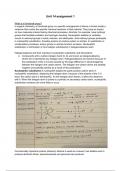
What is a functional group?
In organic chemistry, a functional group is a specific arrangement of atoms or bonds inside a
molecule that control the specific chemical reactions of that material. They have an impact
on how molecules interact during chemical processes. Alcohols, for example, have hydroxyl
groups that facilitate oxidation and hydrogen bonding. Nucleophilic addition or oxidation
occurs to carbonyl groups in acids, ketones, and aldehydes. Acid carboxyl groups participate
in nucleophilic substitution, donating protons to produce esters or amides. In substitution or
condensation processes, amino groups in amines function as bases. Nucleophilic
substitution or elimination is how halogen substituents in halogenoalkanes react.
Halogenoalkanes and their reactions (nucleophilic substitution and elimination)
● Compounds with a carbon-halogen bond (C-X) are known as halogenoalkanes,
where the X represents any halogen atom. Halogenoalkanes are reactive because of
the polarisation of the C-X bond caused by the large difference in electronegativity
between the halogen and carbon atoms. The halogen and carbon atoms are partially
negative and partially positive as a result of this polarisation
Nucleophilic substitution:A nucleophile targets the partly positive carbon atom in
nucleophilic substitution, displacing the halogen atom, because of the polarity of the C-X
bond, the carbon atom is electrophilic. As the halogen atom leaves, it takes two electrons
with it. When the halogen atom is joined to a primary or secondary carbon atom, nucleophilic
substitution reactions are more likely to occur.
Commercially important product (ethanol): ethanol is used as a solvent, fuel additive and to
produce alcoholic drinks, pharmaceuticals and personal care products
, Elimination: Elimination results in the production of alkenes and the release of a halide ion
when a hydrogen and a halogen atom are taken out of adjacent carbon atoms. Under simple
circumstances, an intermediate carbanion is produced when a strong base takes a proton
from a neighbouring carbon atom. This process is known as an elimination reaction. The
halogen atom is then released by the carbanion intermediate, forming the alkene. When the
halogenoalkane is large or bound to a tertiary carbon atom, elimination reactions are more
likely to occur because it is energetically more advantageous for a stable alkene to develop.
Commercially important product (ethene): ethene is a versatile compound used to produce
plastic such as polyethylene.
Alcohols (primary, secondary and tertiary) and their reactions (oxidation)
● Alcohols are a class of chemical compounds in which a saturated carbon atom is
linked to at least one hydroxyl functional group. Their reactivity depends on whether
the alcohol is primary, secondary or
tertiary.
Primary alcohols: Primary alcohols have a
hydroxyl group attached to a carbon atom that
is only directly connected to one other carbon
atom. Under some reaction conditions, they can
be oxidised to generate carboxylic acids and
aldehydes.
Secondary alcohols: In secondary alcohols,
the hydroxyl group is bonded to a carbon atom
that is directly connected to two more carbon
atoms. They oxidise to form ketones.
Tertiary alcohols: The hydroxyl group in
tertiary alcohols is attached to a carbon atom
that is directly linked to three more carbon
What is a functional group?
In organic chemistry, a functional group is a specific arrangement of atoms or bonds inside a
molecule that control the specific chemical reactions of that material. They have an impact
on how molecules interact during chemical processes. Alcohols, for example, have hydroxyl
groups that facilitate oxidation and hydrogen bonding. Nucleophilic addition or oxidation
occurs to carbonyl groups in acids, ketones, and aldehydes. Acid carboxyl groups participate
in nucleophilic substitution, donating protons to produce esters or amides. In substitution or
condensation processes, amino groups in amines function as bases. Nucleophilic
substitution or elimination is how halogen substituents in halogenoalkanes react.
Halogenoalkanes and their reactions (nucleophilic substitution and elimination)
● Compounds with a carbon-halogen bond (C-X) are known as halogenoalkanes,
where the X represents any halogen atom. Halogenoalkanes are reactive because of
the polarisation of the C-X bond caused by the large difference in electronegativity
between the halogen and carbon atoms. The halogen and carbon atoms are partially
negative and partially positive as a result of this polarisation
Nucleophilic substitution:A nucleophile targets the partly positive carbon atom in
nucleophilic substitution, displacing the halogen atom, because of the polarity of the C-X
bond, the carbon atom is electrophilic. As the halogen atom leaves, it takes two electrons
with it. When the halogen atom is joined to a primary or secondary carbon atom, nucleophilic
substitution reactions are more likely to occur.
Commercially important product (ethanol): ethanol is used as a solvent, fuel additive and to
produce alcoholic drinks, pharmaceuticals and personal care products
, Elimination: Elimination results in the production of alkenes and the release of a halide ion
when a hydrogen and a halogen atom are taken out of adjacent carbon atoms. Under simple
circumstances, an intermediate carbanion is produced when a strong base takes a proton
from a neighbouring carbon atom. This process is known as an elimination reaction. The
halogen atom is then released by the carbanion intermediate, forming the alkene. When the
halogenoalkane is large or bound to a tertiary carbon atom, elimination reactions are more
likely to occur because it is energetically more advantageous for a stable alkene to develop.
Commercially important product (ethene): ethene is a versatile compound used to produce
plastic such as polyethylene.
Alcohols (primary, secondary and tertiary) and their reactions (oxidation)
● Alcohols are a class of chemical compounds in which a saturated carbon atom is
linked to at least one hydroxyl functional group. Their reactivity depends on whether
the alcohol is primary, secondary or
tertiary.
Primary alcohols: Primary alcohols have a
hydroxyl group attached to a carbon atom that
is only directly connected to one other carbon
atom. Under some reaction conditions, they can
be oxidised to generate carboxylic acids and
aldehydes.
Secondary alcohols: In secondary alcohols,
the hydroxyl group is bonded to a carbon atom
that is directly connected to two more carbon
atoms. They oxidise to form ketones.
Tertiary alcohols: The hydroxyl group in
tertiary alcohols is attached to a carbon atom
that is directly linked to three more carbon