Notes
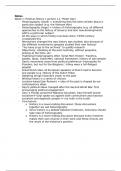
Week 1: Political History | Lecture 1.1: Pieter Geyl
- Historiography (small) = everything that has been written about a
particular subject (e.g. the Vietnam War)
- Historiography (large) = history of historiography (e.g. all different
approaches to the history of slavery) and also new developments
within a particular subject
- All the ways in which history has been done 19th century
crystallized this
- Revolutions changed the way history was studied, also because of
the different investments (peoples studied their own history)
- “You have to go to the archives” to qualify research
- Objectivity: looking at the past neutrally, without prejudice,
looking at the facts, etc.
- Traditional historiography often 'Great Men History' politics,
battles, ideas, Great Men, national framework, history of own people
- Geyl's movement arose from political preference sympathy for
Flanders, but not for the Belgians ( they were a full-fledged
people)
- Great Dutch Idea: all European speakers of Dutch had to become
one people (e.g. History of the Dutch Tribe)
- Debating brings historians closer to the past
- Writing history is a series of choices
- Location-based (Jan Romein) = idea of the past is shaped by our
contemporary ideas
- Geyl's political ideas changed after the Second World War: first
encouraging political engagement
- Geyl 's friends joined the National Socialists, Geyl himself joined
socialism Geyl spoke out against both communism and national
socialism and dogmatic people (= my truth is the truth)
- Conclusions
o History is a never-ending discussion; these discussions
together we call historiography
o Since history is a debate between historians, historians should
take note of historiography
o History is a never-ending discussion because every historian
makes their own choices in their work and these choices are
the result of the historian's position
,Week 2: Political History | Lecture 2.1: Gerda Lerner
- Example exam question: Explain what location-based learning is and
illustrate this using the lectures or the textbook (for example with
Pieter Geyl or Gerda Lerner )
- Gerda Lerner : History was a formative force in life, traditional
history was flawed ('Great Men of History' women were also part
of the historical process)
- The overlap between identity and historical science is unavoidable
and enriches our view of the past Lerner : “We define what our
goals are and what we think is possible to reach in our lives by the
stories we inherit about poele who came before us who are like us .”
- Gerner had everything against her: she was a woman, Jewish and a
communist, and she opposed, for example, the 'blacklisting' of
artists (together with her husband).
- Set himself off against the history curriculum “A history of the
past, in which women did not seem to exist, except rulers or some
who created disturbances.”
- 'Black Women in White America' emerged from her own
collaborations with African Americans during her time in New York,
her affinity with the marginalized populations (through her Jewish
heritage) and her attempt to give them their 'own history'
- Without history a group remains searching: without history no
identity no visibility no role in political and social life (groups in
society derive their identity from shared history); commitment
connectedness
- Both Lerner and Geyl : history is inextricably linked to the present
- Lerner 's program took women's history seriously: something to
study, rather than a hobby
- Biography is a readable genre and since male historical biographies
were often written, history became dominated by male figures
- Individuals determined history, not the historical processes/
structures we know today
- New historical 'actors' appear simultaneously with new historical
perspectives and ideas
- Women's history emerged during the Second Feminist Wave,
periods such as the French Revolution were viewed differently by
women, which meant that the view of these periods also had to be
adjusted
- Women's history was mainly seen as complementary, while men's
history still dominated
- Gender history focuses on the history of social roles (distribution)
between men (masculinity) and women (femininity) and how these
change (e.g. wearing a dress)
- Patriarchy = (roughly) a system in which relationships, beliefs,
values and similar aspects of a society are determined by men and
in which a gender inequality is hidden
- 'Agency' provides room for manoeuvre (= being able to act
autonomously within the (aversive) circumstances given to them) to
exert influence
, - Lerner's work was intended to serve the emancipation of (black)
women
- 'We history' = when historians identify with their historical subject,
this applies to almost all historians
Week 2: Political History | Workshop 2.1: The History of Whom ?
- Ancient history was mainly about the 'Great Men' political leaders
and militaristic history; the 'new' history (from the 19th century ; 1875)
focused more on social history ( from top-down to bottom-up; from
bottom-up to the 'normal man')
- 19th century is the century of history and biology, practiced
professionally (objective Leopold von Ranke)
- History emerged from Germany, roots in the German language
- Historians act on behalf of the nation state, according to nationalist
ideology
- Nation states (originates from nation (= people); driven by the
people) develop themselves and realize themselves in the past,
originated through violence and war ( war is the driving force in
history) and became great after the French Revolution
- Liberalism arises from the urge for freedom and is realized through
reason; communism/ Marxism arises from the class struggle;
Christianity arises from the struggle between good and evil
- With the First World War, politics became quite important, making
the 'Great Men' quite important and thus male history almost
dominant
- Old historiography has not disappeared: wars are still written about,
despite the expansion of historiography (although it has changed
considerably)
- Economic history begins with the collection of data and statistics
can only look at objective numbers (e.g. infant mortality,
economic development, trade networks, etc.); humanity as a whole
- Dutch figures are taken from the CBS (Central Bureau of Statistics),
established after the Second World War
- All data before 1900 were unreliable and difficult to interpret,
statistics only became reliable in the 19th century ( Quetelet index, now
called the BMI index)
- The 'average person' emerged, but it does exist: it is a statistical
cross-section of all people
- Social history emerged from Marxism and focuses on the working
class
- The Making of the English Working Class (1963) , Thompson focused
on craftsmen and their position under the pressure of
industrialization (first weaving and spinning)
- There was dissatisfaction, which led to protests and organizations
were set up
- Thompson shows that workers could shape their own lives and write
their own stories through 'agency'; another example of slavery, for
example, playing dumb so they could get a boss they 'liked', etc.
Week 1: Political History | Lecture 1.1: Pieter Geyl
- Historiography (small) = everything that has been written about a
particular subject (e.g. the Vietnam War)
- Historiography (large) = history of historiography (e.g. all different
approaches to the history of slavery) and also new developments
within a particular subject
- All the ways in which history has been done 19th century
crystallized this
- Revolutions changed the way history was studied, also because of
the different investments (peoples studied their own history)
- “You have to go to the archives” to qualify research
- Objectivity: looking at the past neutrally, without prejudice,
looking at the facts, etc.
- Traditional historiography often 'Great Men History' politics,
battles, ideas, Great Men, national framework, history of own people
- Geyl's movement arose from political preference sympathy for
Flanders, but not for the Belgians ( they were a full-fledged
people)
- Great Dutch Idea: all European speakers of Dutch had to become
one people (e.g. History of the Dutch Tribe)
- Debating brings historians closer to the past
- Writing history is a series of choices
- Location-based (Jan Romein) = idea of the past is shaped by our
contemporary ideas
- Geyl's political ideas changed after the Second World War: first
encouraging political engagement
- Geyl 's friends joined the National Socialists, Geyl himself joined
socialism Geyl spoke out against both communism and national
socialism and dogmatic people (= my truth is the truth)
- Conclusions
o History is a never-ending discussion; these discussions
together we call historiography
o Since history is a debate between historians, historians should
take note of historiography
o History is a never-ending discussion because every historian
makes their own choices in their work and these choices are
the result of the historian's position
,Week 2: Political History | Lecture 2.1: Gerda Lerner
- Example exam question: Explain what location-based learning is and
illustrate this using the lectures or the textbook (for example with
Pieter Geyl or Gerda Lerner )
- Gerda Lerner : History was a formative force in life, traditional
history was flawed ('Great Men of History' women were also part
of the historical process)
- The overlap between identity and historical science is unavoidable
and enriches our view of the past Lerner : “We define what our
goals are and what we think is possible to reach in our lives by the
stories we inherit about poele who came before us who are like us .”
- Gerner had everything against her: she was a woman, Jewish and a
communist, and she opposed, for example, the 'blacklisting' of
artists (together with her husband).
- Set himself off against the history curriculum “A history of the
past, in which women did not seem to exist, except rulers or some
who created disturbances.”
- 'Black Women in White America' emerged from her own
collaborations with African Americans during her time in New York,
her affinity with the marginalized populations (through her Jewish
heritage) and her attempt to give them their 'own history'
- Without history a group remains searching: without history no
identity no visibility no role in political and social life (groups in
society derive their identity from shared history); commitment
connectedness
- Both Lerner and Geyl : history is inextricably linked to the present
- Lerner 's program took women's history seriously: something to
study, rather than a hobby
- Biography is a readable genre and since male historical biographies
were often written, history became dominated by male figures
- Individuals determined history, not the historical processes/
structures we know today
- New historical 'actors' appear simultaneously with new historical
perspectives and ideas
- Women's history emerged during the Second Feminist Wave,
periods such as the French Revolution were viewed differently by
women, which meant that the view of these periods also had to be
adjusted
- Women's history was mainly seen as complementary, while men's
history still dominated
- Gender history focuses on the history of social roles (distribution)
between men (masculinity) and women (femininity) and how these
change (e.g. wearing a dress)
- Patriarchy = (roughly) a system in which relationships, beliefs,
values and similar aspects of a society are determined by men and
in which a gender inequality is hidden
- 'Agency' provides room for manoeuvre (= being able to act
autonomously within the (aversive) circumstances given to them) to
exert influence
, - Lerner's work was intended to serve the emancipation of (black)
women
- 'We history' = when historians identify with their historical subject,
this applies to almost all historians
Week 2: Political History | Workshop 2.1: The History of Whom ?
- Ancient history was mainly about the 'Great Men' political leaders
and militaristic history; the 'new' history (from the 19th century ; 1875)
focused more on social history ( from top-down to bottom-up; from
bottom-up to the 'normal man')
- 19th century is the century of history and biology, practiced
professionally (objective Leopold von Ranke)
- History emerged from Germany, roots in the German language
- Historians act on behalf of the nation state, according to nationalist
ideology
- Nation states (originates from nation (= people); driven by the
people) develop themselves and realize themselves in the past,
originated through violence and war ( war is the driving force in
history) and became great after the French Revolution
- Liberalism arises from the urge for freedom and is realized through
reason; communism/ Marxism arises from the class struggle;
Christianity arises from the struggle between good and evil
- With the First World War, politics became quite important, making
the 'Great Men' quite important and thus male history almost
dominant
- Old historiography has not disappeared: wars are still written about,
despite the expansion of historiography (although it has changed
considerably)
- Economic history begins with the collection of data and statistics
can only look at objective numbers (e.g. infant mortality,
economic development, trade networks, etc.); humanity as a whole
- Dutch figures are taken from the CBS (Central Bureau of Statistics),
established after the Second World War
- All data before 1900 were unreliable and difficult to interpret,
statistics only became reliable in the 19th century ( Quetelet index, now
called the BMI index)
- The 'average person' emerged, but it does exist: it is a statistical
cross-section of all people
- Social history emerged from Marxism and focuses on the working
class
- The Making of the English Working Class (1963) , Thompson focused
on craftsmen and their position under the pressure of
industrialization (first weaving and spinning)
- There was dissatisfaction, which led to protests and organizations
were set up
- Thompson shows that workers could shape their own lives and write
their own stories through 'agency'; another example of slavery, for
example, playing dumb so they could get a boss they 'liked', etc.