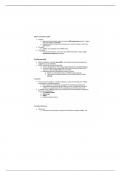
DNA is Transcribed to RNA
● Initiation
● Beginning of transcription when the enzyme RNA polymerase binds to a region
of a gene called the promoter
● Signals the DNA to unwind so the enzyme can ‘‘read’’ the bases in one of the
DNA strands
● Elongation
● Addition of nucleotides to the mRNA strand
● Termination
● Ending of transcription, and occurs when RNA polymerase crosses a stop
(termination) sequence in the gene
Pre-RNA and mRNA
● After transcription, eukaryotic pre-mRNAs must undergo several processing steps
before they can be translated
● mRNA processing involves several steps
● A cap is added to the 5′ end of the growing transcript by a phosphate linkage
● An enzyme called poly-A polymerase adds a string of approximately 200 A
residues, called the poly-A tail to the pre-mRNA
● Eukaryotic genes are composed of exons and introns
● Introns are removed from the pre-mRNA during processing
● The process of removing introns and reconnecting exons is called
splicing
Translation
● The process of translation, or protein synthesis, involves the decoding of an mRNA
message into a polypeptide product
● Amino acids are covalently strung together by interlinking peptide bonds
● Polypeptides are formed when the amino group of one amino acid forms an
amide (i.e., peptide) bond with the carboxyl group of another amino acid
● In addition to the mRNA template, many molecules and macromolecules contribute to
the process of translation
● An mRNA template
● Ribosomes
● tRNAs
● various enzymatic factors
Translation Machinery
● Ribosomes
● A complex macromolecule composed of structural and catalytic rRNAs, and
● Initiation
● Beginning of transcription when the enzyme RNA polymerase binds to a region
of a gene called the promoter
● Signals the DNA to unwind so the enzyme can ‘‘read’’ the bases in one of the
DNA strands
● Elongation
● Addition of nucleotides to the mRNA strand
● Termination
● Ending of transcription, and occurs when RNA polymerase crosses a stop
(termination) sequence in the gene
Pre-RNA and mRNA
● After transcription, eukaryotic pre-mRNAs must undergo several processing steps
before they can be translated
● mRNA processing involves several steps
● A cap is added to the 5′ end of the growing transcript by a phosphate linkage
● An enzyme called poly-A polymerase adds a string of approximately 200 A
residues, called the poly-A tail to the pre-mRNA
● Eukaryotic genes are composed of exons and introns
● Introns are removed from the pre-mRNA during processing
● The process of removing introns and reconnecting exons is called
splicing
Translation
● The process of translation, or protein synthesis, involves the decoding of an mRNA
message into a polypeptide product
● Amino acids are covalently strung together by interlinking peptide bonds
● Polypeptides are formed when the amino group of one amino acid forms an
amide (i.e., peptide) bond with the carboxyl group of another amino acid
● In addition to the mRNA template, many molecules and macromolecules contribute to
the process of translation
● An mRNA template
● Ribosomes
● tRNAs
● various enzymatic factors
Translation Machinery
● Ribosomes
● A complex macromolecule composed of structural and catalytic rRNAs, and